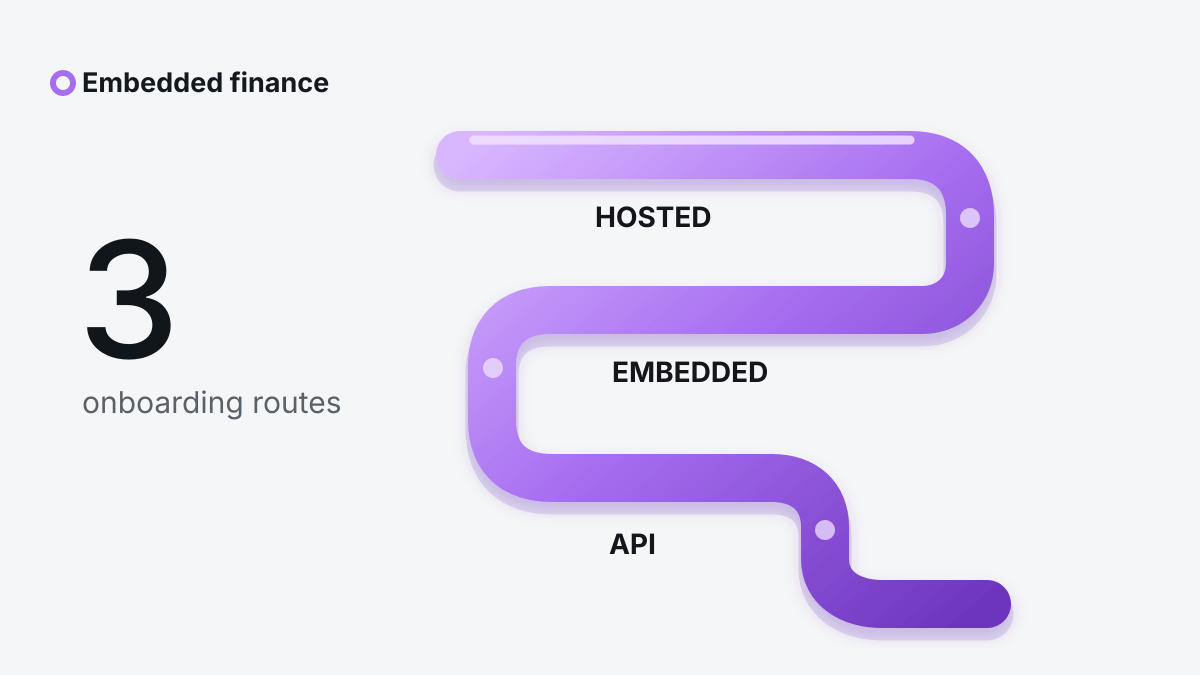
B2B embedded finance is a software platform offering financial products to its business customers inside its own product: payment acceptance and payouts, business accounts, cards for spending and bill pay, and working capital. The regulated part, such as the deposit account, the card or the loan, is usually supplied by a partner bank or a licensed provider. The platform owns the customer relationship, the workflow and the data that shapes the offer.
What B2B embedded finance includes
| Product | What the business customer gets | Examples from provider documentation |
|---|---|---|
| Payment acceptance and payouts | Takes card and bank payments inside the platform and receives payouts | Stripe Connect onboards a platform’s users, takes payments for them, splits funds and sends payouts; Finix serves SaaS platforms, marketplaces and PayFacs |
| Business accounts | Holds and moves funds without a separate bank app | Adyen for Platforms offers embedded business accounts in the United States, the United Kingdom and the Eurozone; Unit offers accounts and wallets through partner banks |
| Cards and spend management | Employee, fleet or payables cards controlled from the platform | Highnote lists AP and bill pay, spend management and fleet among its use cases; Synctera offers a Smart Charge Card and a Fleet Card |
| Working capital | Loans or cash advances offered where the business already works | Parafin runs term and flex loans and merchant cash advances for platforms; Adyen lists Adyen Capital |
| Bill pay | Pays suppliers from the platform | Unit lists a ready-to-launch Bill Pay solution |
Who holds the licence
Each product above rests on a licensed entity, and it is not always the provider whose API you use.
- Partner bank. Parafin states that its loans are issued by Celtic Bank and its Spend Cards by Column N.A., Member FDIC, while Parafin handles underwriting, servicing and support. Unit says its regulated products are supplied by its partner banks.
- Provider’s own licence. Adyen says Adyen for Platforms is built on its own banking licence; Adyen N.V. is a credit institution registered with De Nederlandsche Bank. Adyen also states that its U.S. business accounts are not FDIC-insured.
- Acquiring banks for card acceptance. Stripe’s acquirer disclosure lists the banks for which Stripe acts as a payment facilitator in the United States, plus Stripe’s own Georgia merchant acquirer limited purpose bank.
For a platform, the licensed entity decides whose name appears in disclosures, whose rules apply and whether balances are deposits at an insured bank.
How the rules differ from consumer products
Several U.S. consumer-protection rules are written for consumers, which changes the compliance picture for business products:
- Accounts. Regulation E’s definition of “account” covers accounts “established primarily for personal, family, or household purposes” (12 CFR 1005.2(b)).
- Credit. Regulation Z exempts credit extended primarily for business, commercial or agricultural purposes (12 CFR 1026.3(a)). Its rules on card issuance and liability for unauthorized use still apply to business credit cards.
- Credit decisions. Regulation B, which implements the Equal Credit Opportunity Act, covers business credit. It sets separate notification rules for business applicants, with different treatment depending on the business’s revenue (12 CFR 1002.9(a)(3)).
Business programs are still bank programs: the sponsoring bank’s third-party risk management, anti-money-laundering and customer identification obligations apply. See how to choose a sponsor bank.
How platforms are paid
Published models vary by product:
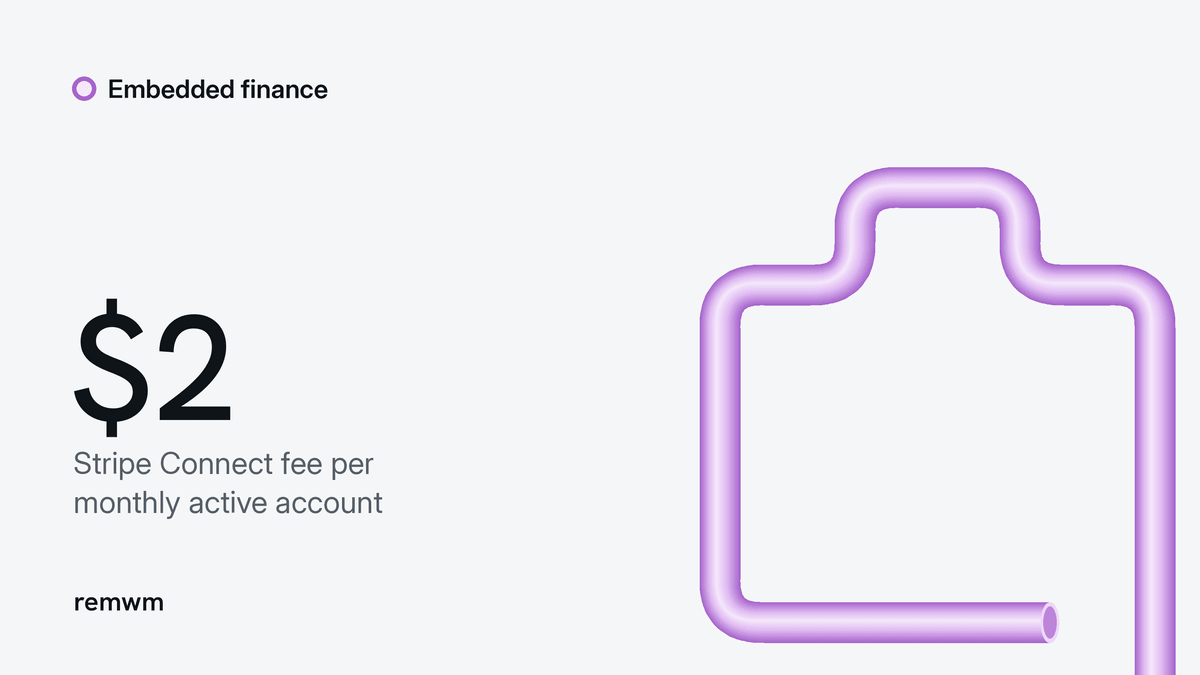
- Payments. Stripe publishes two Connect models: Stripe handles pricing with no platform fees, or the platform handles pricing at $2 per monthly active account and 0.25% + 25¢ per payout.
- Working capital. Parafin says the platform earns a share of the capital fee when a customer takes financing, and the business pays one fixed fee with no interest.
- Card acceptance. Highnote publishes standard acquiring pricing of 2.85% + 25¢ per transaction and quotes issuing prices individually.
Questions to ask a provider
- Which licensed entity issues the account, card or loan, and in which countries?
- Are business balances deposits at an FDIC-insured bank, and who keeps the ledger?
- Who underwrites credit and who carries the losses?
- Who sends adverse action notices to declined business applicants?
- Which fees go to the platform, and are they published?