Embedded finance vs banking as a service is a question of which end of the same chain you look at. Embedded finance is a non-bank company offering accounts, cards, payments or loans inside its own software. Banking as a service (BaaS) is how it gets them: a licensed bank, often through a technology provider, supplies the regulated product through APIs. U.S. bank regulators note that these arrangements are sometimes called by either name.
The short answer
| Embedded finance | Banking as a service | |
|---|---|---|
| Who sells to the end customer | A software platform, marketplace or other non-bank brand | Nobody directly: the bank and its provider sell to the brand |
| What is being bought | A financial feature inside a product: checkout, payouts, a business account, a card, working capital | Access to a bank’s charter: deposit accounts, card issuing (BIN sponsorship), payment rails, lending |
| Who holds the licence | Usually a partner bank or a licensed provider, not the platform | The bank |
| Typical buyer | Product and partnership teams at SaaS companies and marketplaces | Fintechs and providers building accounts, cards or payments |
| Examples in our provider directory | Stripe Connect, Adyen for Platforms, Parafin | Unit, Treasury Prime, Synctera, Increase |
How regulators describe it
On July 25, 2024 the Federal Reserve, the FDIC and the OCC issued a joint statement on banks’ arrangements with third parties to deliver deposit products and services. Its footnote says such arrangements “are sometimes referred to as ‘banking-as-a-service’ or ‘embedded finance’.” The statement names the intermediaries that can sit between the bank and the end user: intermediate platform providers, processors, middleware providers, aggregation layers and program managers.
For the bank, the label does not change the responsibility. The FDIC’s September 11, 2026 letter on proposed new third-party guidance says the proposal “continues to reflect that use of third parties does not diminish banks’ responsibility to manage risks and comply with applicable laws and regulations.”
The value chain
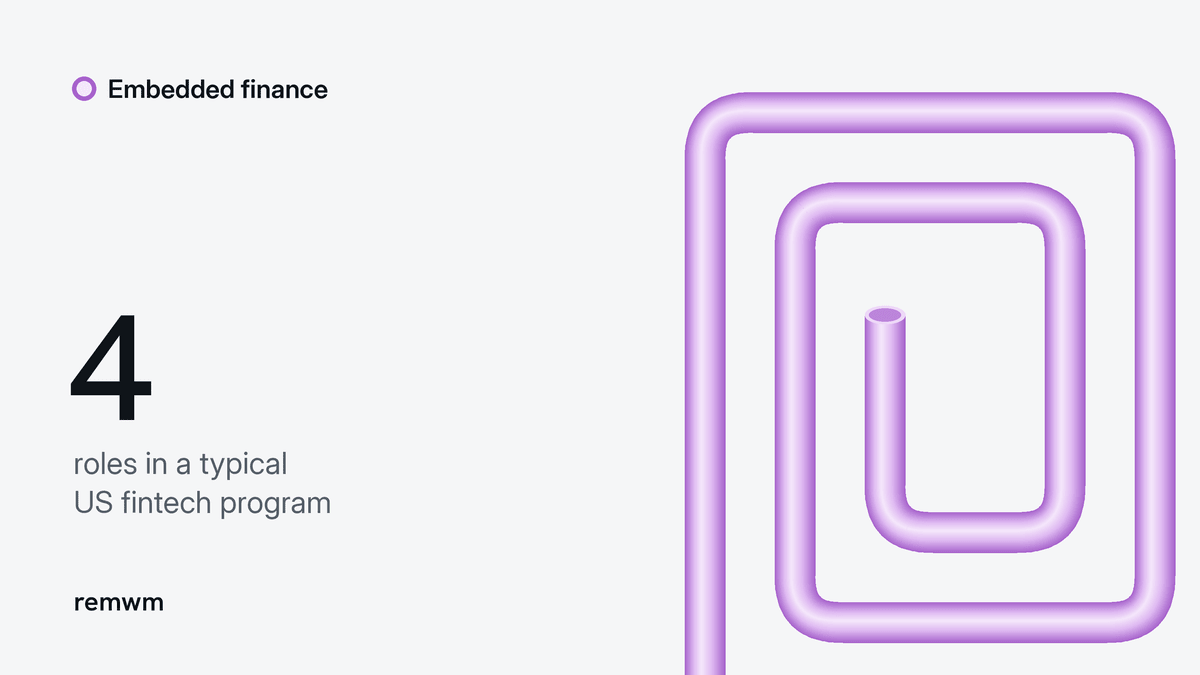
A typical U.S. program has four roles:
- End customer. A consumer or a business that uses the platform.
- Brand or platform. The software company that owns the customer relationship and the user interface. This is the embedded finance side.
- Technology provider. APIs, ledger, onboarding and compliance tools, sometimes program management. Unit, for example, describes itself as providing APIs, a dashboard and white-label UI, “with the regulated products supplied by Unit’s partner banks.”
- Bank. Holds the deposits, sponsors the cards or makes the loans, and answers to its regulators. This is the BaaS side. Our sponsor banks directory lists banks that work with fintech programs.
Some providers combine roles. Adyen for Platforms states it is “built on our own banking license”: Adyen N.V. is registered as a credit institution with De Nederlandsche Bank. Increase offers accounts through its own bank, Increase Bank, and three partner banks. Parafin runs financing programs for platforms, while its loans are issued by Celtic Bank.
Which one are you buying?
- You run a software platform and want your users to get paid, hold funds, spend or borrow without leaving your product. You are buying embedded finance components, often priced per account or per transaction. Stripe publishes Connect pricing of $2 per monthly active account and 0.25% + 25¢ per payout when the platform handles pricing.
- You are building a financial product whose core is the account or the card. You need a bank that will sponsor it, directly or through a BaaS provider, and you will be reviewed as that bank’s third party. Our guide on how to choose a sponsor bank lists the checks.
In both cases, ask who holds the licence, whose ledger records customer balances and which bank’s name appears in the disclosures.