Commercial card issuing is the launch and operation of payment cards meant for business spending: small-business cards, corporate travel cards, purchasing cards and fleet cards. A bank that is a member of Visa or Mastercard issues them. A fintech or software platform usually runs the program, sets spend controls and decides whether the card draws on a prepaid balance, a charge account paid in full or a revolving credit line.
What counts as a commercial card
Visa’s rules define Visa Commercial Cards as “a physical or virtual Card intended for business expense use.” The list includes the Visa Business Card, Visa Corporate Card and Visa Purchasing Card, with the Visa Fleet Card counted as a purchasing card. Visa also lists Large Market Enterprise and Small Market Expense cards among them.
| Card type | Typical use | Where we cover it |
|---|---|---|
| Business card | Owner and employee spending at small businesses | This guide |
| Corporate card | Travel and entertainment for larger companies | This guide |
| Purchasing card | Supplier purchases; Visa says it replaces “POs, invoices, and checks” | This guide |
| Fleet card | Fuel and vehicle spend with driver and odometer prompts | Fleet card issuing |
| Virtual card | Single-use or merchant-locked numbers, often for accounts payable | Virtual card issuance |
The same card can sit inside software rather than a wallet. In October 2026, BMO and Mastercard launched corporate card payments started from ERP and accounts payable systems, covered in our bmo mastercard embedded commercial payments news.
Three funding models
The first decision is where the money comes from when a card is used.
| Model | How it works | What issuing platforms publish |
|---|---|---|
| Prepaid or debit | The card spends a balance the business or platform has funded | Highnote describes a commercial prepaid template in which a parent account funds subsidiary accounts for teams, projects or employees. Stripe Issuing spends from an Issuing balance funded in advance |
| Charge | The business spends on credit and pays the full statement balance each period; no interest | Lithic’s commercial charge card caps all authorizations at the balance of a program “Security Account” and collects from each business weekly or monthly. Stripe’s charge card program uses partner banks as lenders of record, and platforms can buy the receivables through Stripe |
| Revolving credit | The business can carry a balance and pays interest on it | Lithic supports commercial revolving credit as program manager or as processor, with a credit limit, statements, minimum payments and interest |
Lithic names a fourth party for credit programs, the debt provider, which supplies the money to pay the networks. “The Debt Provider can be the BIN Sponsor, the Card Program, or a third party,” its documentation says. Our guide to bin sponsorship shows a live case in which the sponsor bank issues the card but another company funds the credit.
Rules that differ from consumer cards
Commercial programs sit outside much of consumer card law, but not all of it. This is a summary of the rule text, not legal advice.
- Truth in Lending. Regulation Z exempts “an extension of credit primarily for a business, commercial or agricultural purpose” (12 CFR 1026.3(a)). Consumer disclosures and most credit card rules do not apply.
- Issuing cards. The issuance rule still applies. “Regardless of the purpose for which a credit card is to be used, including business, commercial, or agricultural use,” a card may be issued only on request or as a renewal or substitute (12 CFR 1026.12(a)).
- Unauthorized use. If an issuer gives 10 or more cards to one organization’s employees, the issuer and the organization may agree on liability for unauthorized use. An employee’s own liability still follows the regulation’s limits, including the $50 cap (12 CFR 1026.12(b)).
- Debit interchange cap. Regulation II covers debit cards on an account “established for any purpose,” so business debit and some commercial prepaid programs at a sponsor bank with $10 billion or more in assets fall under the cap. Credit and charge cards do not. The cap is explained in debit card issuing.
What interchange pays on commercial cards
Interchange is the fee the merchant’s acquirer pays the card issuer on each purchase, and it funds many card programs. Visa publishes its U.S. rates. These are the corporate and purchasing card rates effective April 18, 2026, with fleet cards included:
| Visa fee program, Purchasing and Corporate T&E | Rate |
|---|---|
| Commercial Card Present | 2.50% + $0.10 |
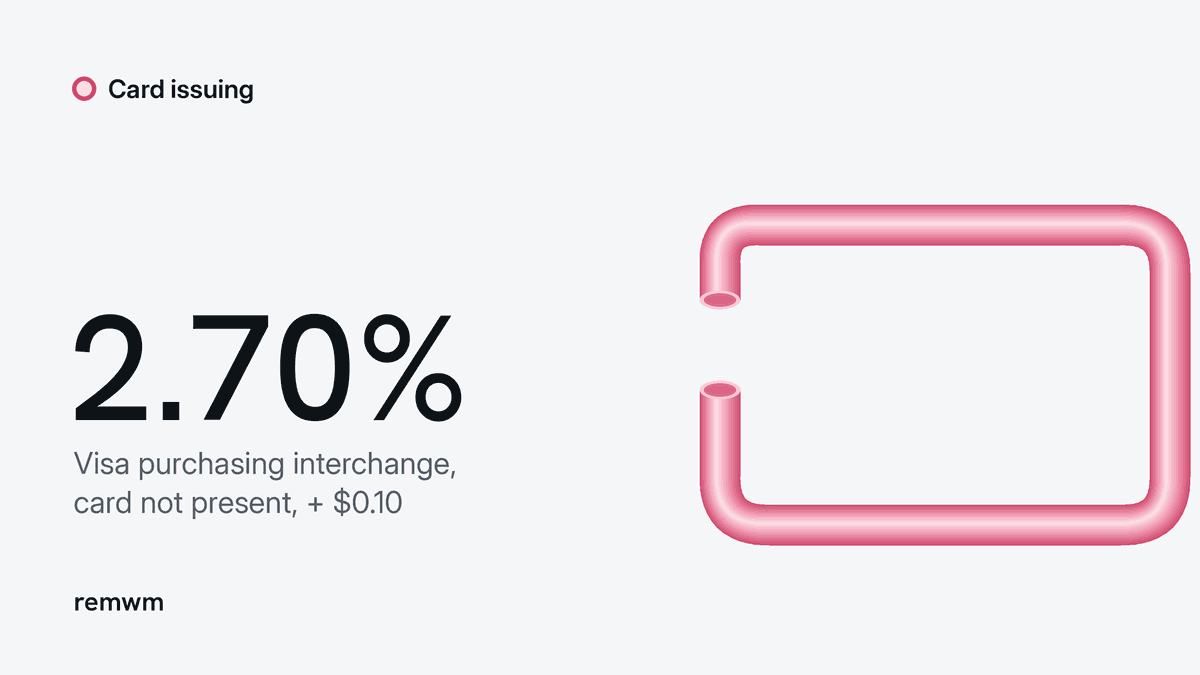
| Commercial Card Not Present | 2.70% + $0.10 |
| Commercial Travel Service | 2.65% + $0.10 |
| Non-Qualified | 2.95% + $0.10 |
| Commercial Product Large Ticket | 1.30% + $35.00 |
Visa Business credit cards use five spend tiers. “Business Product 1” runs from 2.65% + $0.10 in Tier I to 3.00% + $0.10 in Tier V. How much of the issuer’s interchange reaches the program depends on its contract with the sponsor bank and processor.
Platforms that publish commercial issuing
Listed in alphabetical order. This is not a ranking; each entry rests on the provider’s own pages.
| Provider | What its pages say about commercial issuing |
|---|---|
| Highnote | Commercial prepaid template with funding hierarchies and authorized users |
| Lithic | Commercial charge card quick start; commercial revolving credit as program manager or processor |
| Marqeta | Commercial credit for co-branded business cards, gig platforms and B2B SaaS |
| Stripe Issuing | Commercial issuing in the United States, United Kingdom and European Economic Area; charge card credit through partner banks in a private preview API |
More platforms, with their bank partners and card types, are compared in card issuing platforms. To compare processors, read how to choose an issuer processor.
Questions to settle before launch
- Who is the lender of record? The sponsor bank, the platform or a third party. It decides who underwrites, who funds and whose name is on the agreement.
- Who funds network settlement? Lithic, for example, requires a program to keep enough in its Security Account for daily settlement.
- Which controls do you need? Purchasing and fleet programs often need merchant-category, amount and per-employee limits that a business card does not.
- Which data must reach the buyer’s books? Accounts payable and expense customers expect card data to land in their ERP. Visa’s rules describe Visa Commercial Format, a structured file for business data.