Embedded lending is credit offered inside software a business or consumer already uses: a payments dashboard, a marketplace seller account, an online checkout, or payroll software. The platform shows the offer and often collects repayment out of sales. A bank or a specialist finance company usually makes the loan or buys the receivables, and the program’s provider handles underwriting, servicing and collections.
What embedded lending means
Three parties sit behind almost every offer. The platform owns the customer relationship and the surface where the offer appears. A program provider builds and runs the product. A lender of record extends the credit, or a funder buys the receivables.
Stripe Capital for platforms is a clear example. A platform offers financing to its connected accounts through Connect, and Stripe’s documentation says “Stripe and its financial partners manage eligibility, underwriting, pricing, funding, servicing, and collections”. Parafin sells the same shape of program white-labeled, and says it handles underwriting, compliance, risk, servicing and support for the platforms it serves.
The split is written into the customer-facing pages. Gusto’s Payroll Bridge, a line of credit for payroll run through Parafin, states that Gusto does not review applications or make credit decisions and that “All loans are issued by Celtic Bank”.
This is a different arrangement from a platform renting a bank’s accounts and cards, which is what banking-as-a-service usually means. Our comparison of embedded finance vs banking as a service separates the two, and the lending software and embedded lending section covers the systems underneath.
The main models
Revenue-based loans and merchant cash advances on payment platforms. Stripe Capital offers carry a flat premium rather than variable interest, and “Stripe withholds a fixed percentage of each transaction until the complete balance is repaid”. Stripe’s documentation gives an example of a 20,000 principal at a 15% payment rate with a 2,000 premium. Shopify Capital takes a percentage of daily sales over a maximum 18-month term, with minimum repayment of 30% by month 6 and 60% by month 12; for loans accepted on or after March 9, 2026, repayments come from the merchant’s Shopify Payments balance. Square Loans take a fixed percentage of daily card sales and, if sales fall short of the minimum payment, Square Financial Services may debit the rest from the seller’s Square balance or linked bank account. Offers run from $100 to $500K. Square says it has extended “$26.5B+ funds extended globally”, a company figure that counts merchant cash advances, SBA PPP loans and business loans from October 2013 to September 2024.
Marketplace programs that hand the lending to third parties. Amazon no longer lends to sellers itself. Its blog says that “although Amazon Lending has discontinued offering Amazon loans directly to sellers, the program now connects sellers with trusted third parties”: Parafin offers merchant cash advances of up to $2 million, while Lendistry, Uncapped and QuickBooks Capital offer term loans. Amazon announced QuickBooks Capital’s addition on September 18, 2025. Parafin reports over $25 billion in offers, a company figure, and platform launches on Amazon, Walmart and DoorDash; on September 29, 2025 it said Cross River Bank’s Principal Finance Group committed to buy up to $360 million of assets under a forward-flow agreement. See the Cross River Bank profile.
Pay over time at checkout. Consumer point-of-sale financing is the most visible model. ChargeAfter describes itself as an embedded lending platform and invites merchants to “Effortlessly integrate multiple lenders into your point of sale”, matched in real time through a waterfall across a network it lists as 40 lenders, a company figure. Affirm’s FY2026 Form 10-K says “Substantially all of the loans facilitated through our platform in the U.S. are originated through Celtic Bank” and Lead Bank, and that Affirm must follow its bank partners’ underwriting policies, which only the banks may change. Affirm relies on the banks’ authority under Section 27 of the Federal Deposit Insurance Act to set interest rates. Our guide to the pos financing platform market covers the integration work.
B2B net terms and trade credit. Resolve embeds net 30, 60 or 90 terms at B2B checkout or on invoices, pays the seller upfront, and takes the credit checks, collections and non-payment risk on a non-recourse basis. Its own pages disagree on how much it advances: “up to 100% upfront” on its offer-net-terms page and up to 90% on its net terms product page. Resolve does not publish a bank partner. US providers in this model generally do not publish pricing; in Europe, Mondu publishes “a Merchant Discount Rate (MDR) of 1.5-3.0%” for 30 to 90-day terms. See b2b embedded finance for the wider category.
Loan or merchant cash advance
The label decides which contract and which rules apply. Stripe describes the YouLend product on its platform as “A purchase of future receivables, not a loan” with no fixed schedule or regular debits. Parafin’s Merchant Capital Advance Agreement, last updated August 14, 2024, states in capitals that “THE PURCHASE OF FUTURE RECEIVABLES DOES NOT AND SHALL NOT CONSTITUTE A LOAN”, with repayment set as a fixed percentage of sales.
Federal and state rules treat that distinction differently. The CFPB’s revised small business lending rule excludes merchant cash advances from covered credit transactions, while California’s and New York’s commercial financing disclosure laws cover them.
The lender of record
The order of the table carries no meaning.
| Program | Where offered | Products (US) | Lender or funder of record | Repayment |
|---|---|---|---|---|
| Stripe Capital for platforms | Stripe dashboard, Connect platforms | Flex loan, fixed-term loan, line of credit, MCA | Loans: Celtic Bank or Lead Bank; MCA: YouLend | Fixed percentage of each transaction |
| Shopify Capital | Shopify admin | Loans | WebBank | Percentage of daily sales, max 18 months |
| Square Loans | Square Dashboard | Loans, $100 to $500K | Square Financial Services, a Utah-chartered industrial bank | Fixed percentage of daily card sales plus minimums |
| Parafin | White-label in platforms | MCA, term loan, Pay Over Time line of credit | MCA: Parafin, Inc. buys the receivables; line of credit: Celtic Bank; term loan not published | Fixed percentage of sales on the MCA |
| Amazon Lending | Seller Central | MCA, term loans | Third-party providers; Amazon no longer lends directly | Varies by provider |
| Toast Capital | Toast dashboard | Loans | WebBank, not an affiliate of Toast | Not published here |
| Gusto Payroll Bridge | Gusto payroll | Line of credit | Celtic Bank, with Parafin running the program | Not published here |
| Affirm | Merchant checkout | Consumer pay-over-time loans | Celtic Bank and Lead Bank originate substantially all US loans | Installments |
| Resolve | B2B checkout, invoices | Net 30, 60, 90 terms | Resolve; bank partner not published | Buyer pays Resolve at term |
The agreements say the same thing as the marketing pages. Parafin’s line of credit agreement states that “Celtic Bank (and not its agents and assignees) is the originator and creditor of your Line of Credit”. A copy of the Stripe Capital loan agreement filed as an exhibit on SEC EDGAR names Celtic Bank as originator and creditor and Stripe Servicing, Inc. as servicer; that document is a form agreement included in another company’s filing, so read it as supporting evidence only. Checking bank names against the contract, not the landing page, is part of how to choose a sponsor bank.
How platforms earn from embedded lending
Platforms are paid a share, and neither Stripe nor Parafin publishes the rate. Stripe’s platform page offers to “Earn a revenue share on all loans or merchant cash advances” with no credit-loss liability for the platform. Parafin says a platform can “Earn a share of the capital fee when a customer converts” without adding operating cost, and that Parafin carries underwriting, compliance, risk and servicing. Terms vary by program, and Amazon publishes no revenue-share figures at all.
Rules that apply in the US
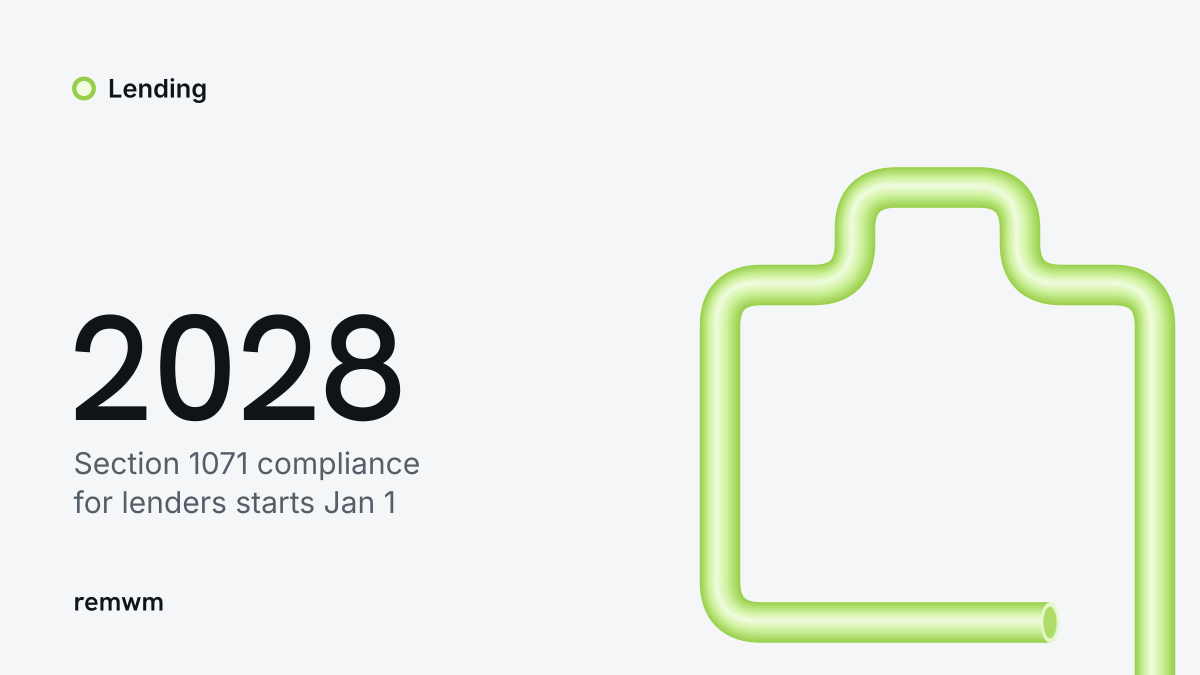
On May 1, 2026 the CFPB published a final rule revising the Section 1071 small business lending data rule under Regulation B. The notice states that “This final rule is effective on June 30, 2026” and sets the compliance date at January 1, 2028, with a grace period running through December 31, 2028. The rule excludes merchant cash advances, agricultural lending and small-dollar loans of $1,000 or less from covered credit transactions; trade credit was already excluded. The coverage threshold rises from 100 to 1,000 covered originations for small businesses in each of the two preceding calendar years, a financial institution may use 2025 and 2026 instead of 2026 and 2027 to determine initial coverage, and a small business is now one with gross annual revenue of $1 million or less rather than $5 million. The CFPB’s own history of the rule records the original final rule on March 30, 2023, compliance-date extensions in June 2024, June 2025 and October 2025, and the revision proposed on November 13, 2025.
State disclosure law reaches further. California’s DFPI commercial financing disclosure regulations were approved on June 9, 2022 and took effect December 9, 2022, covering “traditional installment loans and open-end credit, commercial factoring, and merchant cash advances” and requiring an APR disclosure. The statute defines a provider to include a non-depository institution that arranges a bank’s commercial financing through an online lending platform it administers, which is the embedded bank-partner model, for offers of $500,000 or less. A provider that is itself a depository institution is outside the division.
New York’s DFS adopted its Commercial Finance Disclosure Law regulation on February 1, 2023. The law requires standardized disclosures for commercial financing of up to $2,500,000, including sales-based financing. The regulation sets the compliance date at six months after publication of the Notice of Adoption in the State Register, which gives August 1, 2023 by calculation from that text. New York’s definition of provider reaches “a person who solicits and presents specific offers of commercial financing on behalf of a third party”. Financial institutions are exempt, and a technology services provider to an exempt bank is exempt only if it holds no interest and no agreement to purchase an interest in the financing.
| Rule | Covers MCAs | Threshold | Status |
|---|---|---|---|
| CFPB Section 1071, 2026 revision | No, excluded | 1,000 covered originations in each of two prior years; small business is $1 million revenue or less | Effective June 30, 2026; compliance January 1, 2028 |
| California SB 1235 and DFPI regulations | Yes | Offers of $500,000 or less; depository institutions exempt | Effective December 9, 2022 |
| New York CFDL, 23 NYCRR 600 | Yes, as sales-based financing | Up to $2,500,000; financial institutions exempt | Adopted February 1, 2023; compliance August 1, 2023 |
This section describes published rules and is not legal advice.