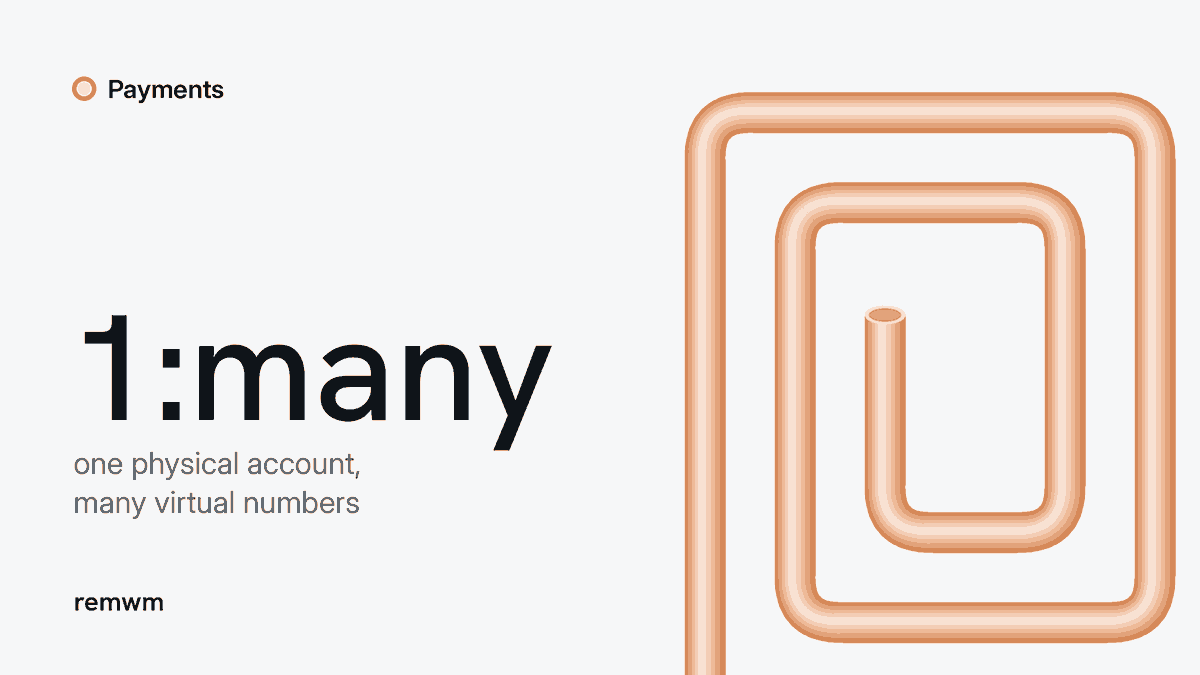
Virtual accounts are account numbers that a bank links to one real deposit account. Payments sent to a virtual account land in that physical account, but the bank tags each one in its reporting, so a business can see who paid without opening a separate bank account for every customer, entity or user. Corporates use virtual accounts for receivables and treasury; fintechs and platforms use them to give each user an account number.
How a virtual account works
Every virtual account structure has two parts: a physical account that holds the money, and a layer of numbers and records on top of it.
- The physical account. J.P. Morgan describes its Virtual Account Management (VAM) service as a demand deposit account combined with “a virtual account subledger.” The money sits in the demand deposit account.
- The virtual numbers. Each virtual account has its own number. DBS says its numbers run up to 16 digits and the client customizes the last 9 to 11. Raiffeisen Bank International issues virtual IBANs in Europe.
- The booking. DBS says funds paid to a virtual account “go directly to the account registered” for it, because the virtual account “serves only as a mirror.” Raiffeisen says there are “no actual bookings on Virtual Accounts”: payments are booked on the physical account and allocated to the virtual one in reporting.
Modern Treasury, which connects to banks’ virtual account products through its API, puts it in one line: a virtual account is “an alias account number that is linked to a standard bank account.”
What banks say their virtual accounts do
Banks sell the same idea with different limits. The table records what each says on its own product page as of October 5, 2026.
| Bank | Product | What the bank says it supports |
|---|---|---|
| BNY | Virtual Account-Based Solutions | Many virtual accounts linked to one physical account; payments-on-behalf-of and collections-on-behalf-of for subsidiaries; Virtual Reference Numbers as an API-driven wallet tool, available for more than 30 multicurrency accounts |
| BNP Paribas | Virtual Account Management | Virtual accounts that hold a balance; incoming and outgoing credit transfers, with the virtual number usable as the ordering account |
| Citi | Virtual Account Wallet, part of Citi Services’ banking-as-a-service offering | Chosen by Coinbase to power Coinbase Virtual Accounts, with incoming fiat converted to stablecoins |
| DBS (Hong Kong) | Virtual Account | One virtual account per payer to identify who paid and why; a DBS business account acts as the master account |
| HSBC (US) | HSBC Virtual Accounts | Receivable and payable payment types; any number of virtual accounts per physical account; self-service management |
| J.P. Morgan | Virtual Account Management | Multi-entity and multi-level structures; links to notional pooling, physical cash concentration and multi-bank sweeps |
| Standard Chartered | Virtual Accounts | Named virtual accounts for payment companies; one virtual account per payer across several currencies |
The Coinbase case shows virtual accounts reaching crypto on- and off-ramps: see coinbase virtual accounts.
Corporate use: receivables and in-house banks
The oldest use is collections. A company gives each buyer, distributor or tenant its own virtual account number. When money arrives, the number tells the company who sent it, so the receivable can be matched without reading free-text references. HSBC gives the example of an equipment manufacturer that uses virtual numbers to identify payers “without exposing physical account numbers.”
The second use is group treasury. A company that pays and collects for many subsidiaries can give each entity a virtual account on one physical account. BNY ties this to payments-on-behalf-of (POBO) and collections-on-behalf-of (COBO) structures and in-house banks. Fewer physical accounts means fewer account openings, signatories and statements to manage.
Platform use: one account number per user
Fintechs, marketplaces and software platforms use virtual accounts differently. The platform holds its users’ money in one account at a partner bank, often a for-benefit-of (FBO) or custodial account, and issues each user a virtual account number for incoming transfers.
Which features a platform gets depends on the bank. Modern Treasury’s documentation splits bank products into two types:
| Bank reports a balance per virtual account | Bank reports only the total balance | |
|---|---|---|
| How Modern Treasury models it | Nested internal accounts | Virtual accounts linked to one internal account |
| Receive payments | Yes | Yes |
| Originate payments | Yes | No |
| Link to a counterparty | Yes | Yes |
Where the bank gives only a total, the platform has to keep each user’s balance itself. Modern Treasury says any virtual account’s balance can be tracked by linking it to a ledger, and its API can post every payment in or out to the linked ledger account. How that ledger layer is built or bought is covered in ledger as a service; the provider is profiled at Modern Treasury.
Deposit insurance sits on the records, not the number
A virtual account number does not create a separate deposit at the bank. The money is a deposit in the physical account, usually in the platform’s name. Whether each end user is insured as the owner depends on FDIC rules on accounts held by an agent or custodian.
Under 12 CFR 330.7(a), funds owned by principals and deposited in the name of an agent, custodian or nominee are insured “to the same extent as if deposited in the name of the principal(s).” Under 12 CFR 330.5(b), the FDIC recognizes such a fiduciary relationship only if it is “expressly disclosed” in the bank’s deposit account records. For commingled custodial funds, 12 CFR 330.5(a)(2) lets each owner’s interest be counted as a fractional share.
In practice that puts weight on who keeps the record of which user owns what, and whether it matches the bank’s. The synapse bankruptcy showed what happens when those records cannot be reconciled. Sponsor-bank structures are explained in what is banking as a service.
Questions to ask a bank or provider
- Does the bank report a balance for each virtual account, or only for the physical account?
- Can payments be sent from a virtual account, or only received?
- Which payment types can reach a virtual number, and in which currencies?
- How are numbers allocated: does the client choose them inside a range, or does the bank assign them?
- Through which channels does reporting arrive? BNY, for example, lists its TreasuryEdge portal, Swift and API.
- For user funds: how is the custodial relationship titled, and who keeps the ownership records the FDIC would rely on?