Banking as a service (BaaS) is an arrangement in which an FDIC-insured chartered bank supplies deposit accounts, cards, payments or loans that a non-bank company sells to its own customers, usually through a technology platform that connects the two. The federal banking agencies use the term themselves, and apply the label “embedded finance” to the same kind of arrangement depending on its structure and parties.
What banking as a service means
The term comes from the regulators as well as the industry. In a joint statement dated July 25, 2024, the Federal Reserve, FDIC and OCC wrote that arrangements in which a third party delivers bank deposit products to end users are “sometimes referred to as ‘banking-as-a-service’ or ‘embedded finance’”.
The same statement sets out the split of work: “a third party, rather than the bank, typically markets, distributes” the deposit product to the end user, and the bank may depend on that third party for the system of record, payments, compliance, the customer application, servicing and complaint handling. For the difference between the two labels, see embedded finance vs banking as a service.
The three parties in a BaaS program
The bank holds the charter, opens the accounts and carries the FDIC insurance, and the joint statement is explicit that a bank’s use of third parties “does not diminish its responsibility” for the risks and the law.
The platform in the middle connects bank and brand. The agencies list the names it goes by: intermediate platform providers, processors, middleware providers, aggregation layers and program managers. The brand owns the customer relationship: it markets the account or card, runs the app and usually answers support first.
A published chain shows the three layers together. Relay, a small-business banking brand, builds on Unit, which says Relay “powers bank accounts, bill pay, receivables, and expense cards for 110,000+ small businesses”. Relay’s own help page names Thread Bank as the partner bank that holds deposits, issues its Visa debit and credit cards and clears ACH, wires and checks: “Thread Bank provides the underlying banking infrastructure, and Relay provides the software layer”. Unit, writing in February 2023, describes its own role for Thread as helping the bank “meet, select, and onboard innovative tech companies” that fit its risk appetite, a partnership it dates to June 2022. Which party does what inside those roles is a contract question; see how to choose a sponsor bank.
How the money is held: FBO accounts and sub-ledgers
The FDIC describes the usual structure plainly: non-banks “often deposit these funds together into a single custodial account at a bank” rather than opening individual accounts, and such an account may hold the funds of many thousands of consumers and businesses. The bank may not readily know who those owners are (FDIC, September 17, 2024).
Unit’s documentation sets out the “For the Benefit of” model: the bank opens the account in the bank’s name under the bank’s EIN and holds, moves and manages the funds, while customer balances are “tracked via the Wallets, which are sub-ledger entries”. Unit distinguishes those wallet balances, held with the platform, from deposit accounts at partner banks, where each account “carries its own routing and account number”. Unit also states that it is not a bank and that banking services come from its bank partners, Members FDIC. The full list of those partner banks is not published on its disclosures.
When FDIC pass-through insurance applies
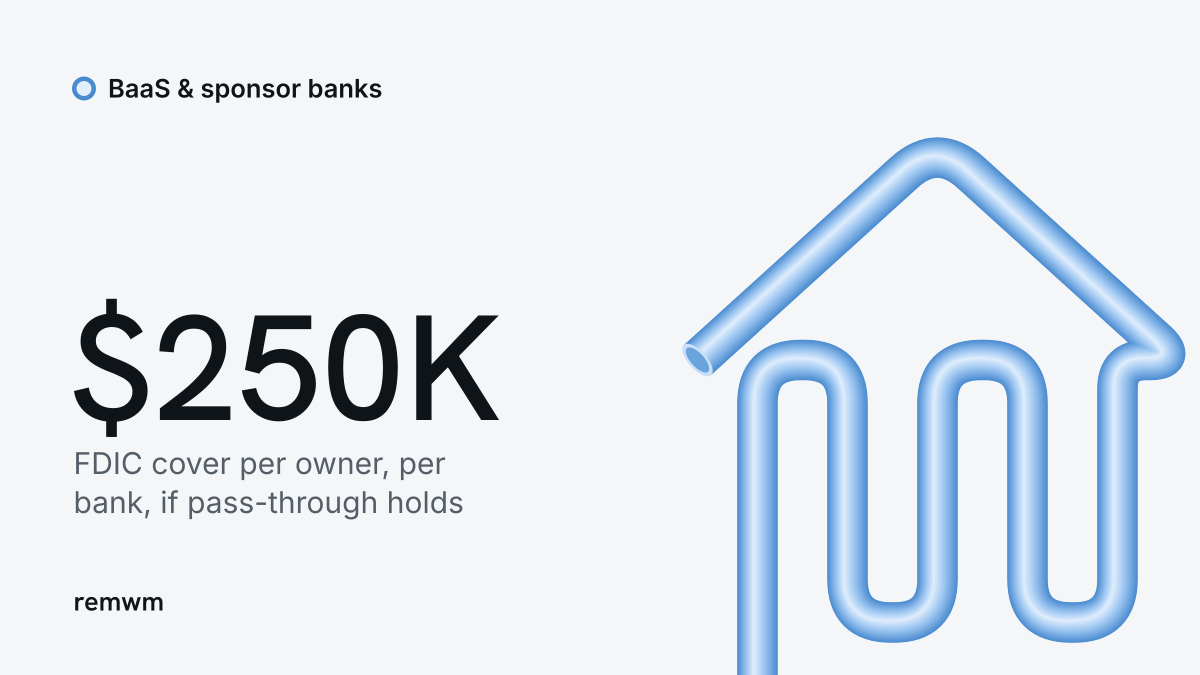
Pass-through insurance is a method of insuring depositors whose funds reach an insured bank through a third party, and the FDIC states it is “not a separate ownership category”. Three conditions must all be satisfied: the funds are owned by the principal; the bank’s account records disclose the agency nature of the account, for example “XYZ for the benefit of (FBO) customers”; and records identify each principal and the interest of each.
If any condition fails, the deposits are insured to the named account owner, typically the third party, aggregated up to $250,000, which the FDIC says “could result in uninsured deposits”. The agency tells consumers that “nonbank companies themselves are never FDIC-insured” (FDIC, June 2024), and that insurance does not protect against a non-bank’s default, insolvency or bankruptcy, “nor does it cover fraud or theft”.
Synapse and the FDIC’s custodial account proposal
On September 17, 2024 the FDIC Board approved a proposed rule to strengthen recordkeeping for deposits placed at banks by third-party non-banks. Chairman Martin J. Gruenberg called it a step to ensure that banks “know the actual owner of deposits placed in a bank by a third party” such as Synapse.
The proposal (12 CFR Part 375, RIN 3064-AG07, 89 FR 80135) applies to custodial deposit accounts with transactional features, defined by three prongs: the account is established for beneficial owners, it holds commingled deposits of multiple owners, and an owner may direct transfers to other parties, for example to make purchases or pay bills (FDIC board memorandum). A bank would keep records of each beneficial owner, the balance attributable to each and the ownership category, with “reconciliations no less frequently than as of the close of business daily” (FDIC financial institution letter). A third party could hold those records only where the bank has direct, continuous and unrestricted access, backed by annual independent validation, a CEO or COO certification and an annual report. Then-Vice Chairman Travis Hill, voting for the proposal, noted an estimate of 600 to 1,100 banks in scope even though “only a few dozen are heavily engaged” in the targeted activity.
The comment period ran to December 2, 2024 and was extended to January 16, 2025. As of September 19, 2026, the FDIC’s docket page for RIN 3064-AG07 lists the proposal and that extension only. It remains a proposal; the FDIC has not finalized it.
What regulators expect from sponsor banks
On June 6, 2023 the Federal Reserve, FDIC and OCC issued final Interagency Guidance on Third-Party Relationships, covering relationships with financial technology companies across the life cycle: “planning, due diligence and third-party selection, contract negotiation, ongoing monitoring, and termination”. On July 25, 2024 the agencies added the joint statement on third-party deposit arrangements and a request for information on bank-fintech arrangements. The FDIC said supervisory experience had identified “safety and soundness, compliance, and consumer-related concerns” in how these arrangements are managed, while the statement does not establish new supervisory expectations.
On September 11, 2026 the FDIC, Federal Reserve, NCUA and OCC proposed new third-party risk management guidance. The OCC release says that when finalized the bank agencies plan to rescind existing guidance and replace it; the Federal Reserve board memo names the 2023 guidance, the 2024 community bank guide and the July 2024 joint statement among the documents to be rescinded. The agencies say the 2023 guidance “frequently has been interpreted in an overly broad manner” and that the proposal removes “overly prescriptive language” which “may unduly impede fintechs from entering partnerships” with banking organizations, while keeping the principle that third parties do not diminish a bank’s responsibility (FDIC, September 11, 2026). It was published at 91 FR 58536 on September 15, 2026, with comments due November 16, 2026. The guidance is non-binding. Our news report covers the proposal: regulators propose new third-party risk guidance.
Enforcement shows what supervisors do when a program fails. On June 14, 2024 the Federal Reserve acted against Evolve Bank & Trust, a bank in the Synapse network that “partners with various financial technology companies”, requiring stronger oversight of those partnerships “including through enhanced procedures related to recordkeeping”. See the sponsor bank enforcement actions tracker and how to read a consent order.
Brokered deposits after the 2024 proposal
On July 30, 2024 the FDIC Board approved a brokered deposits proposal (89 FR 68244, published August 23, 2024) that Chairman Gruenberg tied to the “nonbank deposit broker Synapse Financial”. It would have simplified the definition of “deposit broker”, removed the exclusive deposit placement arrangement exception and eliminated the enabling transactions designated business exception that many fintech arrangements relied on.
On March 3, 2025 the FDIC Board withdrew it, effective March 14, 2025, saying the proposal “would have significantly disrupted many aspects of the deposit landscape”. Any future action would require a new proposal.
BaaS platforms and the banks they name
The table lists what four platforms publish about themselves. The order carries no meaning.
| Platform | Products on its own site | Banks named on its own site | Model note |
|---|---|---|---|
| Unit | Deposit accounts, FBO wallets, credit accounts, cards, ACH, wires, RTP, program management including KYC/KYB, AML monitoring, disputes and reconciliation | Full list not published; disclosure says banking services come from “Unit’s bank partners, Members FDIC”; Thread Bank named in Unit posts from 2022 and 2023 | States “$100B+ annual transaction volume” and “5M+ accounts” as of September 19, 2026 |
| Treasury Prime | Bank operating system and APIs for accounts and payments; partner marketplace | Network of “more than 20 financial institutions” in January 2026, when it added i3 Bank and Coastal | Bank-direct since February 2024: banks “directly sell, manage and service fintechs” themselves |
| Synctera | APIs for accounts, cards and money movement | Regent Bank of Tulsa, Oklahoma as the example on its banks page; Veritex Community Bank, Midland States Bank and Emigrant Bank in a press release that carries no date | Matches fintechs with sponsor banks; states “Banking services are provided by Synctera’s partner banks” |
| Increase | ACH, bank accounts, cards, checks, wires, RTP, FedNow | Increase Bank, Grasshopper Bank, N.A., First Internet Bank of Indiana, Core Bank | Says “we operate as a parallel core for our bank partners”; nearly $500 billion in payments a year |
Sponsor banks describe the same market from their side. Cross River Bank says on its about page that it has become “the leading financial infrastructure platform powering 100+ technology partners today”, the bank’s own claim. Increase’s “parallel core” language sits next to the ledger a bank already runs, explained in what is core banking; the card layer of these programs follows the roles set out in debit card issuing.