A US business accepts stablecoin payments from business customers by sending an invoice or a payment link that offers a stablecoin option, usually USDC. A provider such as Stripe, Coinbase Business, Request Finance, BitPay or BVNK receives the coins, then either holds them or converts them to US dollars for the company’s bank account. Published fees, supported networks and settlement timing differ by provider.
How a B2B stablecoin payment works
The flow has five steps. You issue an invoice or a payment link. The payer’s wallet sends stablecoins on a named blockchain network. The provider credits a balance. You convert to dollars, if you want dollars. The provider pays out by ACH, wire or an instant rail. The plumbing underneath is the subject of stablecoin infrastructure; this page is about receivables.
Two address patterns are in use. Hosted invoices and payment links normally generate a quote and an address per payment. Reusable addresses skip the quote: BVNK calls them channels, “a unique, repeated-use blockchain address”, converted at spot on receipt (BVNK docs). Bridge, a Stripe company, uses liquidation addresses, described in its API docs as “permanent on-chain addresses that auto-route incoming crypto” to a fiat or crypto destination (Bridge).
Amounts and networks have to match. Stripe’s API-only deposit mode returns a deposit address per network and warns that if the customer sends more or less than the specified amount, “we can’t automatically match or return the funds”. The same document notes that USD uses two decimal places while USDC uses six (Stripe).
Providers that support stablecoin invoices
The order of the rows carries no meaning. Everything below is as published by the provider.
| Provider | B2B invoice or link | Coins and networks | Settles to | Published fee |
|---|---|---|---|---|
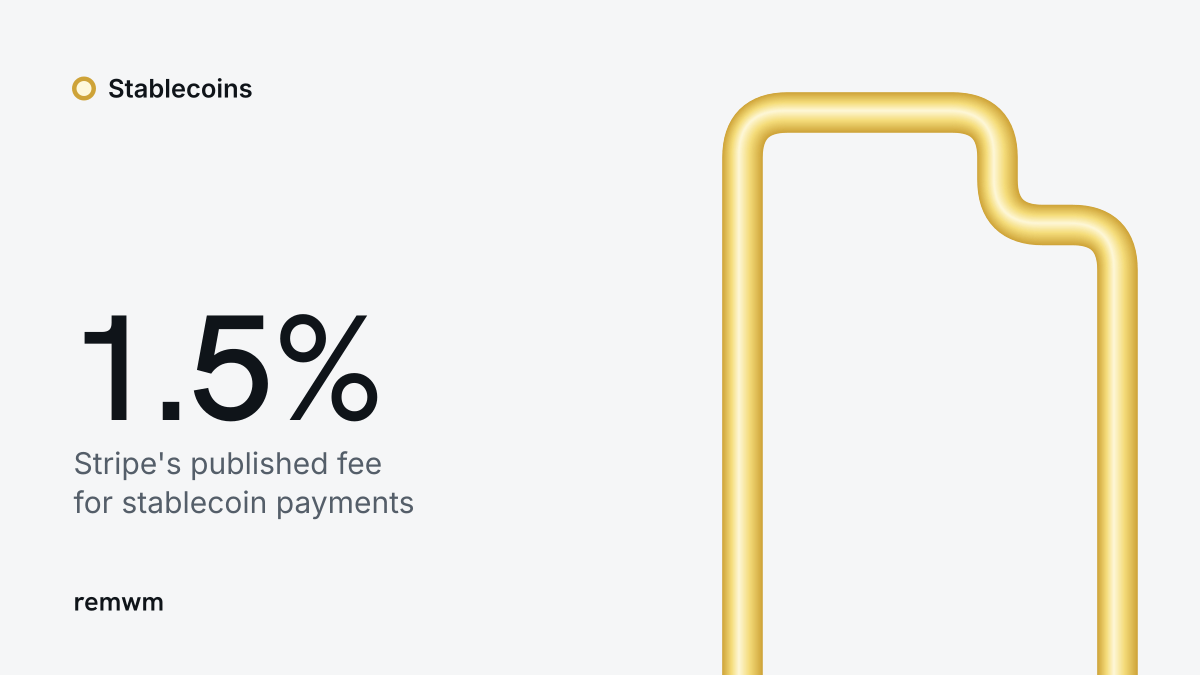
| Stripe stablecoin payments | Invoicing, Payment Links, Billing invoices and subscriptions | USDC on Ethereum, Solana, Polygon and Base, with Tempo listed in Stripe’s latest documentation; USDP on Ethereum and Solana; USDG on Ethereum | USD in the Stripe balance; US businesses only; $10,000 per transaction | 1.5% |
| Bridge (Stripe) | API only: liquidation addresses | USDC and other supported stablecoins | USD by wire, ACH (daily batch) or FedNow | Not published |
| Coinbase Business | Payment links, emailed invoices with line items and a recurring option; read-only invoicing API | USDC on Ethereum, Base, Polygon, Optimism, Arbitrum; USDT on Ethereum | USDC balance, optional auto-convert to USD, cash-out by wire or ACH | Shown inside the account |
| Request Finance | Invoices in 25+ currencies or in USDC/USDT; payer picks crypto or bank transfer | USDC on Ethereum, Base or Solana; EURC on Ethereum; USDT on Ethereum or Tron | One Business Account, offramp on your schedule | 0% on crypto invoice payments; 0.5% fiat payouts; plans from $50/month |
| BitPay | Email billing invoices, API | USDC among other assets | Local fiat next business day; USD by ACH | Tiered by monthly volume per BitPay’s pricing post; current rate not verified |
| BVNK | Hosted payment pages, payment links, invoices by email, SMS or WhatsApp, channels | 16 pay-in currencies on the platform | USD, EUR or GBP | “Starts at $5,000 USD/month” |
| Circle Mint and CPN | Not an invoicing tool | USDC, EURC | USD at 1:1 redemption | Not published |
| Crypto.com Pay for Business | Invoice emails from the dashboard | Stablecoins among 20+ assets | USD, minimum 100 USD, or USDC | No transaction fee; payout fee in the dashboard |
Stripe’s documentation is explicit about eligibility: “Currently only US businesses can accept stablecoin payments.” All such payments settle in the Stripe balance in USD, refunds go back as stablecoins, and dispute support is listed as no (Stripe). The method is not on by default; a business requests it and Stripe reviews the request.
For a checkout flow rather than invoices, see stablecoin payment gateway. More on the topic sits in the stablecoins guides.
Networks and coins
USDC is the common denominator. Every provider above that names coins names USDC first. USDT support is narrower: Coinbase Business accepts it on Ethereum only, and Request Finance on Ethereum or Tron. Request Finance also lists EURC on Ethereum, with invoice minimums of 2 USDC or 3 EURC (Request Finance). USDP and USDG appear on Stripe’s accepted list, marked US-only, but Paxos is not an invoicing provider here.
The practical consequence is that your invoice must state both the coin and the chain. A payer who sends the right coin on the wrong network is outside the automatic matching path.
Getting to US dollars
There are two models. Settle-in-USD converts on receipt: Stripe credits USD, BitPay “settles funds in local fiat to your bank account the next business day”, and Circle’s Managed Payments payins are “inbound USDC that Circle converts and deposits as fiat in your bank account”. Hold-in-stablecoin leaves the choice to you: Coinbase Business settles in USDC and offers an auto-convert toggle in Settings, and Request Finance keeps balances in one Business Account.
Timing, where published:
- BitPay: USD settlement is by ACH to US banks, funds appear two business days after the settlement is issued, minimum settlement 20 USD (BitPay developer docs).
- Bridge: wire, ACH or FedNow; batch rails such as ACH are “queued and processed daily”.
- Circle Mint: every token mints and redeems 1:1, and “payouts typically settle on the next business day” (Circle). Circle Mint is not for individuals, and Circle Payments Network connects participating financial institutions rather than merchants.
Fees as published
Stripe publishes 1.5% for stablecoins, and lists conversion to fiat, wallet and AML screening, fraud prevention and gas sponsorship as included (Stripe pricing). Coinbase Business states that it charges a fee on each completed payment and that current fees are visible only after signing in to the account; a 1% fee on completed payment-link transactions was announced on October 16, 2025. Auto-conversion from USDC to USD is also subject to a fee, whose rate Coinbase does not publish.
Request Finance publishes the most granular schedule: stablecoin payouts free, fiat payouts a flat 0.5%, local ACH or wire $10, SWIFT $30, USDC top-ups free, USDT and USD fiat top-ups 0.30%, plans from $50 a month (Request Finance). BVNK states that “pricing starts at $5,000 USD/month and scales with flow and setup”. Crypto.com Pay for Business states it has no transaction fee and applies a payout fee shown in the Merchant Dashboard. BitPay describes tiered processing fees by cumulative monthly volume in its pricing post; its live pricing page did not render when checked, so treat the tiers as unverified and read the current page. Bridge and Circle Mint fees are not published.
One balance-side item is worth noting without a verdict: Coinbase’s help page states that USDC balances in a Coinbase Business account earn 3.35% APY, while the Federal Reserve’s GENIUS Act proposal implements the statutory ban on issuers paying interest or yield solely for holding a payment stablecoin, and would presume some third-party arrangements to be prohibited yield.
Tax and accounting rules as published
The IRS states that “for U.S. tax purposes, digital assets are considered property, not currency”, lists stablecoins among digital assets, and says a digital asset received in exchange for goods or services in a business context is taxed as ordinary income. Businesses are expected to record the USD fair market value of digital assets received in the ordinary course of a trade or business (IRS). Forms 1120, 1120-S and 1065 carry the digital asset question, which covers receiving a digital asset as payment for property or services.
Form 1099-DA is a broker form. A processor of digital asset payments is a broker under the instructions, and for sales after 2025 gross proceeds reporting is mandatory for all digital assets, with basis reporting for covered securities. Two de minimis thresholds apply: PDAP sales of $600 or less per customer per year need not be reported, and under the optional method, designated sales of qualifying stablecoins need not be reported unless a customer’s aggregate gross proceeds exceed $10,000 for the year. Brokers are not required to file for corporations (IRS instructions). The form reports the party disposing of the digital asset, not the invoicing business’s revenue, which it reports on its own return either way. This section describes published rules and is not tax advice.
On the accounting side, FASB issued a proposed Accounting Standards Update on August 18, 2026 with illustrative examples of when certain digital assets such as stablecoins meet the existing definition of cash equivalents, plus a new disclosure of significant components of cash equivalents. Comments are due November 19, 2026, and no effective date is set (FASB).
The GENIUS Act and the rulemaking calendar
The GENIUS Act became Public Law 119-27 on July 18, 2025. Its effective date, per a Federal Reserve Board memo, is the earlier of January 18, 2027 or 120 days after the primary federal payment stablecoin regulators issue final implementing regulations.
Treasury proposed rules on section 3, covering who may issue, offer and sell payment stablecoins in the United States, on August 17, 2026, published in the Federal Register on August 18, 2026 with a 60-day comment period; the notice records a comment deadline of October 19, 2026. From July 18, 2028, digital asset service providers generally may not offer or sell payment stablecoins to persons in the United States unless a licensed issuer issued them. See treasury stablecoin issuance rule.
On September 24, 2026 the Federal Reserve Board requested comment on two proposals: reserve, capital and risk rules for Board-supervised issuers, with custody and anti-tying provisions for all issuers, and an application process for state member banks. Comments are due 60 days after Federal Register publication, a date not set in the released text. The OCC, FDIC and NCUA have issued their own proposals for the institutions they supervise. See Fed GENIUS Act stablecoin proposals.
What changes in AR and AP
- The invoice carries technical data. Coin, network and address, plus an exact amount. Six-decimal precision in USDC against two in USD is a rounding question your billing system has to answer.
- Caps and thresholds apply. Stripe limits customers to $10,000 per transaction. Transfers of $3,000 or more on Circle Mint are subject to the FinCEN Travel Rule. BitPay’s minimum settlement is 20 USD, and Crypto.com Pay’s USD settlement minimum is 100 USD.
- Disputes work differently. Stripe lists no dispute support for stablecoin payments, and refunds go back to the customer as stablecoins.
- Onboarding is a gate. Stripe reviews access requests before the method goes live, and Circle Mint is closed to individuals.
- Reconciliation needs a USD line. Request Finance issues account statements with a USD amount on every line, and Coinbase said balances can be synced to QuickBooks or Xero through CoinTracker.
For how these rails sit inside a wider platform product, see b2b embedded finance.