Marketplace payouts are how a platform sends a seller’s, driver’s or creator’s share of a customer payment to that person’s bank account, debit card or wallet. Three choices shape them: which rail carries the money, when the platform releases it, and who holds the funds in the meantime. Form 1099-K reporting follows from the same flow, and US rail limits changed in 2025 and 2026.
How a marketplace payout works
A payout is the last leg of a flow that starts when the platform collects the customer’s money, the pay-in side covered in our guide to embedded payments. The platform takes the charge, allocates each party’s share, holds the funds until its release rules are met, then sends each share over a payout rail.
Where the money sits between those steps depends on the charge type. On Stripe Connect, charges made on a connected account build up in that account’s balance and pay out on a daily rolling basis by default. With destination charges or separate charges and transfers, a platform can instead “retain funds in your platform balance”, as Stripe’s documentation puts it, and move each share later. Adyen for Platforms gives every user a balance account that “holds the funds of your user” until payout, with a separate liable balance account for the platform’s own money (Adyen docs).
Payout rails in the US
The order of the rows carries no meaning.
| Rail | Per-payment limit | Hours | Typical speed |
|---|---|---|---|
| Same Day ACH | $1 million, rising to $10 million on September 17, 2027 | Banking days; settles at 1:00, 5:00 and 6:00 p.m. ET | Same day |
| Standard ACH | An item above $1 million is not rejected; it settles next day | Banking days | Next banking day or later |
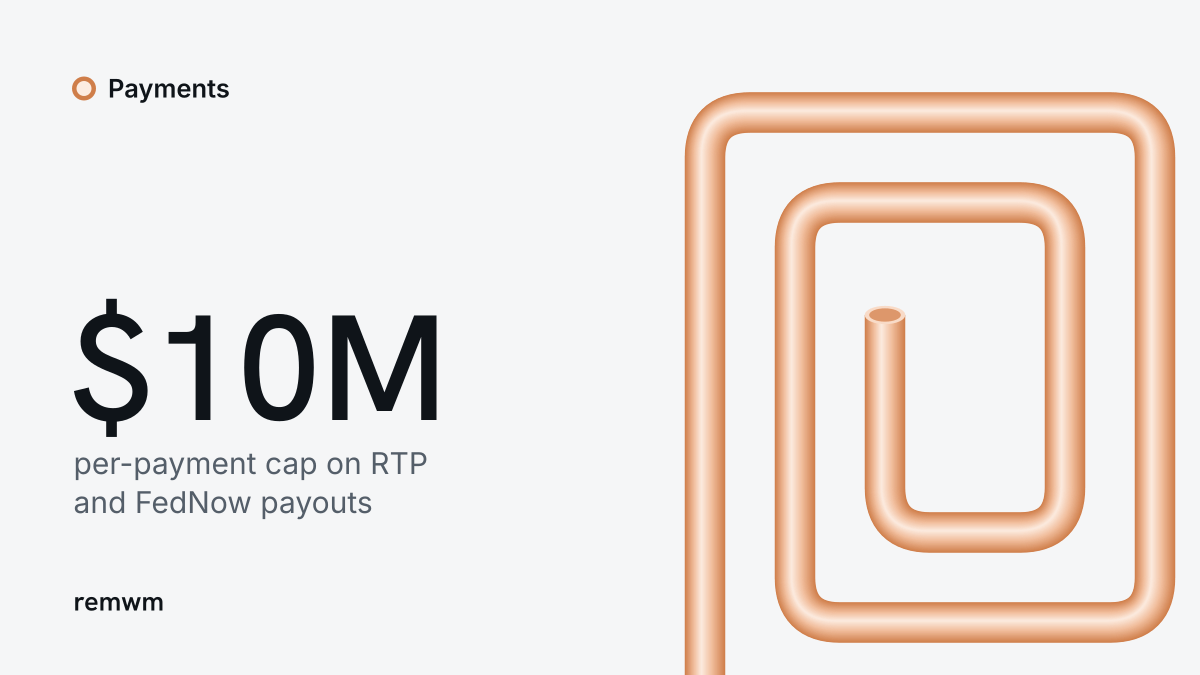
| RTP network | $10 million since February 9, 2025 | 24/7/365 | Seconds |
| FedNow | $10 million network maximum since November 12, 2025; participants may set lower limits | Not stated in the sources used here | Instant payment service |
| Push-to-card (Visa Direct OCT) | Not published | Any time | Visa requires US issuers to make funds available within 30 minutes of approval |
| Wire (Fedwire Funds) | No limit stated in the sources used here | 9:00 p.m. ET the prior day to 7:00 p.m. ET, Monday to Friday; third-party cut-off 6:45 p.m. ET | Same day |
Nacha raised the Same Day ACH per-payment limit to $1 million on March 18, 2022, from $100,000, and the rule covers “consumer and business payments, credits and debits”. On April 27, 2026 Nacha announced that its membership had approved an increase to $10 million, which takes effect September 17, 2027.
Sending ACH payouts also brings Nacha’s fraud-monitoring rules, which require non-consumer originators and their third-party service providers to run risk-based processes to identify fraudulent entries. Phase 1 applied from March 20, 2026 to originators with 6 million or more 2023 entries. Phase 2 drops the volume threshold for everyone else, with an effective date of June 19, 2026 and, because of the holiday, a “practical effective date” of Monday, June 22, 2026.
The RTP network’s per-transaction limit went to $10 million on February 9, 2025, announced by The Clearing House on December 4, 2024. Nacha’s rule page dates the same change to June 2025; the date used here is The Clearing House’s own. RTP runs around the clock and carried 142 million transactions worth $576 billion in Q2 2026, with more than 1,322 participants as of July 2026. The Clearing House lists “merchant settlement, insurance, and gig economy disbursements” among its uses.
The FedNow Service network limit for customer credit transfers rose from $1 million to $10 million on November 12, 2025. The Federal Reserve notes that participants “may choose to utilize the maximum limits or set lower limits”, so a seller’s bank may cap a payout well below the network maximum.
Wires stay on banking hours for now. The Fedwire Funds Service business day runs from 9:00 p.m. ET on the preceding calendar day to 7:00 p.m. ET, Monday to Friday, and the deadline for transfers for the benefit of a third party, such as a bank’s customer, is 6:45 p.m. ET. The Federal Reserve Board announced on October 9, 2025 that Fedwire Funds will add Sundays and weekday holidays, an expansion to be “implemented in 2028 or 2029”.
Push-to-card moves funds to a recipient’s card account through an Original Credit Transaction. Visa’s developer documentation lists “Merchant settlement (marketplace seller earnings)”, gig worker earnings and content creator earnings among supported uses, and a platform can also ask Visa to hold a push request for a fixed deferred period of 48 hours. Payouts can land on cards the platform itself issues; see debit card issuing.
For cross-border payouts, Visa says Visa Direct reaches over 195 countries across card, account and wallet rails. Mastercard Move, Mastercard’s money movement portfolio, reaches 200+ countries and territories in 150+ currencies, paying out to bank accounts, cards, wallets and cash pickup. A platform that runs several rails or several providers has to route between them, the subject of payment orchestration.
Payout timing, holds and negative balances
Stripe typically schedules a new account’s first payout 7 to 14 days after its first successful payment, and longer depending on industry risk and country. After that, standard payouts typically arrive 1 to 2 business days after submission, while Instant Payouts “typically reach the account within 30 minutes”.
A platform that owns fraud and dispute liability controls the schedule. Stripe lets it set a connected account’s payout delay with delay_days_override, “a number up to 31” days, and set the interval to manual, daily, weekly or monthly.
Adyen for Platforms publishes four payout priorities, Regular, Fast, Instant and Wire, and says that “A payout with a higher priority incurs higher fees”. For USD in the US it publishes cut-offs of 01:45 ET for Regular (maximum 99,999,999.99), 16:15 ET for Fast (maximum 1,000,000.00), 24/7 for Instant (maximum 1,000,000.00) and 18:30 ET for Wire. Under managed payouts, standard funds reach the user’s bank account two days after settlement and accelerated funds the day after.
Refunds and chargebacks that arrive after a payout can push a user’s balance below zero. Adyen allows negative balances for up to 30 days, then debits the platform’s reserved compensation account.
Split payments across several recipients
One customer charge often belongs to more than one recipient. Stripe’s separate charges and transfers covers that case, and its own example is “a restaurant delivery platform that splits payments between the restaurant and the deliverer”. A transfer can wait for the charge’s funds to become available by naming the charge as its source_transaction. Funds segregation, which keeps payment funds in a protected holding state before transfer, is a private preview feature at Stripe.
Who holds the funds
There are three common answers: the connected account’s balance at the provider, the platform’s own balance at the provider, or a bank account held for the benefit of users, known as an FBO account. An FBO account sits at a bank, which brings that bank’s rules and examiners into the design; see how to choose a sponsor bank.
The FDIC proposed a recordkeeping rule for custodial deposit accounts with transactional features on September 17, 2024, under which banks would keep beneficial-owner records and reconcile at least daily. The FDIC’s framing of the problem is that non-banks “often deposit these funds together into a single custodial account at a bank”. The comment period was extended to January 16, 2025. No final rule was on fdic.gov as of September 14, 2026, so it stands as a proposal. Bank oversight of platform arrangements is moving on other fronts too; see the interagency TPRM guidance proposal.
Money transmission and the payment processor exemption
This section reports what the primary sources say. It is not legal advice.
FinCEN’s definitions exclude from “money transmitter” a person who acts “as a payment processor to facilitate the purchase of” a good or service through a clearance and settlement system, by agreement with the creditor or seller (31 CFR 1010.100(ff)(5)(ii)(B)). FinCEN has set four conditions for that exemption: the company facilitates purchases of goods or services, operates through clearance and settlement systems that admit only BSA-regulated financial institutions, acts under a formal agreement, and has that agreement at least with the seller. In ruling FIN-2014-R009 of August 27, 2014, FinCEN said a processor that pays merchants “outside of a clearance and settlement system that admits only BSA-regulated financial institutions” could not claim it.
State law is separate. California’s Money Transmission Act exempts an agent of the payee: Financial Code section 2010, subdivision (l), covers transactions where the recipient is an agent of the payee under a preexisting written contract and delivery of the money to the agent satisfies the payor’s obligation to the payee. The DFPI has applied it in published opinion letters, including to marketplace-style arrangements, and its 2020 rulemaking document states that the exemption “is self-executing, meaning that an entity does not need the Department’s prior authorization”. Other states word it differently: Wisconsin’s statute adds a condition about the payee holding the agent out to the public. California’s treatment does not carry over to every state.
Form 1099-K and 1099-NEC thresholds in 2026
The One, Big, Beautiful Bill (Public Law 119-21, July 4, 2025) retroactively reinstated the earlier 1099-K threshold. A third party settlement organization, which is what a marketplace usually is for this purpose, files Form 1099-K for a payee only when gross reportable payments exceed $20,000 and transactions exceed 200. The IRS published FAQs on the change on October 23, 2025, and the same test appears in the current Form 1099-K instructions.
Three qualifications go with it. Card payments have no threshold, a TPSO may report lower amounts voluntarily, and the IRS warns that “Your state may have a lower reporting threshold for TPSOs”.
Platforms that pay contractors directly rather than as a TPSO use Form 1099-NEC or 1099-MISC. For tax years beginning after 2025, that threshold rose from $600 to $2,000 and will be adjusted for inflation beginning in calendar year 2027.
What payout providers publish
The order of the rows carries no meaning, and every figure is the provider’s own published price as of September 14, 2026.
| Provider | Published payout fee | Fast option | Reach | Tax forms |
|---|---|---|---|---|
| Stripe Connect | Platform-set pricing: $2 per monthly active account plus 0.25% + 25 cents per payout sent; no account or payout fee when Stripe bills the connected accounts | Instant Payouts at 1% of payout volume | Cross-border payouts from 0.25% of payout volume | 1099 e-file $2.99 per form with the IRS, $1.49 per form with states |
| Adyen for Platforms | Not published | Instant priority, 24/7, USD maximum 1,000,000.00 | Cut-offs published per country and currency | Not covered in the sources used here |
| PayPal Payouts | 2% of the payout, capped at $1.00 domestic and $20.00 international; $0.25 flat per US payout through the Payouts API | PayPal and Venmo balances; Venmo payouts carry the same US fees | International supported | Not covered in the sources used here |
| PayPal Enterprise Payouts (formerly Hyperwallet) | Not published | Fast transfers via PayPal, Venmo, PYUSD and instant ACH | 200+ markets, 50+ send currencies | 1099 reporting in the US |
| Tipalti Mass Payments | Plans from $249 per month plus per-payment transaction fees, which are not published as figures | Not published | 200+ countries and territories | W-9 and W-8 collection |
| Trolley | ACH $1.00; debit card 1.00% ($1.50 minimum); Venmo $1.50; PayPal $0; wire $10.00 with FX and $25.00 without; 2.00% conversion margin | Debit card payout | Domestic and international bank transfers, wallets, checks | IRS statements $2.00 each |
Figures come from Stripe Connect pricing, PayPal’s business fee page and Payouts API fees, Tipalti pricing and Trolley pricing, where the Pay plan is $2,399 per year. Adyen’s public pricing page lists payment-method fees and says “Other Adyen products, besides payment methods, are priced separately”, so payout pricing for Adyen for Platforms is not published. PayPal Enterprise Payouts is “the new name for Hyperwallet” and pays to bank accounts, debit cards, PayPal, Venmo, check, prepaid cards, PYUSD wallets and cash pickup; the PYUSD side is covered in our guide to the stablecoin payment gateway. Tipalti says it is “Regulated through money transmitter licenses in the US, Canada, UK & EU”. More names are in the provider directory.