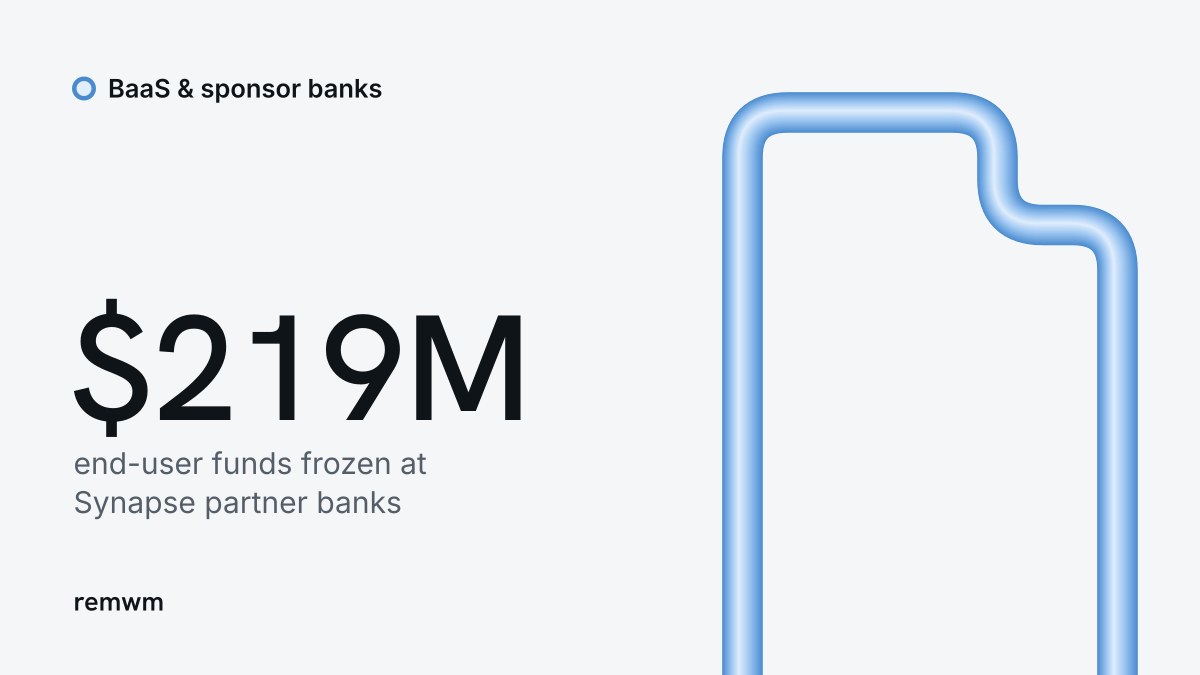
The Synapse bankruptcy began on April 22, 2024, when Synapse Financial Technologies filed a voluntary Chapter 11 petition in the US Bankruptcy Court for the Central District of California (CFPB judgment). In May 2024 partner banks froze about $219 million of end-user funds. Trustee filings put the gap between bank balances and Synapse’s ledger at $65 million to $95 million. The court dismissed the case on November 12, 2025.
What happened in the Synapse bankruptcy
The case, number 1:24-bk-10646-MB in the San Fernando Valley Division, opened with a sale attempt. On the petition date Synapse filed an emergency motion to sell all its assets to TabaPay Holdings for $9.7 million, and the trustee’s later filings record that the buyer was “unwilling to proceed with the sale without the Evolve settlement” after the May 9, 2024 hearing (Dkt. 538).
On May 24, 2024 Synapse told the court it “had no remaining cash,” terminated its remaining officers and employees and ceased all operations. The US Trustee appointed Jelena McWilliams as Chapter 11 trustee (Dkt. 684).
After that the estate had nothing to sell. By April 11, 2025 the trustee reported “no actionable opportunities for a sale of the debtor’s assets” (Dkt. 500), and filed a motion to convert or dismiss on June 6, 2025. At an October 9, 2025 hearing the court found the estate administratively insolvent. The order of November 12, 2025 states that “The Case is hereby dismissed” and authorizes the trustee to destroy the remaining records and data (Doc. 687). Before that, a supplemental trustee declaration recorded that a complete copy of the debtor’s AWS data was held in “an Evolve-controlled and maintained AWS environment” (Dkt. 611).
The court docket shows the case closed on June 29, 2026, with the trustee discharged and the bond exonerated. That entry is read from a PacerMonitor mirror of the docket, not from the court’s own system.
The shortfall: $219 million frozen, $65 million to $95 million missing
The trustee’s status reports are the record of the numbers. In May 2024 the partner banks reported that approximately $219 million held for Synapse end users had been frozen because of ledger reconciliation problems (Fifteenth Status Report). The precise figure in the trustee’s tables is $219,077,467 of aggregate FBO funds held on the date of her appointment by four banks: AMG National Trust Bank, American Bank, Evolve Bank & Trust and Lineage Bank (Fourteenth Status Report).
The estimated shortfall never moved. The Ninth Status Report of September 12, 2024 says the “$65 million to $95 million estimated shortfall has not changed” (Dkt. 370), and the Fourteenth Report repeats it. The trustee also stated she had been “unable to independently ascertain the exact amounts of a potential shortfall.” The CFPB, describing the same events, gives a different band: “a shortfall of between $60 and $90 million” (CFPB enforcement page). The two ranges come from two different bodies of work and are presented here as each source states them.
By January 2025 the trustee reported “the return of over $192 million in end user funds, which is 87% of the total $219 million,” and wrote that the apparent shortfall appeared to have existed before the bankruptcy.
| Figure | Source | Date |
|---|---|---|
| ~$219 million frozen ($219,077,467 FBO funds on the trustee’s appointment date) | Trustee status reports | 2024–2025 |
| $65 million to $95 million estimated shortfall | Trustee status reports, dismissal motion | Sept 2024 onward |
| $60 million to $90 million shortfall | CFPB enforcement page | Aug/Sept 2025 |
| Over $192 million (87%) returned | Trustee Fourteenth Report | Jan 2025 |
| $9.7 million proposed TabaPay sale, not completed | Trustee motion | Apr 2024 |
| $1 civil money penalty | Stipulated judgment | Sept 12, 2025 |
| $55,214,058 Civil Penalty Fund allocations | CFPB Civil Penalty Fund page | Nov 2025 and May 2026 |
Evolve Bank and the Federal Reserve order
The CFPB’s complaint says Synapse began with one partner bank in 2017 and that “as early as September 2023, Synapse’s records did not match the records maintained by that bank.” The complaint does not name the bank in that paragraph. It does say that beginning in October 2023 Synapse directed transfers of end-user funds from Evolve Bank & Trust to Synapse Brokerage and then to accounts at other partner banks (complaint).
The Federal Reserve Board, with the Arkansas State Bank Department, announced a consent cease-and-desist order against Evolve Bancorp and Evolve Bank & Trust on June 14, 2024, effective June 11. Examinations in 2023 found Evolve “engaged in unsafe and unsound banking practices” in its fintech partnerships, and the Fed said the action was “independent of the bankruptcy proceedings regarding Synapse” (press release). The order carries no civil money penalty.
Two paragraphs of the order matter to anyone running a program. Paragraph 3(a)(iii)© requires controls so that ledger and sub-ledger responsibilities of the bank and its fintech partners are defined and maintained, “including in the event of a material business disruption.” Paragraph 19 bars new fintech partners and new products without prior written supervisory approval. Paragraph 28 keeps the order in force until the supervisors terminate, modify or suspend it in writing; no termination announcement was found on the Fed’s enforcement listing as of September 19, 2026. Our guide to how to read a consent order walks through that structure, and the order is one of the entries in the sponsor bank enforcement actions tracker.
Evolve’s own account of the reconciliation is its position, not a court finding. Evolve says its consultant Ankura rebuilt balances from Federal Reserve and Evolve transaction data “to evaluate the flawed ledgers from Synapse,” in the words of founder Scot Lenoir, and that notifications to end users began on November 4, 2024 (media release). A later update says Evolve would disburse more funds to a subset of end users on or about March 6, 2025 (update).
The CFPB case and the $55.2 million penalty fund
The CFPB sued Synapse inside the bankruptcy court as adversary proceeding 1:25-ap-01052, alleging the company failed to keep adequate records of where consumers’ funds were held and to match them against partner-bank records. The CFPB’s page and the docket give the filing date as August 21, 2025, while the judgment’s own text says the action was commenced on August 20, 2025. The court entered the stipulated final judgment on September 12, 2025.
The judgment imposes “a civil money penalty … in the amount of $1.00,” permanently bans Synapse from deposit-taking, funds transmission, custody and payments processing, and bars any sale of customer information. The CFPB explains the dollar: it “enables the Bureau to access the civil penalty fund” to redress harmed consumers. The judgment defines affected consumers as anyone who had an account with a fintech platform as of May 17, 2024.
Two allocations followed. The Civil Penalty Fund page lists $46,248,291 for Synapse victims on November 28, 2025 and $8,965,767 on May 29, 2026, a total of $55,214,058 (CFPB). As of September 19, 2026 the CFPB’s payments by case page did not list a Synapse distribution, and the CFPB notes that an unlisted case may mean the distribution process has not begun. How the money will be split among end users, and when payments start, is not published.
The FDIC proposal on custodial deposit accounts
On September 17, 2024 the FDIC Board approved a proposed rule, a new 12 CFR part 375 under RIN 3064-AG07, for banks holding custodial deposit accounts with transactional features. Then-Chairman Martin Gruenberg framed the aim as making sure “banks know the actual owner of deposits placed in a bank” by a third party such as Synapse (FDIC press release).
The Federal Register notice of October 2, 2024 covers an account established for beneficial owners that holds commingled deposits of multiple owners where an owner may direct transfers to third parties. The bank would keep records of each beneficial owner, balance and ownership category, and reconcile “no less frequently than at the close of business daily.” A third party may keep those records only if the bank has direct, continuous and unrestricted access to them, including in the third party’s business interruption, insolvency or bankruptcy, with annual independent validation, an annual CEO or COO certification and an annual report to the FDIC and the primary regulator (FDIC letter).
Then-Vice Chairman Travis Hill voted for the proposal, saying better recordkeeping “can reduce the likelihood of another Synapse-like disaster,” while arguing the FDIC should have waited for comments on the interagency RFI (statement).
It is still a proposal. The comment period was extended to January 16, 2025 (FDIC), and the Federal Register holds only two documents for the RIN, the proposal and that extension of November 20, 2024. The FDIC’s March 3, 2025 withdrawal covered brokered deposits, corporate governance and the Change in Bank Control Act, not this rule. No final rule and no withdrawal had been published as of September 19, 2026.
The 2024 joint statement and the 2026 plan to rescind it
On July 25, 2024 the Federal Reserve, FDIC and OCC issued a joint statement on bank arrangements with third parties to deliver deposit products, alongside an RFI. “The statement does not establish new supervisory expectations,” the agencies wrote (Fed). Its risk list names lack of access to records, where insufficient bank access to the deposit and transaction system of record “can impair the bank’s ability to determine its deposit obligations.” It points to contracts that address transferring accounts, data or activities to another entity if the third party goes bankrupt, and warns that deposit insurance “does not protect against losses resulting from the failure of the third party” (statement).
That document is now proposed for removal. On September 11, 2026 the OCC, Federal Reserve, FDIC and NCUA proposed new third-party risk management guidance, published September 15, 2026 at 91 FR 58536, with comments due November 16, 2026. Finalized guidance “would replace the 2023 Guidance and the Supplemental TPRM Resources,” a set the notice defines to include the July 2024 joint statement (notice). A Federal Reserve staff memo states that the agencies “would rescind the Joint Statement” issued as SR 24-5 (memo). The proposal is non-binding supervisory guidance, and until it is finalized the 2024 statement stands. See our coverage of the interagency TPRM guidance proposal.
Post-Synapse documents on records and reconciliation
The order of rows carries no meaning.
| Document | Issuer | Date | Binding | Records and ledger | Reconciliation | Status, Sept 27, 2026 |
|---|---|---|---|---|---|---|
| Consent cease-and-desist order, Evolve Bancorp and Evolve Bank & Trust | Federal Reserve Board, Arkansas State Bank Dept. | Effective June 11, 2024 | Yes, one bank | Ledger and sub-ledger duties defined, including in a material business disruption | No frequency set | In force until terminated in writing |
| Joint Statement on Banks’ Arrangements with Third Parties | Fed, FDIC, OCC | July 25, 2024 | No | Flags lack of access to records; contracts for transfer on third-party bankruptcy | Cites 2016 deposit reconciliation guidance | Proposed for rescission Sept 11, 2026 |
| Recordkeeping for Custodial Accounts, RIN 3064-AG07 | FDIC | Approved Sept 17, 2024 | Would bind if finalized | Beneficial owner, balance, ownership category; third-party records only with bank access | At least daily, close of business | Proposal; latest document Nov 20, 2024 |
| CFPB v. Synapse stipulated final judgment | CFPB, Bankr. C.D. Cal. | Entered Sept 12, 2025 | Yes, against Synapse | Alleged failure to keep records matching partner banks | Not addressed | $1 penalty; $55,214,058 allocated; no distribution listed |
| Proposed Third-Party Risk Management Guidance | OCC, Fed, FDIC, NCUA | Sept 11, 2026 | No | Principles-based, risk-tailored | Not specified | Comments open to Nov 16, 2026 |
How BaaS programs hold funds now
The structure at issue is not exotic. In Synapse’s Cash Management Program, end-user funds sat in an omnibus account held by a Synapse subsidiary for the benefit of consumers at partner banks, and Synapse was responsible for tracking and recording the movement of those funds across the banks. That is the arrangement the CFPB complaint describes.
Provider documentation shows how the same shape is documented today. Synctera writes that the FBO account on the bank’s core holds the aggregate of end-customer funds only, while Synctera is “a Sub-Ledger to the Bank and the Ledger of Record for the FinTech” (docs), and that an end-of-day process syncs the sub-ledger and the FBO accounts daily (docs). That is one provider’s description of its own setup, not an industry standard. The FDIC proposal would make daily reconciliation a rule rather than a practice, and the Evolve order already requires the duties on each side to be written down. More on the layer in the BaaS and sponsor banks section.
What to check with a sponsor bank
Each item below maps to a document above, not to an opinion.
- Which party keeps the ledger of record, and which keeps the sub-ledger. The Evolve order requires those duties to be defined and maintained.
- Whether the definition survives a failure. The order’s wording covers a material business disruption; the joint statement raises contracts for transferring accounts and data on a third party’s bankruptcy.
- How often balances are reconciled against beneficial-owner records. The FDIC proposal would set close of business daily.
- Whether the bank has direct, continuous and unrestricted access to beneficial-owner records if the middleware stops, the test the FDIC proposal would apply to third-party recordkeeping.
- How deposit insurance is described to end customers. The joint statement warns that insurance does not cover the failure of the third party.
- What happens to the data. In this case a copy of the debtor’s AWS data ended up in an environment controlled by one bank.
The selection criteria are in how to choose a sponsor bank.