BIN sponsorship is the arrangement in which a bank that is a principal member of Visa or Mastercard lets another company’s card program run on its bank identification numbers (BINs). The bank stays the card issuer and answers to the network and its regulators. The fintech or software platform runs the product as the bank’s program manager, usually under a program management agreement, and is approved, monitored and audited by the bank.
What a BIN sponsor is
A BIN is the first six or eight digits of a card number. Stripe’s documentation says it identifies “both the card network and the bank that issues the card.” Visa’s partner directory defines the BIN sponsor as “the issuing bank that owns the Bank Identification Number (BIN), which is necessary to access the Visa network.” Visa adds that the issuing bank “holds cardholder funds,” manages risk and local regulation, follows Visa rules and often acts as the settlement agent.
Visa names two other roles. The issuer processor keeps the system of record and authorizes transactions. The program manager oversees the program “on the issuing bank’s behalf” and is “typically responsible for developing, launching and managing the program through its lifecycle.” Some companies sell all three as one package.
The cardholder sees the fintech’s brand. The network and the regulators see the bank.
What the sponsor bank does
Column, a nationally chartered bank that sponsors card programs, lists four duties it keeps as BIN sponsor:
| Sponsor duty | What Column’s documentation says |
|---|---|
| Network membership and BIN ownership | Column owns the BIN and stays a principal issuing member of Visa, Mastercard and Discover for the life of the program |
| Settlement | Column settles with the networks daily by wire drawdown, funded from users’ accounts (debit) or Column loans (credit) |
| Program oversight | Regular reporting to regulators and networks, follow-up diligence and program testing |
| Transaction monitoring | BSA/AML monitoring and OFAC sanctions screening, with information requested from the partner |
Cross River Bank describes the same core. As a principal member, it allocates its assigned BINs to partner programs, manages network settlement and reports card portfolio activity to Visa and Mastercard every quarter, as network rules require. Its documentation also describes credit card programs in which Cross River is the lender of record.
What the program manager does
Most of the daily work moves to the fintech. Column says a partner “will operate as an agent of the bank,” with the relationship set out in a program management agreement. Its list of program manager duties includes:
- know-your-customer and know-your-business checks on every customer, plus written CIP, BSA/AML and OFAC policies;
- fraud monitoring, complaints and disputes;
- card production and delivery;
- customer support, with the program’s contact details on the back of the card;
- marketing reviewed against the bank’s guidelines;
- vendor management, including a list of third-party vendors;
- answering authorization requests in time. Column notes that Visa requires a response within 10 seconds for standard point-of-sale messages, and some processors allow only 2 seconds before applying default settings.
The money risk sits with the fintech too. “As Program Manager, you’re responsible for any losses and expenses for your program, including network fees, fraud losses, and other penalties,” Column writes. It asks for financial statements to set the program reserve, the cash a partner keeps at the bank against those losses.
Sponsorship models
Banks package BIN sponsorship in different ways. The main choices are who runs the processor, who keeps the ledger and where customer money sits.
| Model | Who runs the processor | Who keeps the ledger | Where funds sit |
|---|---|---|---|
| Card-only BIN sponsorship (Cross River) | Partner | Partner | Not at Cross River |
| FBO subledger (Cross River’s preferred model) | Partner | Partner, pushing customer balances to the bank at least daily | For-benefit-of account at Cross River, with a subledger per customer |
| FBO pooled account (Cross River) | Partner | Partner, sending daily balance files | Pooled for-benefit-of account at Cross River |
| BIN licensed by a platform (Stripe Issuing) | Stripe | Stripe | Prepaid balances funded by the platform or its connected accounts, or an external credit account |
An FBO (“for benefit of”) account is a bank account held for many customers at once. When a bank holds customer funds this way, Cross River notes, “federal banking regulations require that partners must make beneficial owner identity and ownership interests ascertainable for FDIC pass-through insurance.” In plain terms, the records must show whose money is whose. Our guide to the synapse bankruptcy shows what happens when they do not.
Platforms that act as program manager also decide BIN setup. Stripe licenses a BIN for each Issuing program and offers a shared BIN by default. A dedicated BIN, used only by one customer’s accounts, is in preview. On a shared BIN, Stripe may give a user its own account range, the digits after the BIN, so acquirers can tell programs apart.
Banks that publish BIN sponsorship
These banks describe BIN sponsorship for third-party programs on their own pages. The list is alphabetical, it is not a ranking, and it includes only banks whose pages say so.
| Bank | Card types and networks named on its own pages |
|---|---|
| Column | Consumer and commercial debit, credit and prepaid; Visa, Mastercard, Discover |
| Cross River Bank | Debit, credit and prepaid; principal member of Visa and Mastercard; partner-managed and integrated issuing models |
| FinWise Bank | Credit, debit, prepaid, consumer, commercial and payroll cards; “all major global card networks” |
| Sunrise Banks | Debit card BIN sponsor for “over 17 years”; principal member of Mastercard, Visa and Discover |
| The Bancorp | Prepaid debit and credit card program sponsorship for fintechs and non-bank companies |
Issuer processors and BaaS platforms that bring their own bank partners are compared in card issuing platforms, and sponsor banks’ fintech partners and orders are in the sponsor banks directory.
Credit programs: issuer is not always lender
On a credit card, the sponsor bank does not have to fund the loans. GoodLeap’s July 30, 2026 release for its HELOC-backed Visa card says Cross River “acts solely as the Visa program sponsor and card issuer and is not the lender.” The credit is originated and funded by GoodLeap. On October 1, 2026, Cross River said it had given GoodLeap a $50 million revolving credit facility to finance that card, as reported in our cross river goodleap credit facility news.
That split decides whose name sits on the credit agreement and which lending rules apply to whom. Cross River’s documentation describes the other set-up too, where the bank is lender of record and the partner submits applications through the bank’s approval API.
Interchange and the bank’s size
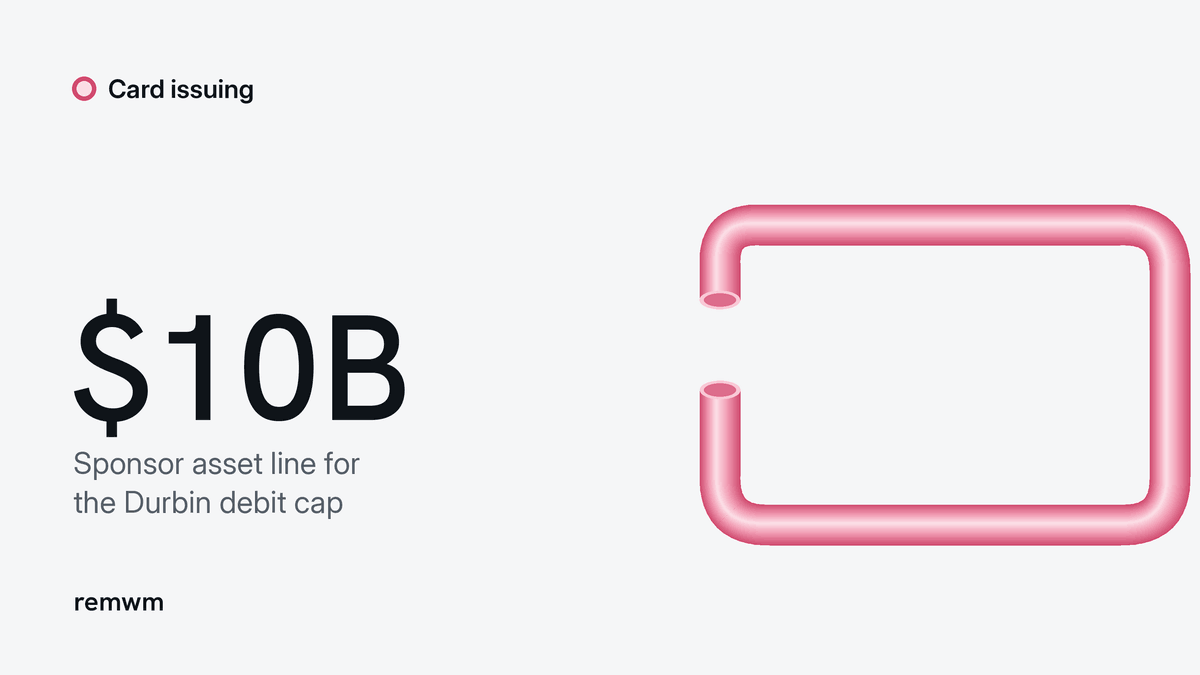
The sponsor’s balance sheet changes the economics of a debit or prepaid program. Under Regulation II, the Federal Reserve’s debit interchange rule, the fee cap does not apply when “the issuer, together with its affiliates, has assets of less than $10 billion” at the end of the prior calendar year (12 CFR 235.5(a)). The issuer here is the sponsor bank, not the fintech. The cap itself and the pending changes to it are explained in our guide to debit card issuing.
The bank keeps the responsibility
Sponsorship moves work to the partner, but not the bank’s accountability. The federal banking agencies’ 2023 guidance on third-party relationships says a bank’s use of third parties “does not diminish its responsibility” to meet legal and safety-and-soundness requirements “to the same extent as if its activities were performed by the banking organization in-house.” The agencies proposed replacement guidance in September 2026; the third-party risk management guidance proposal keeps that principle.
Enforcement orders are issued to the bank, and some require the regulator’s non-objection before the bank adds new partners or products. The sponsor bank enforcement actions tracker lists them with document numbers, and how to choose a sponsor bank covers the questions to ask before signing.