Fleet card issuing means putting a commercial card in a driver’s or vehicle’s hands, with controls and data built for fuel and maintenance spend. Programs come in two shapes. Closed-loop fuel cards run on a private network that the provider owns. Open-loop fleet cards run on Visa Fleet or Mastercard Fleet. Modern issuing platforms such as Highnote, Lithic and Stripe now publish fleet features that a trucking software company can build on.
Closed-loop fuel cards vs open-loop fleet cards
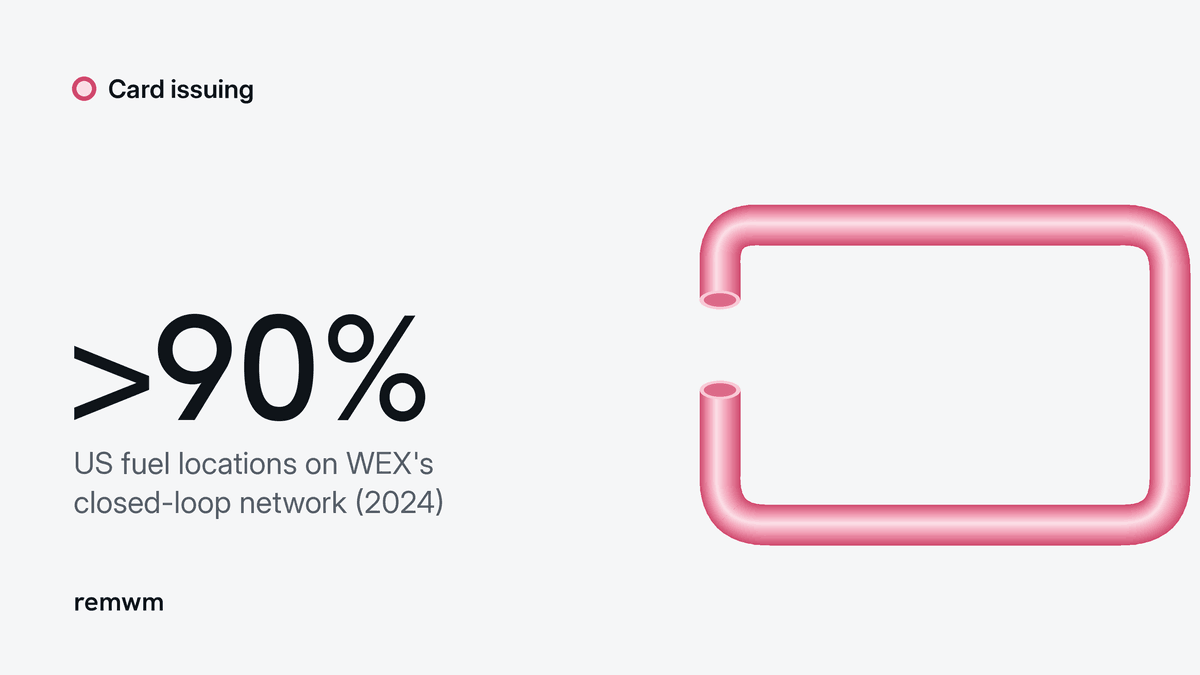
A closed-loop network is one where one company plays every role. WEX’s 2025 annual report defines closed-loop as a proprietary network “in which the card issuer, payment processor and merchant network are all part of the same system.” WEX says its closed-loop networks are its main difference in the Mobility segment. They let it capture rich data, set custom controls and “optimize the economics between fleets and merchants.” In its 2024 annual report, WEX said its U.S. closed-loop network covered more than 90% of fuel locations and 80% of EV charging locations.
Corpay describes the same trade-off in its 2025 annual report. On its proprietary networks, transactions run only “at select participating merchants with whom we have contracted directly.” Those networks give Corpay better economics and richer data. Third-party networks such as Mastercard and Visa “tend to be more broadly accepted,” though merchant economics “tend to be inferior.”
Open-loop fleet cards are network-branded commercial cards. Visa says Visa Fleet offers “advanced category-level controls, enhanced data reporting and real-time dashboards.” Mastercard’s Corporate Fleet Card page cites acceptance at over 560,000 fuel and maintenance merchant locations. It also offers driver or vehicle cards. Mastercard’s Fleet implementation guide explains the plumbing. The Fleet BIN range is a subset of the Corporate Purchasing Card BIN range. So the card acts as a fleet card at petroleum locations and as a purchasing card everywhere else.
The line is blurring. WEX’s 2025 report describes a BP program that uses its “integrated closed- and open-loop network capabilities.”
Fleet-specific controls
Three layers of control show up across network and platform documents.
Merchant category restrictions. A merchant category code (MCC) is a four-digit code the networks assign by business type. Mastercard’s guide lists petroleum MCCs 4468, 5499, 5541, 5542 and 5983. It says vehicle-assigned cards may allow only fuel and maintenance MCCs, such as 7538 (automotive service shops) and 7542 (car washes). Highnote’s docs list the purchase types each network supports. Visa has Open, Fleet (fuel and maintenance) and Fuel only. Mastercard has Open and Fuel only.
Product-level restrictions on the chip. Visa’s Fleet 2.0 implementation guide describes three card setups: magnetic stripe, Track 2 on chip, and “Full Chip.” Full Chip is based on the Conexxus and IFSF industry standards. The issuer writes prompting and purchase-restriction data to chip tags, and the terminal applies those restrictions at the pump. Highnote notes that a product restriction code can block non-fleet items, such as food at fuel stops. Visa says it is bringing Google Pay to fleet cards, with fleet data tags configured by “the issuer, fintech or processor” during tokenization.
Driver and odometer prompts. The Visa guide defines service prompt codes. They include “Driver ID and Odometer Reading” and “Vehicle ID and Odometer Reading.” The cardholder’s answers travel in the authorization message. The issuer or program manager can then decline based on who is fueling which vehicle.
Fuel pumps add one quirk. Highnote explains that at automated fuel dispensers, “a $1 or estimated amount is sent for authorization.” The final amount arrives later. Marqeta warns that for these transactions “the final clearing amount may be higher than the initial authorization.” Marqeta also offers an AFD hold-increase setting on its card products.
Level 2 and Level 3 data
Level 1 data is the standard transaction record. Level 2 adds details about the purchase as a whole, such as tax, fuel type, driver ID and odometer. Level 3 adds line items. Lithic’s docs call Level 3 “a digital receipt.” They note merchants usually send this data on commercial BINs “to qualify for cheaper interchange rates.” Visa and Mastercard deliver it on different schedules.
| Network | Data | When it arrives (per Highnote docs) |
|---|---|---|
| Both | Level 1 | Authorization and clearing |
| Visa | Level 2 | Authorization, authorization advice or clearing (acquirer decides) |
| Visa | Level 3 | 24–48 hours after the transaction |
| Mastercard | Level 2 and 3 bundled | End of business day (ET), in a single event |
For a product team, this means reconciliation cannot wait on a single event. Highnote tells developers to check for Visa Level 2 data on authorization, reversal and clearing events.
Who issues and who processes
On an open-loop program, the issuer is a bank. It holds the network license and the BIN. Mastercard’s guide says issuers “must be assigned a BIN by Mastercard prior to issuing this product.” The processor runs authorizations, controls and data feeds. The software platform owns the fleet customer and the product experience.
The Motive Card shows the split. The October 2023 release says Motive chose Marqeta, a card issuing platform, “as its fleet card issuer.” The legal issuer is still a bank: the card runs on Mastercard and “is issued by Sutton Bank, Member FDIC.” At the time, Motive said it had issued over 35,000 cards.
Credit fleet cards also need funding. Highnote’s Fleet Credit template uses a product funding account, where “you or your debt facility” deposit capital to back credit lines. WEX reports that its own bank, WEX Bank, “funds a significant portion” of its Mobility and Corporate Payments operations. Stripe’s fleet guide requires connected accounts where the platform is responsible for “requirements collection and loss liability.”
What issuing platforms publish on fleet support
| Provider | Fleet material published | Fleet data fields documented | Model |
|---|---|---|---|
| Highnote | Fleet Credit template (FLEET vertical); fleet onboarding with fuel tax exempt flag; fleet simulator | visaFleetData and mastercardFleetData: driver ID, vehicle ID, odometer, fuel and non-fuel products | Open-loop, Visa and Mastercard |
| Lithic | Fleet cards launched June 25, 2024, “available to all customers”; L2/L3 enhanced data endpoint | Vehicle number, driver number, odometer, fuel type, quantity, unit price | Open-loop |
| Stripe Issuing | Fleet integration guide for Connect platforms | fleet hash with odometer prompt, purchase type, service type; fuel object | Open-loop |
| Marqeta | General MCC groups, authorization controls, AFD hold settings; Motive fleet program release | Fleet-specific fields: not published in the pages reviewed | Open-loop (Motive on Mastercard) |
| WEX | Annual report on SEC EDGAR | Driver, vehicle, odometer, provider, items purchased | Proprietary closed-loop, plus open-loop |
| Corpay | Annual report on SEC EDGAR | Richer data on proprietary networks (no field list) | Proprietary and third-party networks |
Highnote hosts the Visa Fleet 2.0 and Mastercard Fleet implementation guides in its docs. To compare broader capabilities, see card issuing platforms and profiles of Highnote, Lithic and Marqeta.
Rules that apply to commercial fleet cards
Consumer rules mostly fall away, but not entirely.
- Regulation E. It covers an “account” defined as a consumer asset account “established primarily for personal, family, or household purposes” (12 CFR 1005.2(b)(1)). A business fleet account is not that kind of account.
- Regulation Z exemption. Credit “primarily for a business, commercial or agricultural purpose” is exempt from Regulation Z (12 CFR 1026.3(a)).
- Regulation Z exceptions that still apply. The ban on unsolicited credit cards applies “regardless of the purpose for which a credit card is to be used, including business, commercial, or agricultural use” (12 CFR 1026.12(a)). If an issuer gives 10 or more cards to an organization’s employees, the issuer and the organization may agree on liability for unauthorized use. That liability can reach an employee only as the rule allows (12 CFR 1026.12(b)(5)).
The network rules add their own requirements. Visa’s guide says it is “the sole responsibility of the Issuer” to make sure its Visa Fleet program complies with the law. For partner selection, see how to choose an issuer processor. For the product strategy side, see embedded finance for vertical saas.