A stablecoin on and off ramp API lets a business turn dollars or another local currency into a stablecoin such as USDC, and turn the stablecoin back into a bank payment, from its own software. The on-ramp usually hands out bank account details that mint or buy tokens when money arrives. The off-ramp usually hands out a blockchain address that pays out by wire when tokens arrive.
The two building blocks
Most ramp APIs are built from two kinds of standing route, plus one-off calls for everything else.
- A deposit account that converts. The provider gives a customer bank details, and every incoming payment is converted to a stablecoin and sent to a set wallet. Bridge calls these virtual accounts: “permanent, reusable fiat deposit addresses that convert incoming fiat into crypto”. Brale’s automations give “a unique account number and routing number” that mint stablecoins to a pre-configured wallet when wires or ACH deposits arrive. Paxos runs rule-based orchestrations that trigger on a deposit to a bank account.
- An address that pays out. The provider gives a blockchain address, and every token sent to it is converted and paid to a set bank account. Bridge calls this a liquidation address: when funds land on it, Bridge will “automatically convert it to USD and send a wire payment” in its documented example. A liquidation address can also point to a crypto destination instead. Paxos rule-based orchestrations can trigger on a crypto deposit in the same way.
- One-off calls. For a single movement, the business calls the API each time. Circle Mint’s quickstart deposits fiat by wire to mint USDC and redeems it with a payout to a linked bank account. Brale’s transfers name a source and a destination, such as a wire in and a stablecoin wallet out, or USDC in and an ACH credit out. Paxos ad-hoc orchestrations move funds from a profile to one or more destinations.
Ramps are one layer of stablecoin infrastructure. Taking stablecoins from buyers is covered in accept stablecoin payments b2b, and paying sellers in USDC in stablecoin payouts.
What each provider documents
The table uses only the providers’ own developer docs, checked October 11, 2026. “Not stated” means the pages cited do not give it.
| Bridge | Circle Mint | Brale | Paxos | Coinbase Onramp and Offramp | |
|---|---|---|---|---|---|
| On-ramp | Virtual accounts in the customer’s name | Wire to Circle’s instructions mints USDC | Wire or ACH debit transfer, or an automation | Rule-based orchestration on a bank deposit | Hosted or headless widget for an app’s users |
| Off-ramp | Liquidation address paying an external bank account | Payout to the linked bank account | Stablecoin to wire or ACH credit transfer | Orchestration to an external fiat account | Coinbase-hosted widget only |
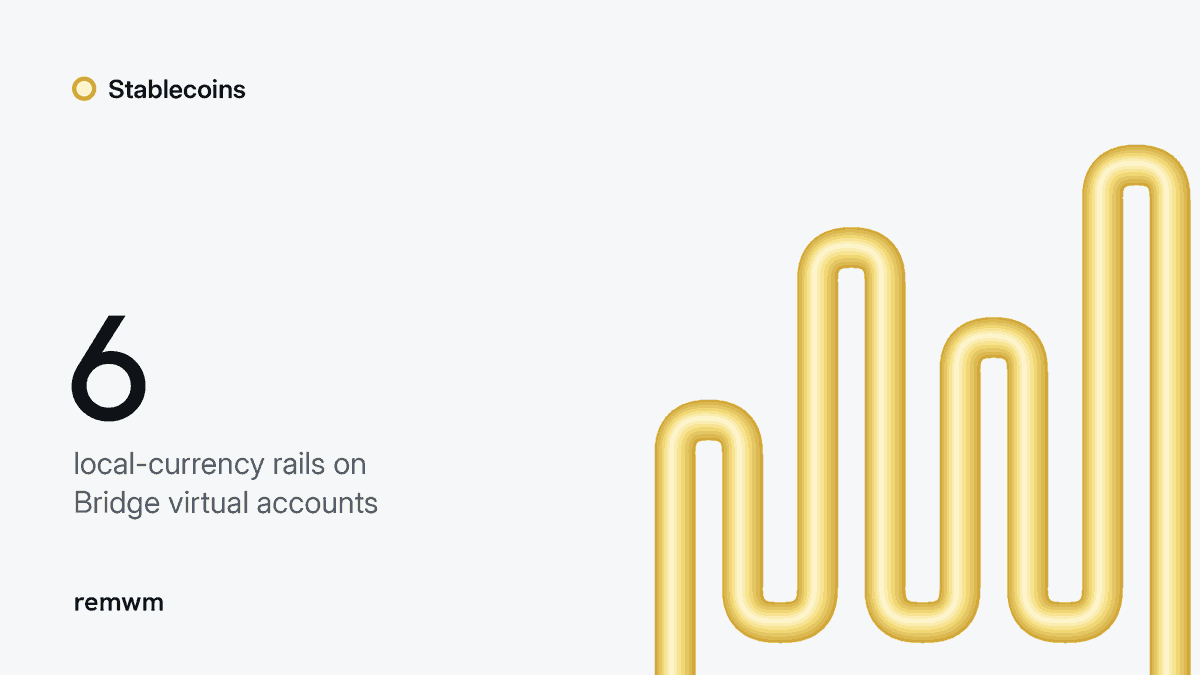
| Fiat rails named | USD (ACH, wire), EUR (SEPA), MXN (SPEI), BRL (PIX), GBP (FPS), COP (Bre-B) | Wire in the quickstart | Wire, ACH debit, ACH credit | Bank deposits and withdrawals | On: cards, Apple Pay, Google Pay, ACH (US). Off: ACH (US), PayPal in select countries |
| Standing route or per call | Both | Per call | Both | Both | Per session |
| Before you start | Customers must be KYC/KYB-approved | Mint account and API key | API credentials with scopes | Crypto destination addresses registered | Session token to start the widget |
| Fees in the docs | Developer fee, exchange fee and gas fee fields; no amounts on these pages | Not stated | Stablecoin swaps 1:1 with no slippage; other fees not stated | Not stated | Quote API before the transaction |
Two points about the table. Bridge’s gas fee “is usually 0 for most currencies and chains”, per its virtual accounts page. Coinbase’s products serve the end users of an app, while the other four are built for the business or its own customers to move money through a provider account.
Bridge: virtual accounts and liquidation addresses
Bridge stablecoin routes are tied to a customer object. A USD virtual account “gives your customer a U.S. account and routing number for ACH or wire transfers”, and EUR accounts come with IBANs in the customer’s name. The destination is a wallet on a chosen chain. For memo-based chains such as Stellar, an optional blockchain_memo travels with each payment.
A liquidation address works the other way. Bridge does not allow a second liquidation address for the same customer with the same source chain, source currency and destination; that request “will fail with an API error”. Virtual account events carry an amount and a subtotal_amount, which is what arrived minus the developer fee and exchange fee.
Circle Mint: mint and redeem by wire
Circle Mint is the route for a business that holds its own USDC with Circle. The quickstart has five steps: link a wire bank account, read Circle’s wire instructions, send a wire carrying the tracking reference to mint USDC, transfer USDC onchain, then redeem with a payout to the same bank account. The sandbox uses a mock bank account and a mock wire, so a team can test the full cycle without moving real money.
Brale: transfers and automations
Brale stablecoin issuance docs treat every movement as a transfer with a source and a destination. Each side names a value_type (USD, USDC, USDT, MXN or the business’s own token) and a transfer_type (wire, ACH credit, or a chain such as Polygon or Solana). ACH debits come from Plaid-linked bank accounts. For outbound wires, the transfer’s payment details include the IMAD, the Fedwire reference assigned by the sending bank. Every request needs an Idempotency-Key, so a retried call does not move funds twice.
Paxos: orchestrations
Paxos stablecoin issuance docs describe orchestrations as multi-step workflows “to move between assets, networks, and rails”. Rule-based orchestrations start from an external fiat or crypto deposit; ad-hoc orchestrations start from one of the customer’s profiles. Any route can convert between assets on the way. Before sending crypto out, the destination address must be registered, which Paxos says “is required for travel rule compliance and address approval”. Paxos recommends webhooks over polling for status.
Coinbase: ramps for an app’s end users
Coinbase Onramp and Offramp share session tokens, webhooks and transaction APIs. Onramp can be Coinbase-hosted or headless with embedded Apple Pay or Google Pay; Offramp is Coinbase-hosted only. The Offramp API set includes config (countries and payment methods), options (currencies and assets), quote and transaction status endpoints. This fits a wallet or app whose users buy or sell crypto, not a company moving its own treasury.
How to choose
- Moving your own company’s money: Circle Mint, Brale transfers or Paxos ad-hoc orchestrations. Each call is one movement you start.
- Giving each customer standing routes: Bridge virtual accounts and liquidation addresses, Brale automations, or Paxos rule-based orchestrations. Customers pay in or send tokens without your system starting each movement.
- Letting app users buy and sell: Coinbase Onramp and Offramp, with Coinbase running the hosted flow.
The bank-details half of a ramp works like the virtual accounts that banks and BaaS platforms issue: one account number per customer, so each payment matches itself. A brand that wants its own token instead of USDC is in white label stablecoin.