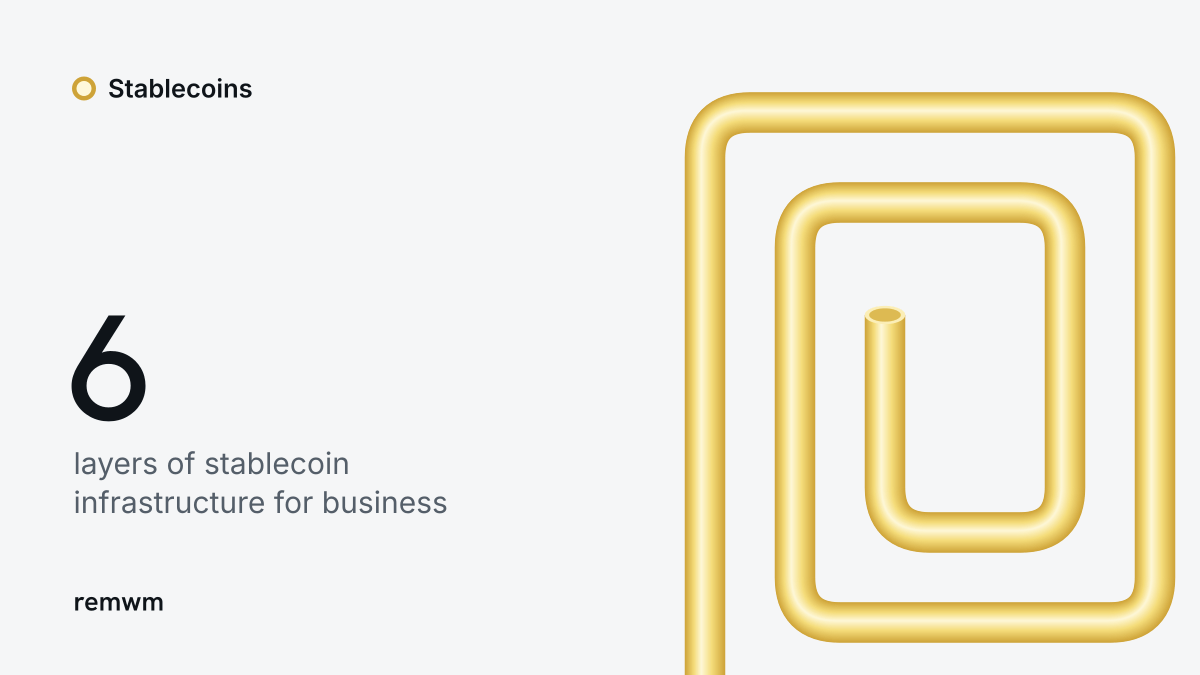
Stablecoin infrastructure is the set of services a business needs to issue, hold, move and settle dollar-backed tokens. It has six layers: issuers that mint and redeem tokens, issuance-as-a-service for branded coins, custody and wallets, on- and off-ramps to bank accounts, orchestration APIs that route payments, and settlement with card networks and banks. In the US, the GENIUS Act, signed July 18, 2025, sets the legal frame. Most of its rules are still proposals.
What counts as a payment stablecoin
The GENIUS Act defines a payment stablecoin as a digital asset used, or designed to be used, as a means of payment or settlement. Its issuer must convert or redeem it for a fixed amount of money and keeps, or creates the expectation of keeping, a stable value. That is how Treasury restates the definition in its August 2026 proposal. In practice, the token lives on a blockchain, and a pool of cash and short-term Treasury bills backs it.
A business rarely builds all of this itself. It buys each layer from a provider, or buys several layers from one.
The layers and example providers
| Layer | What it does | Examples, per their own documentation |
|---|---|---|
| Issuer | Mints tokens against reserves and redeems them 1:1 | Circle (USDC, through Circle Mint); Paxos (PYUSD, USDG) |
| Issuance-as-a-service | Issues a token under another company’s brand | Paxos white-label; Bridge Open Issuance |
| Custody and wallets | Holds keys and signs transactions | Circle Wallets; Coinbase Business (custodial accounts) |
| On- and off-ramps | Converts bank money into tokens and back | Bridge virtual accounts; Zero Hash on and off ramp |
| Orchestration | One API to move value between fiat and stablecoin formats | Bridge Transfers; BVNK; Zero Hash |
| Settlement | Networks and banks settle obligations in tokens | Visa USDC settlement with Cross River Bank and Lead Bank |
Issuers
The issuer holds the reserves and owes the holder a dollar per token. Circle Mint lets institutional customers mint and redeem USDC directly; Circle says USDC redeems 1:1 for U.S. dollars. Circle’s license page, updated September 8, 2026, lists First National Digital Currency Bank, N.A., operating as Circle National Trust, as a national trust bank chartered by the OCC. Paxos describes itself as the issuer behind PYUSD, PAXG and USDG and as an OCC-regulated national trust bank.
Issuance-as-a-service
Here a company puts its own name on a token, and a regulated partner issues it. Paxos says it issues “white label and partner assets only” and that PYUSD, PayPal’s stablecoin, runs this way. Bridge’s Open Issuance offers open-loop tokens, closed-loop tokens used only inside one platform, and an off-the-shelf token, USDB. Bridge says it invests reserves in cash and Treasuries through BlackRock, Fidelity and Superstate and shares treasury earnings with the brand. The question that matters under the new law is who the legal issuer is.
Custody and wallets
Custody means holding the private keys that control tokens. Circle Wallets offers developer-controlled, user-controlled and modular wallets; Circle secures keys with MPC (multi-party computation, which splits a key into shares) or passkeys. Coinbase Business holds merchant balances in custodial accounts. The Federal Reserve’s September 24, 2026 proposal would add rules for Fed-supervised firms that safekeep the assets backing stablecoins.
On- and off-ramps
An on-ramp turns bank money into tokens; an off-ramp does the reverse. Bridge virtual accounts give a customer bank details in USD, EUR, MXN, BRL, GBP or COP and convert incoming fiat into crypto. Customers must pass KYC or KYB (identity checks for people and businesses) first. Zero Hash’s off-ramp gives a customer a deposit address, quotes a rate and credits fiat; platforms can earn through spreads or explicit fees.
Orchestration
Orchestration is a single API that converts between two money formats where at least one side is a stablecoin. Bridge Transfers, for example, handle conversions such as USDC to EUR or USD to USDC. BVNK lists six capabilities in one integration: send, receive, store, convert, spend and earn. It says it works with businesses processing at least $500,000 a month. Zero Hash offers multichain stablecoin orchestration alongside its ramps. This is narrower than card-side routing; for that, see our explainer on embedded payments.
Settlement
Settlement is how banks and networks pay each other at the end of the day. On December 16, 2025, Visa said U.S. issuer and acquirer partners could settle VisaNet obligations in USDC. Cross River Bank and Lead Bank were the first, over the Solana blockchain, with broader access planned through 2026. Visa put its stablecoin settlement at more than a $3.5 billion annualized run rate as of November 30, 2025. The same day, Cross River said it was launching the capability with Highnote, a card issuing and acquiring platform.
For the merchant side of the stack, see our guide to the stablecoin payment gateway. All pieces in this section are listed under stablecoin infrastructure guides.
The US legal frame: the GENIUS Act
The GENIUS Act became Public Law 119-27 on July 18, 2025. It takes effect on January 18, 2027, or 120 days after the federal regulators issue final implementing rules, if that comes first. From then, only a permitted payment stablecoin issuer may issue a payment stablecoin in the United States. From July 18, 2028, digital asset service providers generally may not offer or sell payment stablecoins to people in the United States unless a licensed issuer issued them.
| Agency | Proposal | Comments due |
|---|---|---|
| FDIC | Application procedures, 90 FR 59409 (December 19, 2025) | Closed |
| NCUA | Issuer applications (February 11, 2026); supplemental issuance rule (May 18, 2026) | April 13 and July 17, 2026 |
| OCC | Issuance rule, Bulletin 2026-3 (February 25, 2026) | May 1, 2026 |
| FDIC | Requirements for FDIC-supervised issuers and tokenized deposits (April 10, 2026) | June 9, 2026 |
| FinCEN and OFAC | AML and sanctions programs for issuers | June 9, 2026 |
| FinCEN with OCC, Fed, FDIC, NCUA | Customer identification programs (June 22, 2026) | August 21, 2026 |
| Treasury | Issuance, offer and sale in the U.S. (August 17, 2026) | October 19, 2026 |
| Federal Reserve | Reserves, capital, custody and applications (September 24, 2026) | 60 days after Federal Register publication |
Treasury’s August proposal builds on an advance notice it issued in September 2025. The documents above are proposals. We did not find a final implementing rule from these agencies as of September 24, 2026.
Bank charters that touch stablecoins
Some issuers now hold federal charters. Circle and Paxos both list OCC national trust banks, as noted above. On September 2, 2026, the OCC granted preliminary conditional approval to OpenReserve Bank, N.A. in Salt Lake City (Corporate Decision 1389). The bank plans a wholly owned subsidiary to issue, custody, convert and pay U.S. dollar reserve-backed stablecoins. That subsidiary’s application had not been filed. The OCC requires the bank to conform its activities to the GENIUS Act. Our news item on the OCC conditional charters for Revolut and OpenReserve has the capital terms.
Questions to ask a provider
- Who is the legal issuer of the token, and under which charter or license will it issue once the GENIUS Act takes effect?
- What assets back the reserves, where are they held, and who attests to them and how often?
- Which legal entity holds the money transmitter licenses for the fiat legs, and what is its NMLS ID?
- Who controls the keys: your company, the provider or a third-party custodian?
- Which tokens and blockchains are supported, and what happens if a customer sends the wrong token or network?
- What are the redemption terms, cut-off times and weekend hours?
- Are there volume minimums, and are fees published or quoted?
- How will the product change when final rules replace the proposals?