Stablecoin payouts let a marketplace or platform pay sellers, contractors and creators in a dollar-pegged token, usually USDC, instead of a bank transfer. The platform funds the payout in dollars or stablecoins, a provider converts and sends the tokens to the recipient’s crypto wallet, and the recipient either holds them or cashes out to local currency. Stripe, Circle, BVNK and Coinbase Business all publish docs for this flow, and their coverage differs a lot.
How a stablecoin payout moves
Most providers follow the same four steps. The details change from one provider to the next.
- The platform funds the payout. Some providers let the platform stay in fiat money. Stripe’s Connect docs say “your platform balance stays in fiat currency, while Stripe handles conversion and payout.” BVNK’s platform guide works the same way: you hold a fiat wallet, and BVNK converts to the stablecoin when you create the payout. Circle’s self-managed Stablecoin Payouts product expects the platform to hold USDC or EURC in a Circle Mint wallet already.
- The provider converts and screens. The provider exchanges fiat for the token, checks the destination address, and attaches compliance data. Circle calls its recipient list the Address Book. Every recipient must be registered in the Address Book and reach active status before a payout.
- The tokens settle onchain. The payout lands in a wallet on a specific blockchain (a shared ledger such as Ethereum, Solana or Base). If the recipient’s wallet is on a different chain, the funds can be lost. Circle’s docs warn, for deposits, that sending on the wrong blockchain “results in permanent loss.”
- The recipient holds or cashes out. The recipient can keep USDC, send it on, or sell it for local currency through an exchange or a payout partner. That last step is called an off-ramp. Circle Payments Network (CPN) also has a separate product that delivers local fiat to a bank account, with USDC used only for settlement in the middle.
This is the payout side of stablecoin infrastructure. Accepting stablecoins from buyers is covered in stablecoin payment gateway and accept stablecoin payments b2b.
What each provider publishes
The table uses only the providers’ own docs and pricing pages, checked September 29, 2026. “Not published” means the provider’s pages do not state it.
| Stripe (Connect stablecoin payouts) | Circle (Stablecoin Payouts, CPN) | BVNK (stablecoin payments for platforms) | Coinbase Business (global payouts) | |
|---|---|---|---|---|
| Status | Private preview, US platforms only | Needs activation on a Circle Mint account | Available via API or a hosted payments page | Available to US and Singapore C corps and LLCs |
| Platform funds in | Fiat balance; USD transfers convert automatically | USDC or EURC held in a Mint wallet | Fiat wallet, or a stablecoin wallet for crypto-to-crypto | Platform balance or connected bank account |
| Tokens paid | USDC (“starting with USDC”) | USDC or EURC | USDC, USDT, EURC, PYUSD, USDG (varies by customer region) | USDC |
| Chains | Not listed on the Connect page; Stripe’s stablecoin docs name Ethereum, Solana and Tempo among supported networks | Chains on Circle’s supported list, including Ethereum, Base, Solana, Polygon PoS and XRPL | USDC on Arbitrum, Base, BNB Chain, Ethereum, Polygon, Solana (plus Arc for some regions, Stellar for US customers) | Not published for payouts; Base named as a network with no recipient gas fees |
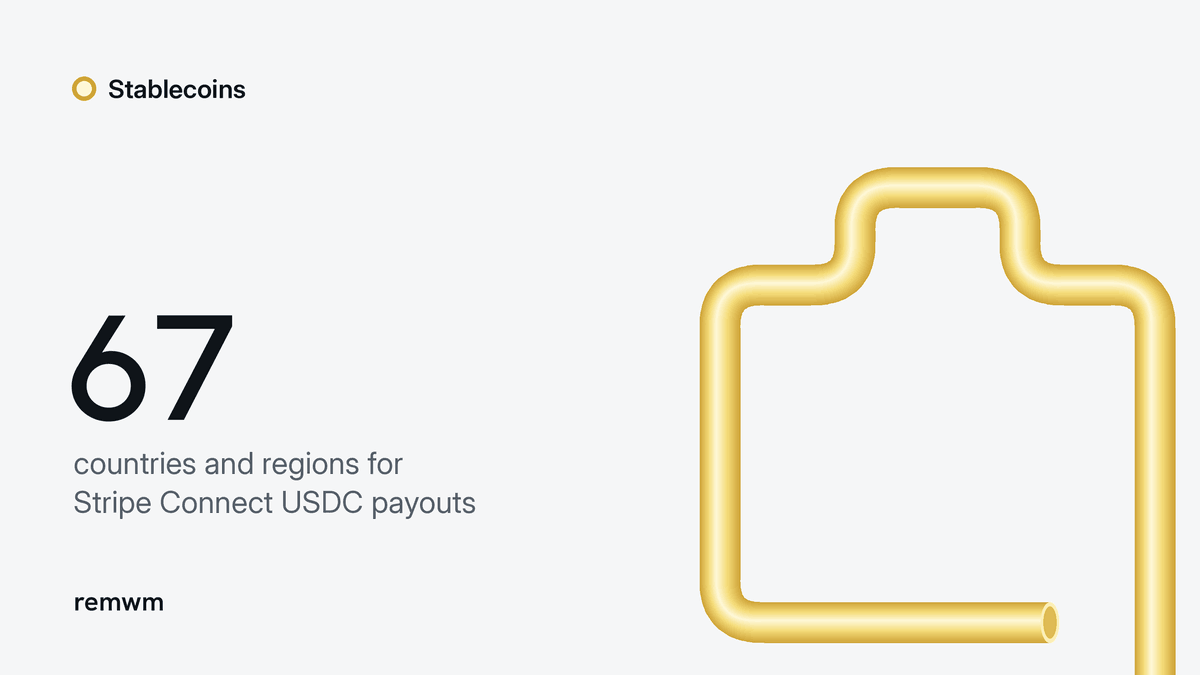
| Recipient countries | 67 countries and regions, excluding New York and Hawaii in the US | Not published as a list for wallet payouts | Not published as a list for wallet payouts | Not published; pays any onchain address or email |
| Recipient type | Individuals and sole proprietors only | Third-party wallets the platform does not own | Beneficiaries identified in each payout request | Vendors, contractors, partners |
| Payout fee | Not published | Not published (the API returns fees and networkFees per payout) | Not published (fees shown in a quote before payout) | Not published |
| Licensed entity named | Bridge custodies USDC in Stripe stablecoin balances | Circle LLC (US), Circle Singapore, Circle SAS (France) | UK and Malta e-money institutions; US money transmitter licenses | Not stated on the payouts pages |
Two points about the table. Stripe’s pricing page lists a fee for accepting stablecoin payments, but that covers pay-ins, not payouts. Coinbase says it “charges a fee on each completed payment,” and customers see the rate inside their account.
Stripe: USDC for Connect recipients
Stripe’s version runs on Stripe Connect. A platform asks for private-preview access, completes a due diligence questionnaire, and then turns on the feature. Recipients link a crypto wallet in the Express Dashboard, Stripe’s hosted account page for connected accounts. The recipient then gets a USDC balance that “works like any other local currency balance.” Transfers the platform sends in USD convert to the recipient’s chosen currency.
The limits are strict. Only US platforms can send. Recipients must be individuals or sole proprietors, and “payouts to companies and non-profits aren’t supported yet.” Platforms must use the Transfers API. The country list includes the US, Mexico, Colombia, the Philippines, Kenya, South Africa and much of Europe, but not New York or Hawaii.
Circle: wallet payouts and fiat delivery
Circle offers two payout products inside Circle Payments Network. Stablecoin Payouts sends USDC or EURC to a registered third-party wallet. It is booked through Circle LLC in the US, Circle Singapore or Circle SAS in France. For US payouts, the Travel Rule applies at $3,000 or more. The Travel Rule requires originator identity data to travel with the transfer. For the Singapore and France entities, every payout needs beneficiary identity, wallet ownership data and a payment reason code. Self-hosted wallets are “not yet supported” on those two flows.
Fiat Payouts is built for financial institutions. An originating financial institution sends USDC through CPN, and a beneficiary financial institution pays local currency into the receiver’s bank account. The routes API lists 38 destination countries and 10 destination currencies, including BRL, MXN, INR, NGN and EUR. Payment rails include PIX, SPEI, SEPA and IMPS. Circle’s product page claims “local fiat payouts in 60+ countries and USD payouts in 180+ countries.” The docs call the API response “the source of truth” for live coverage.
BVNK: fiat in, stablecoin out
BVNK’s platform guide describes a fiat wallet that funds each payout. BVNK “automatically converts your fiat currency to the requested stablecoin” and sends it to the beneficiary’s wallet. The docs name gaming platforms, brokers, neobanks and payment service providers as target users. A payout request carries beneficiary details such as name, date of birth and country. An estimate endpoint returns rates, fees and network costs before any funds move.
Token lists depend on the customer’s region. BVNK’s currencies page also lists US states outside its money transmitter coverage: CA, GA, HI, LA, MA, MT, NJ, NY, TX, VA, WA and WI. Businesses domiciled there get a reduced token set. BVNK’s help center names System Pay Services Limited (FCA reference 901057) and System Pay Services (Malta) Limited as its e-money entities.
Coinbase Business: payouts by address or email
Coinbase launched global payouts in Coinbase Business on October 16, 2025. Businesses send USDC to “any onchain address or email address.” A recipient without a wallet can claim the funds by opening a free Coinbase account and “cash out in their local market.” A Payouts API supports on-demand, batch and scheduled payouts. Coinbase’s help center says the product is open to C corporations and LLCs in the US and Singapore. It verifies the business and each owner of 25% or more.
Recipient KYC: who verifies whom
Recipient verification is split differently at each provider. In Stripe’s model, recipients are connected accounts, so they go through Connect onboarding. At Circle, the platform supplies originator data and, outside the US, beneficiary data. BVNK requests beneficiary party details on each payout. At Coinbase, a recipient who claims by email opens their own Coinbase account. For bank-based payouts to sellers, see marketplace payouts.
US rules in brief
The GENIUS Act, the federal law for payment stablecoins, was enacted on July 18, 2025. Treasury’s August 18, 2026 proposed rule says the law’s effective date “is expected to be January 18, 2027,” 18 months after enactment. Under section 3(b)(1), from July 18, 2028, a digital asset service provider may not offer or sell a payment stablecoin to a person in the US unless a permitted issuer issued it. Treasury’s proposal is open for comment until October 19, 2026. More on the proposal: treasury stablecoin issuance rule.
On tax reporting, Form 1099-DA is filed by brokers, not by the platform that pays. It matters when a US recipient later sells USDC through a broker. IRS instructions let brokers use an optional method for qualifying stablecoins. Under that method, a broker does not report designated sales if the customer’s yearly gross proceeds stay at or below $10,000.