Stablecoin issuers make money mainly from the liquid assets held behind their tokens. When a dollar-backed issuer keeps reserves in Treasury bills, overnight repo, government money market funds or bank deposits, those assets can produce interest. The token holder still has a claim for one dollar, while the issuer keeps the reserve return after partner payments and operating costs.
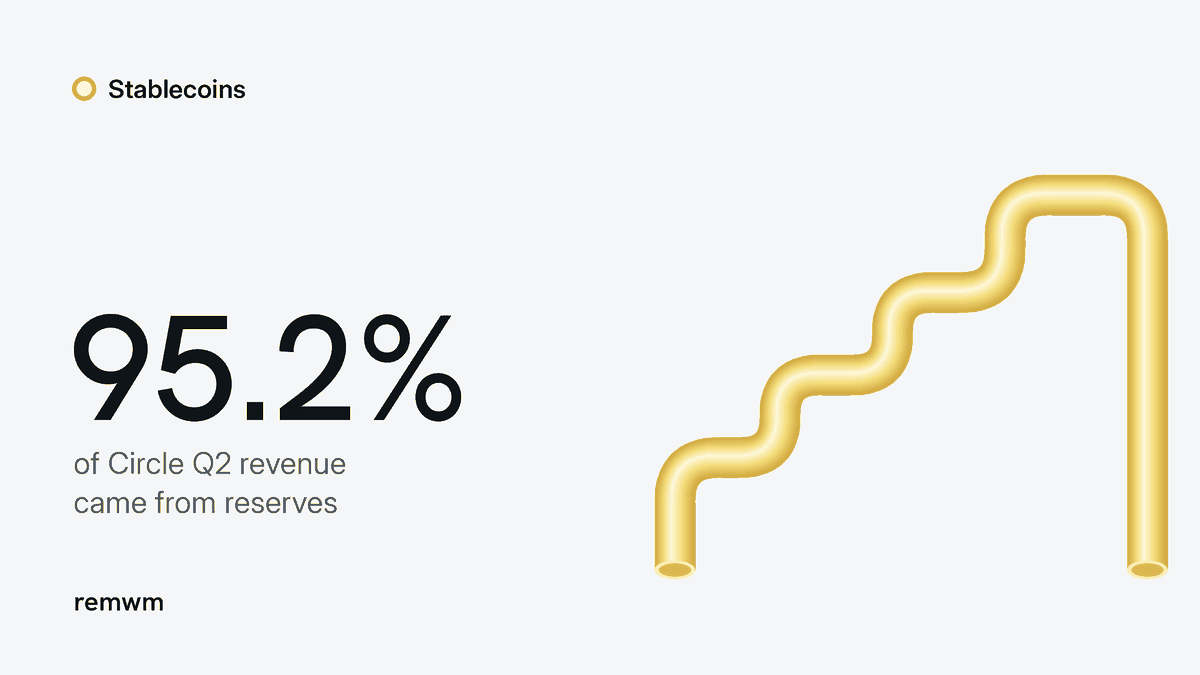
Circle’s public filings show the model at scale. Reserve income supplied 95.2% of its total revenue in the second quarter of 2026. The GENIUS Act now narrows which assets a permitted US payment stablecoin issuer may hold and requires at least one-to-one backing. Those rules make reserve economics easier to map, but they do not make every issuer equally profitable.
The basic stablecoin issuer economics
The simplified calculation is:
Average stablecoins in circulation × reserve return rate = gross reserve income
An issuer with more tokens outstanding holds more reserve assets. A higher market interest rate can lift the return on short-duration reserves. Falling rates can reduce it even if circulation keeps growing.
Circle describes the same two drivers in its June 2026 Form 10-Q: stablecoins in circulation and the reserve return rate. The filing says its reserve assets earned rates close to the prevailing Secured Overnight Financing Rate (SOFR) during the periods reported.
Gross reserve income is not the same as profit. An issuer may pay distribution partners, custody providers, banks, auditors, compliance teams, blockchain costs and staff. It must also stay ready to meet redemptions.
What Circle’s numbers show
Circle is one public example, not a template for every stablecoin company.
For the three months ended June 30, 2026, Circle reported:
| Metric | Q2 2026 |
|---|---|
| Reserve income | $668 million |
| Other revenue | $34 million |
| Total revenue and reserve income | $701 million |
| Distribution, transaction and other costs | $412 million |
| Revenue less those costs | $289 million |
The totals do not add exactly because Circle rounds the figures. Its 10-Q says reserve income was 95.2% of total revenue for the quarter.
Circle also disclosed how much of the economics goes to distribution. In the first half of 2026, it generated about $1.4 billion in revenue and paid about $819 million to USDC distribution partners and transaction costs. The company described that as roughly 59 cents of every revenue dollar.
Those partners include platforms that put USDC in front of users. Circle says a partner that brings and grows USDC balances can receive a share of the reserve income associated with those balances. The arrangement can increase circulation, but it also means the issuer does not keep the full reserve return.
The four revenue buckets
1. Reserve income
This is the main bucket for a fiat-backed issuer such as Circle. The issuer holds eligible reserve assets while tokens remain in circulation. Interest accrues on those assets, subject to their yield and maturity.
US law requires at least one-to-one reserves for a permitted payment stablecoin issuer. Section 5903 of Title 12 lists cash, Federal Reserve balances, demand deposits, Treasury securities with no more than 93 days remaining, certain overnight repo and reverse repo, qualifying government money market funds and approved similarly liquid federal assets. The law also limits pledging and reuse of reserves.
That matters for the business model. The issuer can earn a short-term return, but it cannot chase any asset or maturity it wants.
2. Platform and service revenue
An issuer may sell services around the token: accounts, wallet infrastructure, transfers, cross-chain movement, settlement tools or access to payment networks. Circle reports these activities as other revenue. In Q2 2026, they represented $34 million, or 4.8% of the company’s total.
Service revenue can make the business less dependent on interest rates. It can also create a second reason for customers to stay with the issuer after the token itself becomes a commodity.
3. Issuance and infrastructure fees
White label and infrastructure providers may charge brands for issuing, managing or moving a stablecoin. The fee can be a fixed platform charge, a transaction fee, a share of reserve economics or a negotiated combination.
Public pricing is often incomplete. A buyer should ask which entity receives the reserve income, which fees are charged on minting or redemption, and whether distribution rewards change when rates fall. Our guide to white label stablecoins explains who carries the legal issuance obligation.
4. Distribution economics
Distribution can be an expense for the issuer and revenue for a partner. An exchange, wallet, bank or fintech may receive a share of reserve income for the balances it attracts and retains.
This is why the headline yield on reserve assets does not equal the issuer’s margin. Circle’s public figures show distribution costs can absorb a large part of revenue before operating expenses.
What the GENIUS Act changes
The GENIUS Act separates the reserve pool from the issuer’s general business.
- Reserves must cover outstanding payment stablecoins on at least a one-to-one basis.
- Eligible assets are limited to liquid categories set by law and regulator rules.
- Reserves generally cannot be pledged, rehypothecated or reused.
- A permitted issuer must publish reserve information and follow redemption requirements.
- Only a permitted payment stablecoin issuer may issue in the United States, subject to the law’s transition provisions.
The result is a narrower balance-sheet model than a bank. A stablecoin issuer is not free to lend the reserve dollars into a long-duration loan book. The core economics come from liquid reserves, services and distribution arrangements.
The Federal Reserve’s September 2026 proposal adds detail for issuers it would supervise, including reserve valuation, capital, reporting and redemption rules. It is still a proposal, so a launch model should be tested against final rules when issued.
A simple sensitivity check
Before relying on reserve income, model at least four variables:
- Average circulation. Use average balances, not the end-of-period number.
- Reserve return. Apply the expected yield to each permitted asset category.
- Partner share. Subtract distribution payments tied to balances.
- Operating and compliance costs. Include custody, attestations, licensing, risk, engineering and redemption liquidity.
Run the model with lower rates and lower circulation at the same time. That scenario shows whether service revenue can carry the platform when reserve income contracts.
For the operating stack behind the balance sheet, see stablecoin infrastructure. For converting bank money into tokens and back, see stablecoin on and off ramp APIs.