What is core banking? It is the system of record that keeps a bank’s accounts: the general ledger, deposit and loan balances, transaction posting, interest and statements. Every card payment, ACH transfer and fee ends up there. In the US, most banks and credit unions run a core system licensed or outsourced from a few large vendors, while newer cloud cores and fintech ledgers sit beside them.
What a core banking system does
A core banking system is the software that holds the bank’s official record of customer accounts. FIS describes its core applications as the systems clients “use to maintain the primary records of their customer accounts.” Jack Henry’s annual report says its cores process “deposit, loan, and general ledger transactions, and maintain centralized accountholder information.”
| Function | What it means in practice |
|---|---|
| Ledger | The general ledger and account sub-ledgers that record every debit and credit |
| Accounts | Opening, updating and closing checking, savings, CDs and loans |
| Posting | Applying card, ACH, wire, check and internal transactions to balances |
| Interest and fees | Accruing interest on deposits and loans and charging fees on schedule |
| Statements and notices | Producing statements, tax forms and required disclosures |
| Customer file | The central information file that ties a person or business to all its accounts |
Around the core sit other systems: digital banking, card processing, loan origination, fraud tools and payment gateways. Most of them read from or write to the core. That is why a core banking solution is hard to replace.
Core banking providers in the US
Three public companies describe large core businesses in their SEC filings.
| Provider | Core systems named in filings | What the filing says about clients |
|---|---|---|
| Fiserv | DNA, Finxact, Premier, CoreAdvance, Portico, Signature | Account processing for banks and credit unions, offered mainly as an outsourced service or installed on client systems; 2025 total revenue $21.2 billion |
| FIS | Core processing software for deposits, lending and customer management | Banking segment clients include global banks, US regional and community banks and credit unions; 2025 Banking Solutions revenue $7.285 billion |
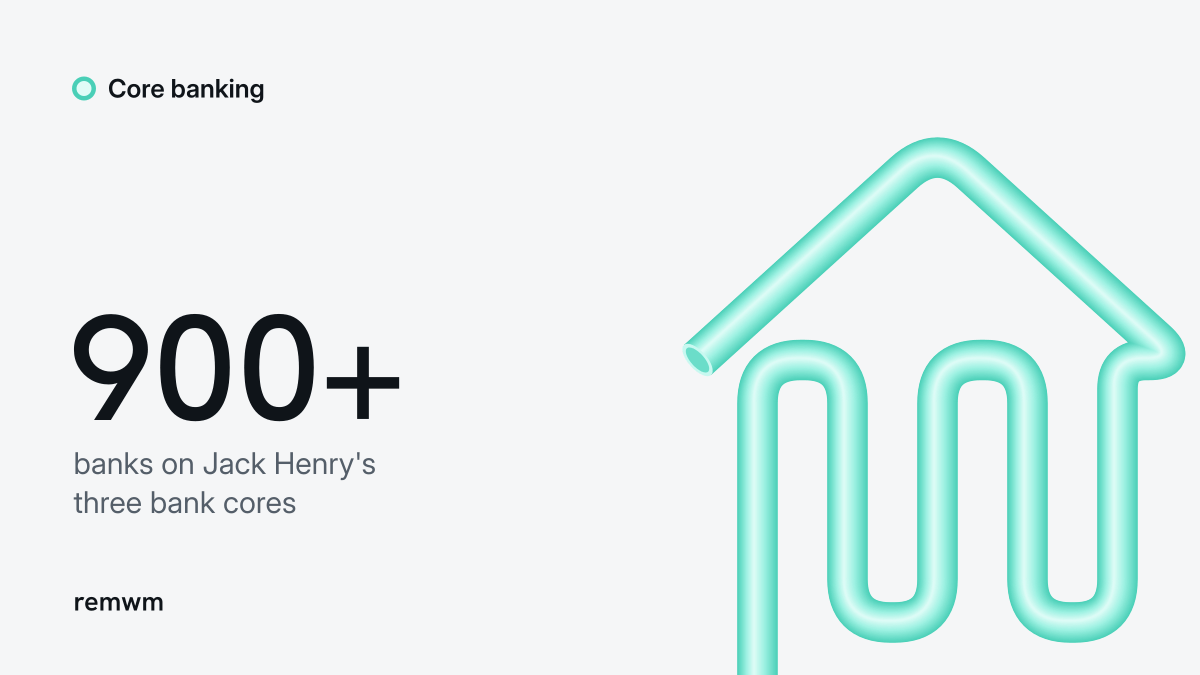
| Jack Henry | SilverLake, CIF 20/20, Core Director for banks; Symitar for credit unions | Over 900 banks on its three bank cores and over 700 credit unions on Symitar, per its fiscal 2026 annual report |
Jack Henry adds detail. SilverLake is in use by over 500 banks, serving banks with up to $55 billion in assets. Its cores run on-premise or in Jack Henry’s private cloud. Fiserv says CoreAdvance is its newest account processing solution, with real-time processing.
Cloud cores and what is not a core
Newer core banking providers build for the public cloud and expose every function through APIs. An API, or application programming interface, is a defined way for one program to request data or actions from another.
- Thought Machine sells Vault Core, which it describes as a cloud-native core that runs retail, SME and corporate banking on one ledger. Banks define products with programmable “smart contracts.”
- Mambu describes a cloud-native, composable core with engines for lending, deposits and payments, sold as SaaS.
- Temenos sells Temenos Core, available as SaaS, on cloud or on-premise, and says it first put core banking in the cloud in 2011.
- Finxact is now part of Fiserv. Fiserv completed the purchase on April 1, 2022, for about $645 million net of acquired cash, according to its quarterly filing. Fiserv’s 2025 annual report lists Finxact among its account processing solutions.
nCino is often grouped with cores, but its own 10-K describes loan origination, onboarding and account opening software built on Salesforce. Its integration layer “connects core banking systems” rather than replacing them. It had over 2,700 customers at the end of fiscal 2026. See the nCino profile.
Sidecar cores for fintech programs
A fintech program often needs thousands of sub-accounts inside one bank account at a sponsor bank. Legacy cores may not handle that well. A sidecar core, also called a supplemental core, keeps those sub-ledgers and syncs totals with the bank’s main core.
- Treasury Prime sells banks a Virtual Ledger, which it calls a supplemental core with virtual sub-ledgers, as part of its Bank OS.
- Increase sells its core to banks for sponsor banking and runs its own bank, Increase Bank.
- Jack Henry’s Payments Orchestrator offers virtual accounts with real-time reconciliation and integrates directly with SilverLake, per its 10-K.
The choice of sidecar often follows the choice of bank. For that side of the decision, see how to choose a sponsor bank.
Core conversions
A core conversion is the move from one core system to another. The bank maps every account, product and parameter to the new system, runs test conversions, and then switches over on a set cutover date. Customers may get new statements, account formats or online banking logins.
Conversions are common enough that vendors report them. Jack Henry reported a record 58 competitive core wins in fiscal 2026, that is, institutions that picked its core over a competing vendor’s. Fiserv notes in its 10-K that support for client-owned devices helps “reduce a new client’s initial conversion expenses.”
For a fintech or a program manager, a sponsor bank’s conversion matters directly. APIs, file formats and posting times can change. It is worth asking a bank partner whether a conversion is planned and how programs will be moved.