A sponsor bank is a chartered bank that lets a non-bank company offer accounts, cards or payments under the bank’s license, card-network membership or ACH access. That is how sponsor banks work: the fintech or platform runs the product and the customer relationship, while the sponsor bank holds the regulated role and stays responsible to its regulators. The term covers three rails: deposits, card issuing and acquiring, and ACH.
What a sponsor bank does
The non-bank in these programs is not a bank and cannot join the card networks or the ACH Network on its own. A sponsor bank fills that gap. It opens the deposit accounts, issues the cards or signs the merchant contracts, and lets the non-bank build the product on top.
Regulators describe the arrangement from the bank’s side. In a joint statement of July 25, 2024, the Federal Reserve, FDIC and OCC said that in these deposit arrangements “a third party, rather than the bank, typically markets, distributes” the product to end users. The same statement says a bank’s use of third parties “does not diminish its responsibility” to operate safely and in line with the law. That responsibility is what “sponsor” means in practice.
Three rails, three meanings
The phrase changes meaning with the payment rail. The table sets the three side by side.
| Rail | What the bank sponsors | The non-bank’s role | Rule set that defines the roles |
|---|---|---|---|
| Deposits (BaaS) | Accounts held at the bank, often in a pooled FBO account | Program manager or brand that markets the account | Interagency guidance and the July 2024 joint statement |
| Card issuing | Cards issued on the bank’s BIN | Program manager running the card product | Card-network rules; see BIN sponsorship |
| Card acquiring | Merchant acceptance through the bank’s network membership | Payment facilitator, ISO or marketplace | Visa and Mastercard acceptance rules |
| ACH | Entries sent through the bank as the ODFI | Third-Party Sender transmitting for its clients | Nacha Operating Rules |
Deposits and banking as a service
In a banking-as-a-service program, the bank holds the deposits and the fintech runs the app. The money often sits in one custodial account at the bank. FDIC pass-through insurance then depends on the bank’s records naming each owner. Our guide on how to choose a sponsor bank covers the checks a fintech runs before signing.
Card acquiring
On the merchant side, the sponsor bank is the acquirer. Visa’s February 2024 guide to acceptance entities says a payment facilitator (PF) is a third-party agent that signs merchant agreements on behalf of an acquirer, or receives settlement from it on behalf of sponsored merchants. It also says “the acquirer remains responsible for the acts and obligations” of sellers and of every entity working between them and the acquirer.
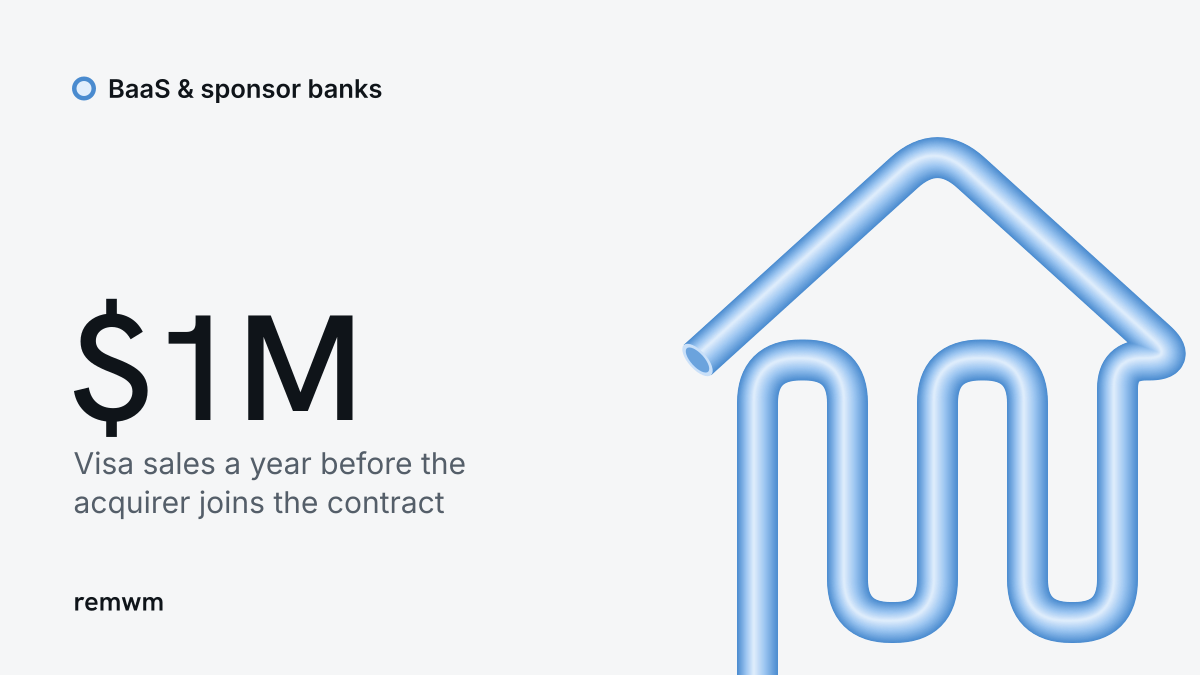
Visa sets a size line inside that model. Once a sponsored merchant’s annual Visa sales exceed US$1,000,000, the PF must add the acquirer to that merchant’s acceptance agreement. The PF can keep servicing the merchant. Our guide to embedded payments explains how platforms use this model.
ACH
On the ACH Network, the bank that sends entries is the Originating Depository Financial Institution (ODFI). Nacha defines a Third-Party Sender as a party that transmits entries for an Originator through an ODFI “without a direct agreement between the Originator and the ODFI”. Nacha’s rules require each Third-Party Sender to run its own risk assessment and annual rules compliance audit. The ODFI is still the bank answerable to the network for the entries it sends.
Sponsor bank vs acquiring bank
The two terms overlap. An acquiring bank contracts with merchants for card acceptance. It becomes a sponsor bank when it brings a non-member into the card networks under its own membership: a payment facilitator, an ISO or a marketplace. Federal Reserve Regulation II defines an acquirer as a person that contracts, directly or indirectly, with a merchant to provide settlement for its debit card transactions. A company that acts only as a processor is not an acquirer under that rule.
So every sponsor bank on the merchant side is an acquirer. Not every acquirer sponsors third parties. For the issuer side of the same transaction, see card issuing vs acquiring.
Sponsor bank examples
Consumer apps name their sponsor banks in their own disclosures.
- Chime. Its website states: “Chime is a financial technology company, not a bank. Banking services provided by The Bancorp Bank, N.A. or Stride Bank, N.A., Members FDIC.” The same banks issue the Chime Visa Debit Card. In September 2026 Chime agreed to buy Stride; see our report on the deal.
- Cash App. The Cash App Prepaid Card Program Agreement, last updated June 4, 2026, is an agreement between the cardholder and Sutton Bank. It says the Cash App Visa Prepaid Card is issued by the bank.
The sponsor banks directory lists the banks remwm tracks, with their regulators and announced partners.
What regulators expect from sponsor banks
Supervisors judge the bank, not the fintech. The 2023 Interagency Guidance on Third-Party Relationships sets the life cycle a bank follows: planning, due diligence, contract negotiation, ongoing monitoring and termination. On September 11, 2026 the agencies proposed replacing that guidance; comments are due November 16, 2026. Our news item covers the third-party risk guidance proposal.
When a program fails, the order lands on the bank. The sponsor bank enforcement actions tracker logs each public order, with its document number and whether it is still in force. Some orders bar new fintech partners without the regulator’s prior non-objection. The guide on how to read a consent order explains those clauses.