Card issuing vs acquiring is the split between the two banks in every card payment. The issuer gives the card to the cardholder, approves each purchase and bills or debits the account. The acquirer signs up the merchant and pays it for its card sales. The card network connects them, and the merchant side pays the issuer an interchange fee on each transaction.
Issuer, acquirer, network and processor
Four roles show up in every card payment. Federal Reserve Regulation II, the US debit card rule, gives legal definitions for most of them.
| Role | Works for | What it does | Regulation II definition |
|---|---|---|---|
| Issuer | The cardholder | Issues the card, authorizes each transaction, holds the account | “any person that authorizes the use of a debit card to perform an electronic debit transaction” |
| Acquirer | The merchant | Contracts with the merchant and settles its card sales | A person that “contracts directly or indirectly with a merchant to provide settlement” for its debit transactions |
| Payment card network | Both sides | Routes data between acquirer and issuer for authorization, clearance and settlement | An entity that provides the “services, infrastructure, and software that route information and data to an issuer from an acquirer” |
| Processor | Whoever hires it | Runs the systems for an issuer or an acquirer | Regulation II excludes a person “that acts only as a processor” from being an acquirer |
Visa and Mastercard are networks. A bank can be an issuer, an acquirer or both. A fintech is usually neither. It works under a bank’s role: as a program manager on the issuing side, or as a payment facilitator on the acquiring side.
How one card payment moves
- Authorization. The merchant’s acquirer sends the payment through the network to the issuer. The issuer approves or declines it.
- Clearing. The transaction details move from acquirer to issuer through the network.
- Settlement. The issuer pays the network, the network pays the acquirer, and the acquirer pays the merchant, less its fees.
- Disputes. If the cardholder disputes a charge, the issuer sends a chargeback back through the network to the acquirer, which passes it to the merchant.
Our guide to marketplace chargebacks shows how that last step reaches platforms and their sellers.
Who earns what
Interchange is the fee that pays the issuer. Regulation II defines it as a fee set by a payment card network and “paid by a merchant or an acquirer for the purpose of compensating an issuer”.
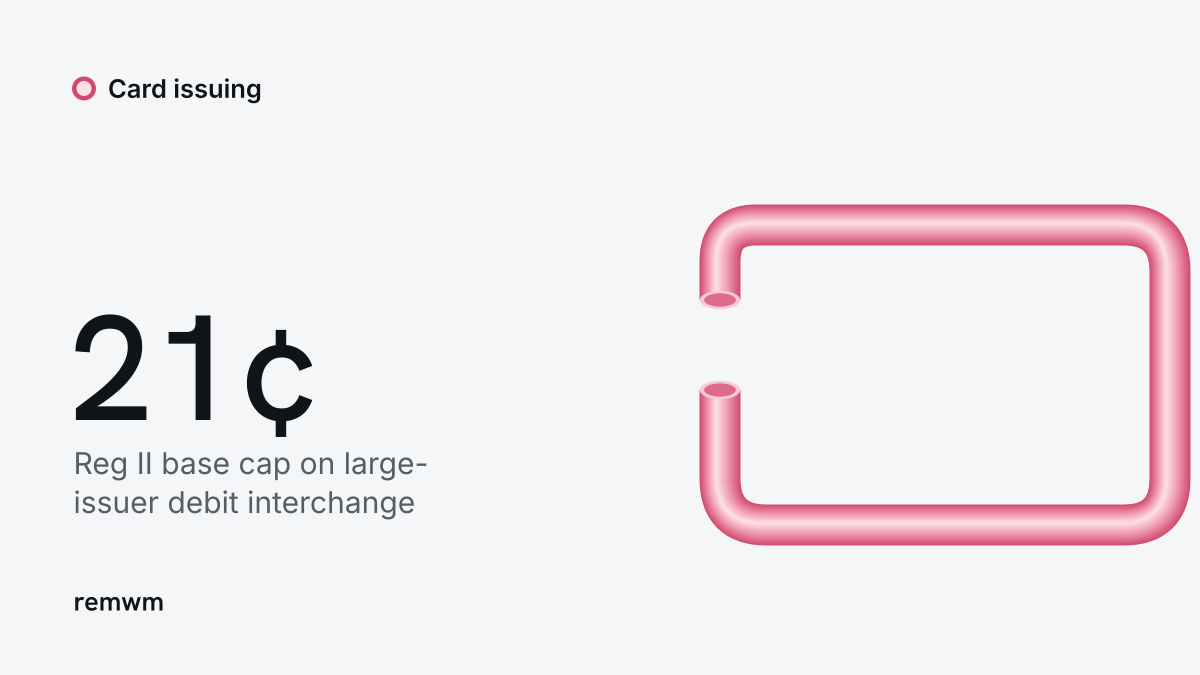
For debit cards in the US, the Federal Reserve caps interchange for large issuers. Under 12 CFR 235.3, the fee can be no more than 21 cents plus 5 basis points of the transaction value. An issuer that meets the Board’s fraud-prevention standards can add 1 cent. The cap applies to issuers with consolidated assets of $10 billion or more. Smaller issuers are exempt from the cap. Our debit card issuing guide covers what that means when a program picks its bank.
The Board proposed lowering the cap to 14.4 cents plus 4.0 basis points, with a 1.3-cent fraud adjustment, in a notice published November 14, 2023. On October 10, 2026 the current eCFR text still shows 21 cents and 5 basis points.
The acquirer earns the gap between what it charges the merchant and what it pays in interchange and network fees.
Card issuing vs acquiring at a glance
| Question | Card issuing | Card acquiring |
|---|---|---|
| Customer | Cardholder: a consumer or a business | Merchant: the seller |
| Main risk | Credit and fraud losses on the cardholder’s account | Merchant fraud, chargebacks and merchant failure |
| Revenue | Interchange, plus interest and fees on credit cards | Merchant discount fees |
| Non-bank way in | Program manager on a sponsor bank’s BIN | Payment facilitator, ISO or marketplace under an acquirer |
| Typical processor | Issuer processor, such as Marqeta, Lithic or Highnote | Acquiring processor or gateway |
| remwm guide | Card issuing platforms | Embedded payments |
Card issuer vs processor
A card issuer is the regulated party: it owns the cardholder relationship and the liability. An issuer processor is the vendor that runs the issuer’s card systems. It holds card records, answers authorization requests and produces the files for clearing and settlement. The bank stays the issuer when it outsources this work. A fintech building a card program usually picks both a bank and an issuer processor; see how to choose an issuer processor and BIN sponsorship.
Card issuer vs network
The network sets the rules and moves the data between acquirers and issuers. It does not hold the cardholder’s account. Regulation II draws the same line: the network routes information to the issuer, and the issuer is the party that authorizes use of the card.