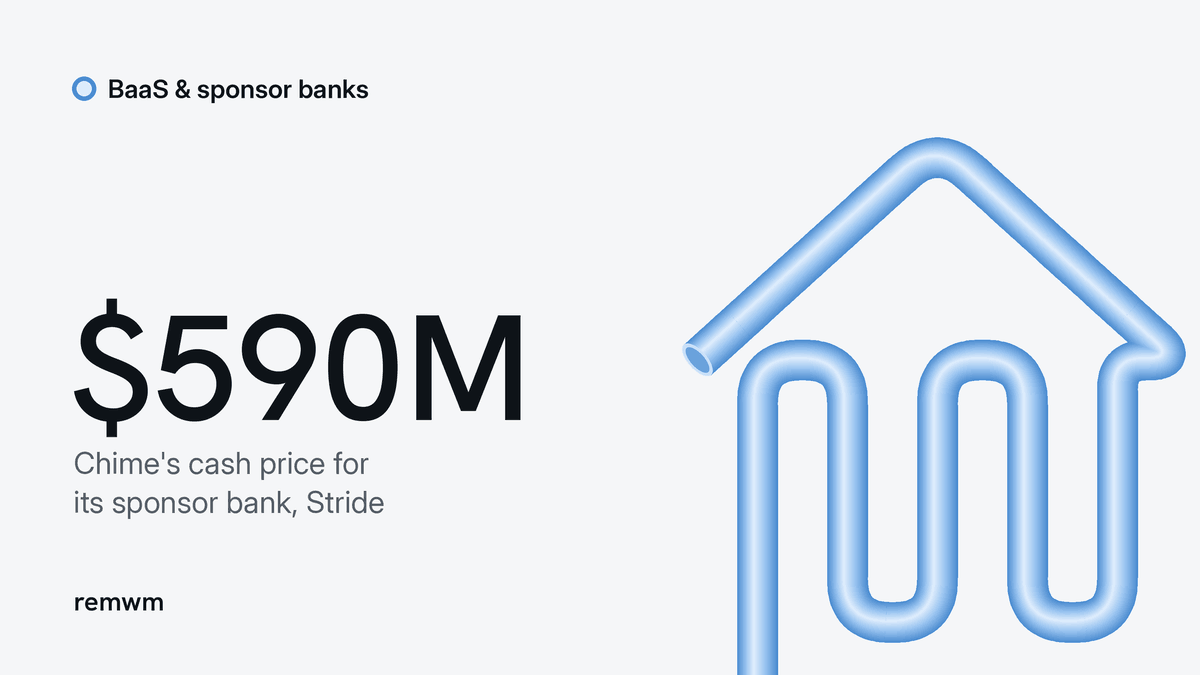
In the Chime Stride Bank acquisition, Chime Financial agreed on September 8, 2026 to buy Central Service Corporation, the parent of Stride Bank, N.A. of Enid, Oklahoma, for $590 million in cash, according to its Form 8-K. Stride has been Chime’s bank partner for more than seven years and would become Chime Bank, N.A. The deal needs approval from the OCC and the Federal Reserve; Chime expects it to close in the first half of 2027.
Deal terms
- Price: $590 million in cash, subject to purchase-price adjustments; about 1.5 times Stride’s tangible book value. Chime says it will fund the deal from balance-sheet cash with no additional capital contribution expected.
- Approvals: the OCC and the Board of Governors of the Federal Reserve System. Central Service Corporation’s shareholders have already approved, per the 8-K.
- Timing: closing expected in the first half of 2027. The merger agreement says closing will not occur before January 1, 2027 unless the parties agree otherwise.
- Size: Chime says it will keep assets below $10 billion “for the foreseeable future,” and Stride will focus mainly on supporting Chime’s consumer business.
- Current banks: at announcement, Chime disclosed that member deposits are FDIC-insured through The Bancorp Bank, N.A. or Stride Bank, N.A.
Why Chime says it is buying a bank
Chime says the deal gives it “a faster and more proven path to full-stack ownership versus pursuing a de novo bank charter.” It expects more than $100 million in net synergies “driven by sponsor bank fee savings, expansion of lending products, and a significantly lower cost of funds,” and says owning the bank “will eliminate partner-bank fees, reduce funding cost, and improve unit economics.”
“Our member-aligned, technology-driven strategy will remain the same,” said Chris Britt, Chime’s CEO and co-founder. Brud Baker, chairman and CEO of Stride Bank, said “Stride’s national bank charter and experienced team will be central to what comes next.”
What it means for the sponsor bank model
The deal is one route from a partner-bank model to an owned charter; another is a new charter, which Revolut is pursuing after its OCC conditional approval on September 2. For how fintechs work with banks they do not own, see embedded finance vs banking as a service and our sponsor banks directory.