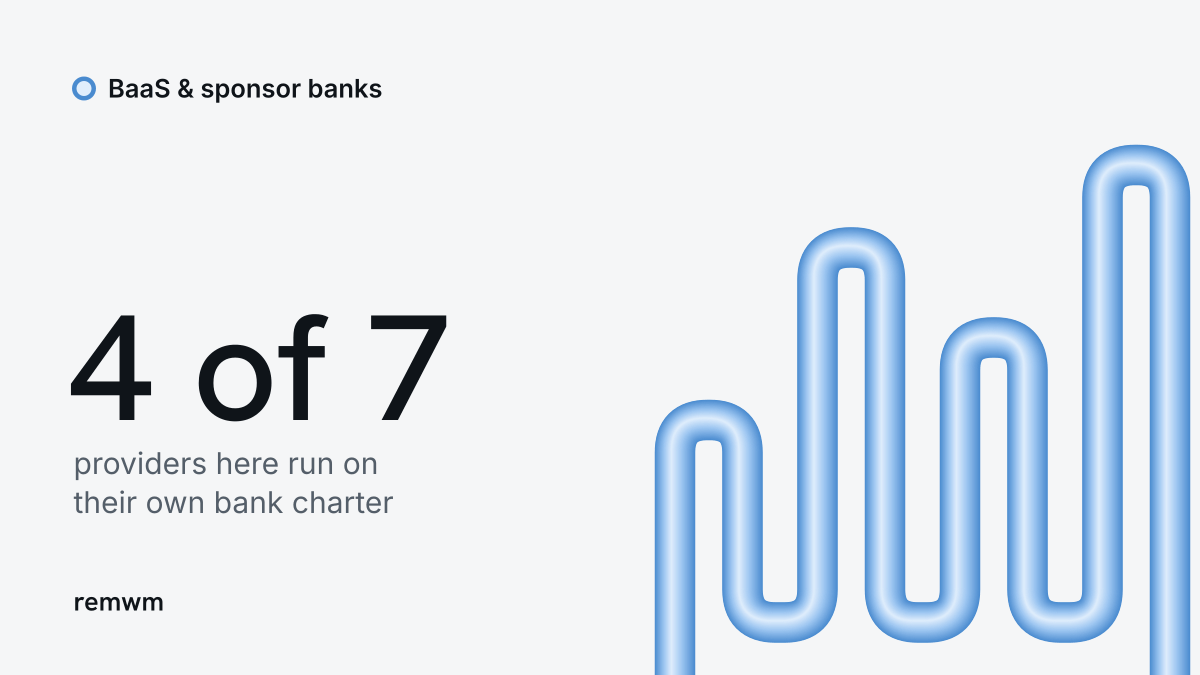
Banking as a service providers let a company offer accounts, payments and cards while an FDIC-insured bank holds the money; federal bank regulators call such arrangements banking-as-a-service or embedded finance. Seven US providers meet the three criteria published below: Column, Increase, Lead Bank, Newline by Fifth Third, Synctera, Treasury Prime and Unit. The order is alphabetical and carries no meaning.
How the seven providers were selected
A provider is on this list if it meets all three criteria, which follow the rules in our methodology:
- It runs live US programs in August 2026.
- It names the bank or banks holding the deposits in its own public documents.
- It publishes API documentation a reader can open.
The second criterion is where most candidates fall out. SoFi Tech Solutions says it is “connected to 25+ sponsor banks” and offers a banking-as-a-service model, but the pages checked name none of them (SoFi Tech Solutions), so it is not here. Solid fails the first: its liquidation plan took effect on November 30, 2025 (BaaS platform). Cross River Bank meets the criteria but is covered in the sponsor bank directory rather than twice.
No provider paid for inclusion, and no provider was given sight of this page before publication. There are no scores, no ratings and no picks below, only facts from each provider’s own documents, the FDIC register and enforcement orders.
Banking as a service providers compared
Three shapes appear in the Model column: a bank selling its own APIs, a bank-owned platform, and software over a network of partner banks. Our guide to the BaaS platform goes through how the models differ on pricing and instant payments, and the BaaS guides cover the layer.
| Provider | Model | Own bank charter | Products from its own docs | Banks named publicly | API docs | Pricing |
|---|---|---|---|---|---|---|
| Column | Bank with its own APIs | Yes: Column N.A., FDIC cert 58224 | Accounts (FBO, sweep, clearing, custom), ACH, domestic and international wires, FedNow and RTP, checks, card programs, loans | Is the bank | docs.column.com | Not published |
| Increase | Own core, own bank plus partner banks | Yes: Increase Bank, announced July 29, 2026, FDIC cert 35261 | Accounts, ACH, wires, checks, RTP, FedNow, cards, push-to-card | Increase Bank; Grasshopper Bank, N.A.; First Internet Bank of Indiana; Core Bank | increase.com | Published fee schedule |
| Lead Bank | Bank with its own APIs | Yes: Lead Bank, FDIC cert 8283 | Accounts, ACH, wires, FedNow and RTP, internal and blockchain payments, card sponsorship on the client’s processor, term loans and lines of credit | Is the bank | docs.lead.bank | Not published |
| Newline by Fifth Third | Bank-owned platform | Yes: Fifth Third Bank, N.A., FDIC cert 6672 | ACH, wires, book transfers, RTP (FedNow not yet), commercial credit and prepaid debit cards, FDIC-insured accounts | Is the bank | developers.newline53.com | Not published |
| Synctera | Platform over partner banks | No | KYC and KYB checks, accounts, payments, ledger, card issuing including credit | Community Federal Savings Bank (2021), Lineage Bank (2022), Stearns Bank N.A. (2023), CCBank (2026) | dev.synctera.com | Not published |
| Treasury Prime | Bank-direct software; the fintech signs with the bank | No | Accounts, ACH, wires, book transfers, checks, cards, FedNow through select banks | KeyBank (2025), People Trust CFCU (2025), U.S. Bank (2025), i3 Bank and Coastal (2026) | docs.treasuryprime.com | Not published |
| Unit | Platform and program manager over partner banks | No | Deposit and FBO wallet accounts, ACH, wires, RTP, checks, debit, charge and credit cards, capital | Thread Bank (2022), Lincoln Savings Bank (2024), i3 Bank (2025); Piermont Bank (bank’s own 2022 release) | unit.co | Not published |
The seven providers
Column
Column sells banking services through its own APIs. Its documentation calls it “the first nationally chartered bank created to serve developers and builders” (Column docs), and the FDIC register lists Column National Association as active under certificate 58224, with the OCC as its regulator. Clients open FDIC-insured FBO, sweep, clearing and custom accounts by API and run card programs with all major networks and issuer processors (Column); ACH, domestic and international wires, checks and loans are in the same documentation (docs index). Instant payments run over both FedNow and RTP, each with a $10,000,000 per-transaction limit (Realtime). Column does not publish prices.
Increase
Increase built its own core and announced its own bank, Increase Bank, on July 29, 2026 (Increase); our profile records FDIC certificate 35261 in Longview, Washington. Its pricing page said on July 30, 2026 that banking services come from “Increase Bank, Grasshopper Bank, N.A., First Internet Bank of Indiana, or Core Bank”. Increase is the one provider here that publishes a fee schedule: on that date it listed $2.00 for same-day ACH origination, $0.50 next-day, $15.00 per wire, $2.50 per RTP or FedNow origination and $0.25 per virtual card (Increase pricing). Increase says Gusto, Ramp and Stripe already use its core technology for more than $500 billion a year.
Lead Bank
Lead Bank is an FDIC-insured bank in Kansas City, Missouri, active under certificate 8283 with the FDIC as primary regulator. Its documentation describes “programmable financial services delivered through REST APIs” (Lead docs), and Lead says it owns “the charter, the underlying infrastructure, and the direct connection to the Federal Reserve” (Lead Bank). It originates term loans and lines of credit, secured and unsecured, and lists five payment rails: ACH, wire, instant payments, internal transfer and blockchain payments (docs index). FedNow and RTP arrive “through a single API integration” (instant payments). Cards run on a dedicated BIN across Visa, Mastercard and American Express with the client’s own processor while Lead handles settlement and oversight, so the client still decides how to choose an issuer processor. Prices are not published.
Newline by Fifth Third
Newline is a division of Fifth Third Bank, National Association, which the register lists as active under certificate 6672 in Cincinnati, Ohio. Fifth Third announced the acquisition of Rize Money on May 22, 2023 (Business Wire), and Newline launched after it (Fifth Third); on July 29, 2024 the bank said Newline would power Stripe Treasury (Business Wire). One API covers ACH, wires, book transfers and Real-Time Payments, and the platform issues commercial credit and prepaid debit cards alongside FDIC-insured accounts (Newline). FedNow support “is not yet available” (instant payments). Prices are not published.
Synctera
Synctera holds no charter of its own and runs programs on partner banks. It signed Community Federal Savings Bank on September 1, 2021, describing it as “the fourth community bank to join Synctera’s growing bank/FinTech marketplace” (Synctera), and its first launch went live with Lineage Bank on February 14, 2022 (Synctera). Stearns Bank N.A. followed on September 19, 2023, and on July 13, 2026 CCBank partnered with Synctera for business and consumer credit cards (Synctera). Identity checks, accounts, payments, the ledger and card issuing are documented at dev.synctera.com. Prices are not published.
Treasury Prime
Treasury Prime sells software to banks and their fintech clients, and its Find a Bank page tells applicants to “sign direct agreement with your bank partner”. On January 22, 2026 it added i3 Bank and Coastal to a network of “more than 20 financial institutions” (Treasury Prime); KeyBank joined on February 27, 2025, People Trust CFCU on June 10, 2025 and U.S. Bank on October 23, 2025. Accounts, ACH, wires, book transfers, checks and cards are documented at docs.treasuryprime.com, with FedNow through select banks. Prices are not published.
Unit
Unit runs a platform and acts as program manager over partner banks, and states that it is a financial technology company and not a bank. It named Thread Bank as its fourth bank partner on August 10, 2022 (Unit) and announced Lincoln Savings Bank on August 7, 2024 (Unit); Piermont Bank announced its own Unit partnership on February 15, 2022 (Piermont Bank), and unit.co named i3 Bank in 2025. Deposit and FBO wallet accounts, payments over ACH, wires and RTP, checks, debit, charge and credit cards and capital are documented at unit.co/docs/api. Prices are not published.
Partner banks and enforcement orders
An order is a fact about the bank it binds, not a verdict on the provider that named that bank. Our sponsor bank enforcement actions tracker holds 17 FDIC, OCC and Federal Reserve actions since March 2023 tied to banks’ fintech, banking-as-a-service, program-manager or third-party payment business. Four of them name banks listed above.
| Bank | Provider naming it | Order | Issued | Status in August 2026 | What it requires |
|---|---|---|---|---|---|
| Lineage Bank | Synctera | FDIC-23-0041b consent order | Jan 30, 2024 | In force | No new fintech partners until a formal onboarding process is in place; exit plans for major fintech partners |
| Community Federal Savings Bank | Synctera | AA-ENF-2025-21 consent order | Apr 24, 2026 | In force | A BSA/AML action plan for its payment processing line; an independent lookback of suspicious activity |
| Piermont Bank | Unit (bank’s own 2022 release) | FDIC-23-0038b consent order | Feb 27, 2024 | In force | Review of controls for every third-party relationship; board approval for new partners |
| Thread Bank | Unit | FDIC-24-0022b consent order | May 21, 2024 | Terminated Dec 22, 2025 | Not applicable |
BSA/AML stands for the Bank Secrecy Act and anti-money-laundering rules. No action in the tracker names Column N.A., Lead Bank, Fifth Third Bank, N.A., Increase Bank, Grasshopper Bank, First Internet Bank of Indiana, Core Bank, or the Treasury Prime banks named above, Coastal Community Bank included. Orders vary in what they actually restrict, which is the subject of our note on how to read a consent order.
How to choose a banking as a service provider
Two interagency documents set out what a bank has to control in these arrangements, which is also the list a prospective client can work through. The Federal Reserve, FDIC and OCC issued a joint statement on bank arrangements with third parties to deliver deposit products on July 25, 2024; it “does not alter existing legal or regulatory requirements” (Federal Reserve). The Interagency Guidance on Third-Party Relationships came on June 6, 2023, published at 88 FR 37920 on June 9, 2023, and covers planning, due diligence, contract negotiation, ongoing monitoring and termination.
- Records. Ask who holds the system of record and how the bank reaches it. A lack of access “can impair the bank’s ability to determine its deposit obligations”, the agencies write.
- Roles in writing. The statement’s sound practices include contracts that “clearly define roles and responsibilities of banks and third parties”.
- Compliance. Functions can be shared, but “the bank remains responsible for failure to comply with applicable requirements”.
- What customers are told. End users may not know that “access to their funds may depend on the third party”, and deposit insurance does not cover the third party’s failure.
- Layers. The agencies flag arrangements where the bank has no direct contract with an entity performing a crucial function.
- Exit. A contract might address “the transfer of the relevant accounts, data, or activities to another entity” if the third party fails.
- Growth. Rapid growth can leave risk management and operational processes “struggling to keep pace”.
- Data and audit rights. The 2023 guidance points to the bank’s ability to access its data “in an appropriate and timely manner”, its right to audit with remediation, and whether the contract should bar subcontracting without consent (Federal Reserve).
Who answers those questions depends on the model. With Column, Lead Bank and Newline the provider is the bank or a division of it; with Synctera, Treasury Prime and Unit a separate company sits between the client and the bank, and Increase now has both. The line between selling software to banks and running a platform over them is the subject of our note on banking as a platform.