An FBO account, short for “for benefit of”, is a single deposit account at a bank that holds money belonging to many people. A fintech, payroll provider or marketplace opens it in its own name, followed by “for the benefit of” its customers, and keeps a ledger showing whose money is inside. Whether each customer is protected by FDIC insurance depends on how well those records are kept.
How an FBO account is set up
The account sits at an FDIC-insured bank, usually the platform’s sponsor bank. The title names the account holder and states that it acts for others, for example “Platform Inc. FBO its customers”. Customer money is pooled in that one account; it is commingled, not split into separate bank accounts per person.
The detail lives in a sub-ledger. Each customer has a balance in the platform’s system, or in the system of a processor working for it, and those balances should add up to the bank balance. Many platforms combine the FBO account with virtual accounts, so each customer gets its own account number for incoming payments while the money still lands in the pooled account.
| Piece | What it is | Who usually keeps it |
|---|---|---|
| FBO deposit account | One account at the bank, titled for the benefit of others | The bank |
| Sub-ledger | Balance of each beneficial owner | The platform, a processor or the bank |
| Reconciliation | Proof that sub-ledger totals match the bank balance | Shared, under the bank’s oversight |
| Account title and agreements | The legal statement that the holder acts for others | Bank and platform |
When FDIC cover passes through
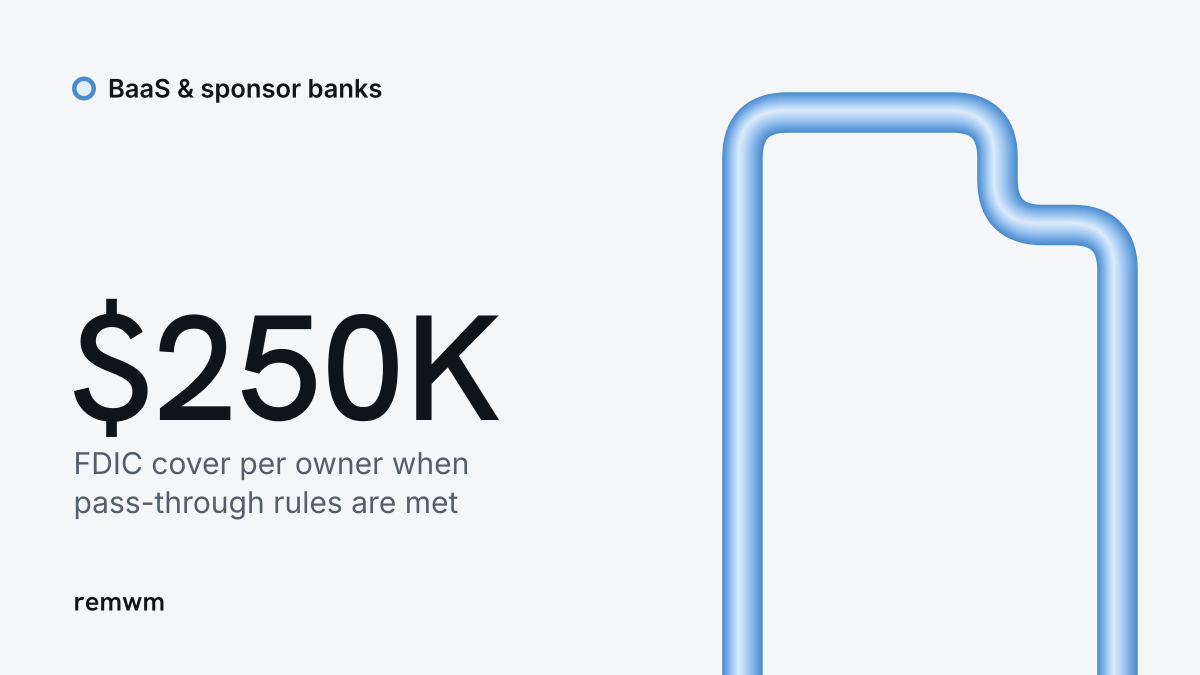
FDIC insurance normally covers the person named on the bank’s records. Pass-through coverage lets it reach the people behind an account like this one. Under 12 CFR 330.7, funds held by an agent, nominee, custodian or similar party are insured as if each principal had deposited them directly. Each owner’s share is then insured up to $250,000 per ownership category at that bank, added to any other deposits the same person holds there in the same category.
Three conditions in 12 CFR 330.5 and 330.7 decide whether that works:
- The relationship is disclosed. The bank’s own deposit account records must show that the account holder acts in a custodial or fiduciary capacity. An FBO title does that.
- Owners can be identified. The interests of each beneficial owner must be ascertainable from records kept by the bank, the account holder or a party acting for it, in good faith and in the regular course of business.
- The funds really belong to the customers. The arrangement has to be genuine; the platform cannot be the actual owner of the money.
If these are not met, the FDIC proposal notes, the deposit is insured to the person named on the bank’s records, here the platform, and capped at $250,000 in total.
Pass-through cover protects against the failure of the bank. It does not protect customers if the fintech or a middleware provider fails, loses data or misstates balances. That gap is what customers found after the synapse bankruptcy.
Why records became the issue
Synapse Financial Technologies filed for bankruptcy in April 2024. The FDIC described it as a middleware provider that offered APIs to fintech companies and held their customers’ funds in custodial accounts at partner banks. After the filing, the banks and the court-appointed trustee had trouble getting and reconciling Synapse’s records, and customers lost access to their money while the gap was worked out.
On October 2, 2024 the FDIC proposed a rule, “Recordkeeping for Custodial Accounts” (RIN 3064-AG07), aimed at that problem. It covers “custodial deposit accounts with transactional features”: accounts held for beneficial owners, with commingled funds, where owners can move money to third parties through the account holder. Most FBO accounts behind consumer fintech apps fit that description.
Under the proposal, the bank would have to:
- keep records of each beneficial owner, the balance attributable to each and the ownership category, in a set electronic file format;
- reconcile those records no less often than as of the close of each business day;
- if a third party keeps the records, have direct, continuous and unrestricted access to them, including if the third party is interrupted, insolvent or bankrupt, plus independent validation of the third party’s records;
- keep written policies, sign an annual certification by an executive officer and file an annual report on these accounts.
The comment period was extended to January 16, 2025. As of October 20, 2026, the Federal Register lists no final rule, so these remain proposed requirements. Banks can still use them as a reference for what examiners and the FDIC want to see.
What platforms should check
If a product holds customer money in an FBO account, these are the questions to settle with the bank:
- Account title. Does the bank’s own record show the custodial relationship?
- Ledger of record. Who keeps the sub-ledger, and can the bank read it directly without the platform’s help?
- Daily reconciliation. Do sub-ledger totals match the bank balance every business day, and who resolves breaks?
- Continuity. If the platform or its processor stops operating, can the bank identify every owner and pay them?
- Customer disclosures. Do marketing and terms describe FDIC cover accurately, including that it applies only if the bank fails?
These points belong in any sponsor bank due diligence and in the wider model described in what is banking as a service.