Tokenized collateral is a margin asset, such as a Treasury bill or a money market fund share, recorded as a token on a blockchain and posted to secure futures or swaps. In the United States, CFTC staff guidance of December 8, 2025 says a tokenized asset keeps its margin eligibility when it gives the holder the same legal and economic rights as the traditional asset and meets the usual custody, haircut and enforceability rules.
Two kinds of collateral, two staff letters
The Commodity Futures Trading Commission (CFTC) handles two different things under the word “tokenized.” Its staff answered them in separate letters on the same day.
| Tokenized real-world assets | Crypto assets, including payment stablecoins | |
|---|---|---|
| Examples named by CFTC staff | U.S. Treasury and agency securities, corporate bonds, money market fund shares, equities | Bitcoin, ether, payment stablecoins such as USDC |
| Staff document | Letter 25-39, Tokenized Collateral Guidance (December 8, 2025) | Letter 25-40, a no-action position for futures commission merchants, reissued as Letter 26-05 (February 6, 2026) |
| Legal form | Guidance on how existing rules apply | A promise not to recommend enforcement, subject to conditions |
| Who it speaks to | Futures commission merchants (FCMs), derivatives clearing organizations (DCOs), swap dealers | FCMs that accept customer margin |
Letter 25-39 defines a tokenized asset as “a digital representation of a real-world asset” recorded on a blockchain as a digital token. The point of the guidance is that the ledger is not what makes an asset eligible. As staff put it, “none of the Commission’s regulations require any particular technology or operational infrastructure” for holding or transferring eligible collateral.
The second track is crypto collateral. Letter 25-40 answered a request from Coinbase Financial Markets, a CFTC-registered FCM, and Letter 26-05 repeated it with one change, covered below.
The five tests in Letter 25-39
Staff grouped their views into five areas. A firm that wants to accept a tokenized Treasury or fund share has to show each one.
- Eligible assets. Staff recommend starting with assets already eligible as regulatory margin: liquid, with established haircuts, and likely to hold value under stress. A DCO must limit initial margin to assets with “minimal credit, market, and liquidity risks” under Regulation 39.13(g). Uncleared swap collateral is listed in Regulation 23.156.
- Legal enforceability. The token must give rights that are “the same or functionally equivalent” to the asset in its traditional form. DCOs need an enforceable legal framework for netting, their interest in collateral and settlement finality; swap dealers hold initial margin under a binding custodial agreement.
- Segregation, custody and control. Margin stays subject to segregation rules and must sit with an eligible custodian. The registrant must hold a perfected security interest in the token.
- Haircuts and valuation. A tokenized asset can take the same risk-based haircut as the underlying asset, adjusted for differences in settlement time or in credit, market or liquidity risk. DCOs review haircuts at least monthly.
- Operational risk. Firms should be ready for cybersecurity, access and network-wide threats, and fit the new technology into their existing risk programs.
Staff also flagged interoperability: how freely collateral moves between ledgers may change the analysis of the other factors.
What each registrant may do today
The staff FAQ, first published March 20, 2026 and updated September 24, 2026, turns the two letters into specific answers.
| Registrant | Crypto assets and payment stablecoins | Tokenized forms of traditional assets |
|---|---|---|
| DCO (clearinghouse) | May accept them as initial margin if they meet Regulation 39.13(g)(10); the DCO sets the haircut and reviews it at least monthly | Same rules as the traditional asset, per Letter 25-39 |
| FCM (broker) | Under Letter 26-05, may count a customer’s non-security crypto assets, after haircuts, when checking whether an account is undermargined; may deposit its own payment stablecoins as residual interest in customer accounts | May invest customer funds in tokenized forms of investments permitted by Regulation 1.25 (new on September 24, 2026) |
| Swap dealer, uncleared swaps | Not eligible: crypto assets, including payment stablecoins, are not on the Regulation 23.156 list | May exchange a tokenized form of an eligible asset; staff would not object to tokenized money market fund shares as initial or variation margin if the fund meets Regulation 23.156(a)(1)(ix) |
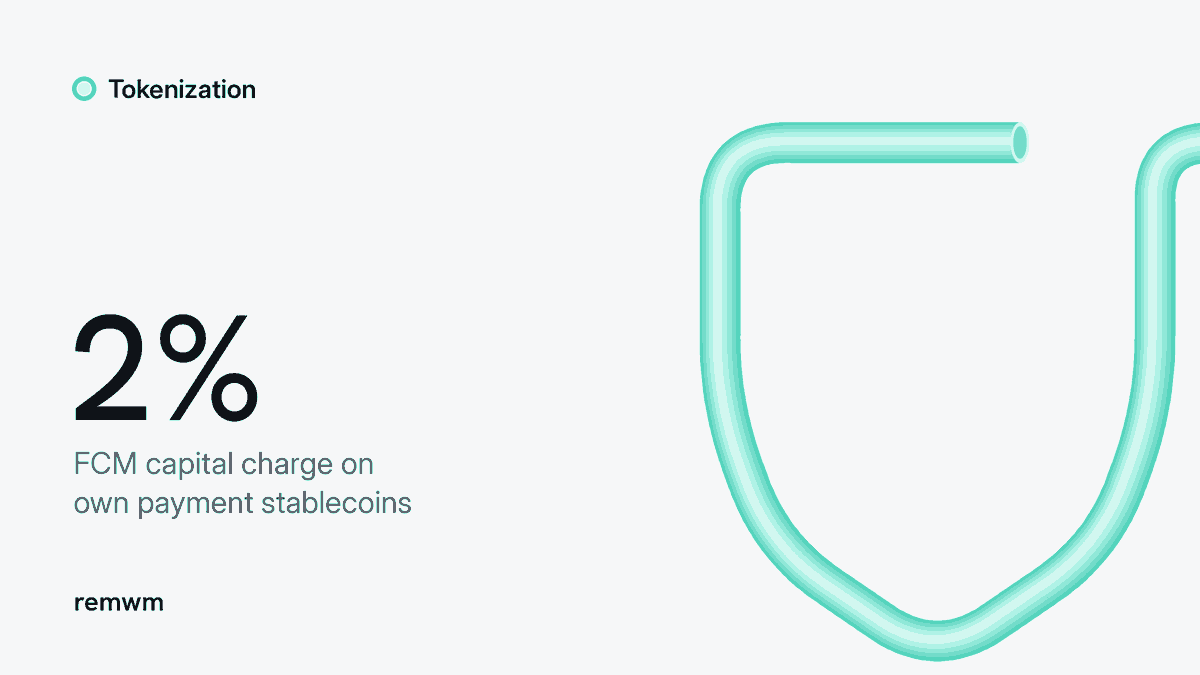
Three limits stand out for FCMs. They may not invest customer funds in payment stablecoins. They may not put their own bitcoin or ether into customer accounts as residual interest; only payment stablecoins qualify. And staff would not object to a capital charge of at least 2% on payment stablecoins an FCM holds, and 20% on bitcoin and ether inventory, in line with SEC staff’s approach for broker-dealers.
For swap dealers, the FAQ notes a rule change that widens the fund route. Amendments the CFTC adopted on July 17, 2026, effective August 17, 2026, removed the “asset transfer restriction” that had kept many money market fund shares out of eligible margin for uncleared swaps.
The FCM pilot: conditions and reporting
An FCM relying on Letter 26-05 must first file a notice with the CFTC’s Market Participants Division, through the WinJammer filing system, with the date it will start accepting crypto collateral. Then three conditions apply for an initial period:
- Three months, three assets. For the first three months the FCM may accept only payment stablecoins, bitcoin and ether from customers.
- Incident notices. In the same period it must promptly report any significant operational or system problem, including a cybersecurity incident, that affects crypto collateral.
- Weekly reports. For three calendar months it files a weekly report of crypto assets held in each class of customer account, asset by asset.
After the first three months the asset limit and the incident notice fall away. The FCM may then accept other crypto assets, subject to the letter’s remaining conditions.
Which stablecoins count
The no-action position covers “payment stablecoins” only. Before the GENIUS Act takes effect, Letter 26-05 defines one as a dollar stablecoin that holds reserves only in cash, Treasury securities or overnight Treasury repos, publishes monthly reserve attestations, and is issued by a state-regulated money transmitter or trust company. After the Act takes effect, the definition follows the Act’s own.
The February 2026 reissue added national trust banks to the list of issuers. Staff said they had not meant to exclude them. That charter route is itself in court: the national trust bank charter lawsuit the Independent Community Bankers of America filed against the OCC on October 2, 2026 challenges the rule that lets national trust banks run non-fiduciary businesses. How such issuers fit into the wider stack is mapped in stablecoin infrastructure.
Investing customer funds in tokenized assets
The September 24, 2026 update added a separate question: may an FCM or DCO invest customer funds in tokenized versions of permitted investments? Staff said yes, if the firm can show four things:
- the underlying asset is a permitted investment under Regulation 1.25(a);
- the token grants the same or functionally equivalent legal and economic rights;
- the investment meets all Regulation 1.25 terms, including liquidity, concentration limits, time to maturity and limits on instrument features;
- the tokens are held with an acceptable depository under Regulation 1.20(b).
For tokenized shares of government money market funds, staff also expect a written acknowledgment letter from the custodian, as Regulation 1.26(b) requires for fund shares today. The same update said a records entity may keep its required records on a blockchain if it meets the recordkeeping rule in full.
What this asks of tokenization and custody providers
The guidance puts the burden on the registrant, but much of the evidence comes from the infrastructure underneath. A firm that sells tokenization, custody or recordkeeping to FCMs, DCOs or swap dealers should expect to be asked for:
- A rights analysis. A legal view that the token carries the same rights as the fund share or bond, which depends on who keeps the official record. Our guide to the tokenized securities transfer agent explains when the blockchain is the record and when it is only a notice layer.
- Depository status. Whether the custodian is an acceptable depository under Regulation 1.20(b), or a fund custodian able to sign a Regulation 1.26(b) acknowledgment.
- Haircut evidence. Settlement times, redemption terms and liquidity data that let a clearinghouse match the traditional asset’s haircut or justify a larger one.
- Control and security. How keys, access rights and chain-level failures are handled, mapped to the firm’s information security program.
- Portability. Which chains and platforms the token can move between, since staff tied interoperability to the other tests.
The platforms that issue tokenized funds and bonds are compared in tokenization platforms, and the asset side is explained in rwa tokenization.
All of this is staff guidance, FAQs and a no-action position. It binds neither the Commission nor a court, and staff say any tokenized asset or structure “must be analyzed on an individual basis.” This page describes the documents; it is not legal advice.