RWA tokenization means recording ownership of a real-world asset, such as a Treasury fund share, a loan or a bank deposit, on a blockchain. The asset itself does not change. The ownership record does. In the United States, a tokenized security is still a security, so the usual rules for issuers, transfer agents, broker-dealers and custodians keep applying.
What RWA tokenization means
A real-world asset (RWA) is anything that exists outside a blockchain: a government bond, a money market fund share, a home equity loan, a bank deposit. Real world asset tokenization creates a token on a blockchain that represents that asset or a claim on it. A token is a digital unit that a blockchain can record and move between wallets.
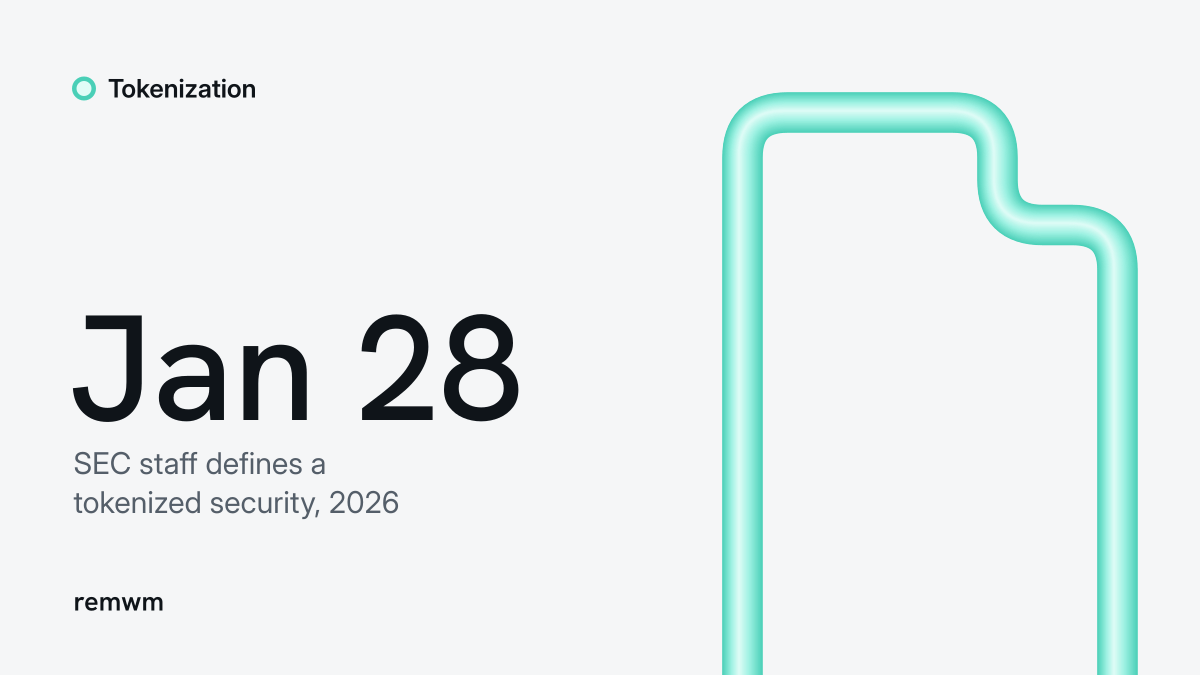
The SEC staff gave a working definition on January 28, 2026. In a joint statement, three SEC divisions described a tokenized security as a security “formatted as or represented by a crypto asset, where the record of ownership is maintained in whole or in part on or through one or more crypto networks.”
The staff split tokenized securities into two groups:
- Issuer-sponsored. The issuer or its transfer agent puts the ownership record on a blockchain. Holders keep direct rights against the issuer.
- Third-party-sponsored. A firm with no tie to the issuer tokenizes someone else’s security. The token may be a custodial receipt for the real share, or a separate “linked” security that only tracks its value.
The difference matters. The staff notes that a third-party token may not give the holder any rights as a holder of the underlying security, and it adds the third party’s own risks, such as its bankruptcy.
The RWA tokenization stack
Most tokenized products sit on the same six layers. One company can cover several of them.
| Layer | What it does | Example from primary sources |
|---|---|---|
| Issuer and asset manager | Creates the fund, note or loan and sets its terms | BlackRock for BUIDL; Franklin Templeton for FOBXX |
| Transfer agent | Keeps the official record of who owns what | Securitize for BUIDL; the fund’s transfer agent for FOBXX |
| Tokenization platform | Smart contracts, investor allowlists, minting and redemption | Securitize, Superstate, Centrifuge, Tokeny |
| Blockchain | The network where tokens are recorded and moved | Ethereum, Stellar, Base, Solana, Provenance |
| Custody | Holds the underlying assets and, for some investors, the token keys | Bank of New York Mellon holds BUIDL’s assets |
| Distribution | Onboards investors and sells the product | Securitize Markets for BUIDL; the Benji app for FOBXX |
A smart contract is code on the blockchain that runs set rules, for example “only wallets on the approved list may receive this token.” An RWA tokenization platform usually sits in the middle of the stack. It writes those contracts, checks that each wallet belongs to an approved investor, and keeps the on-chain record in step with the transfer agent’s books. For the firms that do this work, see our list of tokenization companies.
Real examples
Tokenized treasuries and funds
Tokenized treasuries are fund shares or notes backed by short-term US government debt, with ownership recorded on a blockchain.
BlackRock BUIDL. BlackRock launched the BlackRock USD Institutional Digital Liquidity Fund on Ethereum on March 20, 2024. Securitize acts as transfer agent and tokenization platform. Securitize Markets is placement agent. Bank of New York Mellon is custodian of the fund’s assets and its administrator. The fund issues shares under Rule 506(c) of the Securities Act and Section 3(c)(7) of the Investment Company Act, with an initial minimum of $5 million, according to the launch release.
Franklin OnChain U.S. Government Money Fund (FOBXX). This is a government money market fund registered under the Investment Company Act of 1940. Its August 1, 2026 prospectus says the transfer agent keeps the official share record on a “blockchain-integrated system” that uses public blockchains. Stellar is the primary network. Polygon, Aptos, Avalanche, Arbitrum, Ethereum, Solana and Base are available for some accounts. Fund shares are also called BENJI tokens. The minimum initial purchase on Stellar is $20.
Ondo OUSG. Ondo’s OUSG gives qualified investors exposure to short-term US Treasuries. Ondo’s own page says most of the portfolio is currently held in BUIDL. That is a tokenized fund that holds another tokenized fund, so a buyer carries both layers of structure.
Tokenized loans
Figure Technology Solutions records its loans on the Provenance Blockchain. Its annual report for 2025 says 87% of loans originated through its loan origination system used DART, its blockchain-based lien and eNote registry. Citing RWA.xyz data, Figure put its real-world assets on-chain at about $14 billion as of December 31, 2025.
Tokenized deposits
A tokenized deposit is a bank deposit recorded as a token. JPMorgan’s blockchain unit, Kinexys, piloted a USD deposit token called JPMD on Base in June 2025. On November 12, 2025, JPMorgan said the token, JPM Coin (ticker JPMD), was available to its institutional clients. JPMorgan describes it as a bank-issued deposit token, “not a cryptocurrency or a stablecoin.” Stablecoins are a separate product with their own rules; see our guide to stablecoin infrastructure.
The US legal frame
Tokenized securities are securities. The January 2026 staff statement says the format of issuance and the method of recording holders, on-chain or off-chain, do not change how federal securities laws apply. It is a staff view with no legal force. The Commission itself went further in an interpretive release effective March 23, 2026: “A security is a security regardless of whether it is issued, or otherwise represented, offchain or onchain.”
The same registrations apply. A firm that keeps shareholder records must register as a transfer agent. Securitize Transfer Agent, LLC files with the SEC under file number 084-06638. A firm that sells securities must be a registered broker-dealer. FINRA BrokerCheck lists Securitize Markets, LLC as approved by the SEC and FINRA since September 28, 2016. In a May 2026 announcement filed with the SEC, Securitize said FINRA had approved its broker-dealer to custody tokenized securities.
Custody accounting changed in 2025. SEC Staff Accounting Bulletin 121, issued in 2022, told public companies that safeguard crypto assets for customers to record a liability and a matching asset at fair value. On January 23, 2025, the SEC staff issued SAB 122, which rescinded SAB 121. Firms now apply the standard loss-contingency rules in ASC 450-20 instead.
None of this is legal advice. Structure, investor eligibility and state law still decide how a given token is treated.