A tokenized securities transfer agent keeps the official record of who owns a security when that record lives, in whole or in part, on a blockchain. US law gives the job no new name: it is a transfer agent under the Securities Exchange Act of 1934, registered with the SEC when it serves registered securities. Since May 2025, SEC staff have said such an agent may use a blockchain as its official master securityholder file.
What a transfer agent does
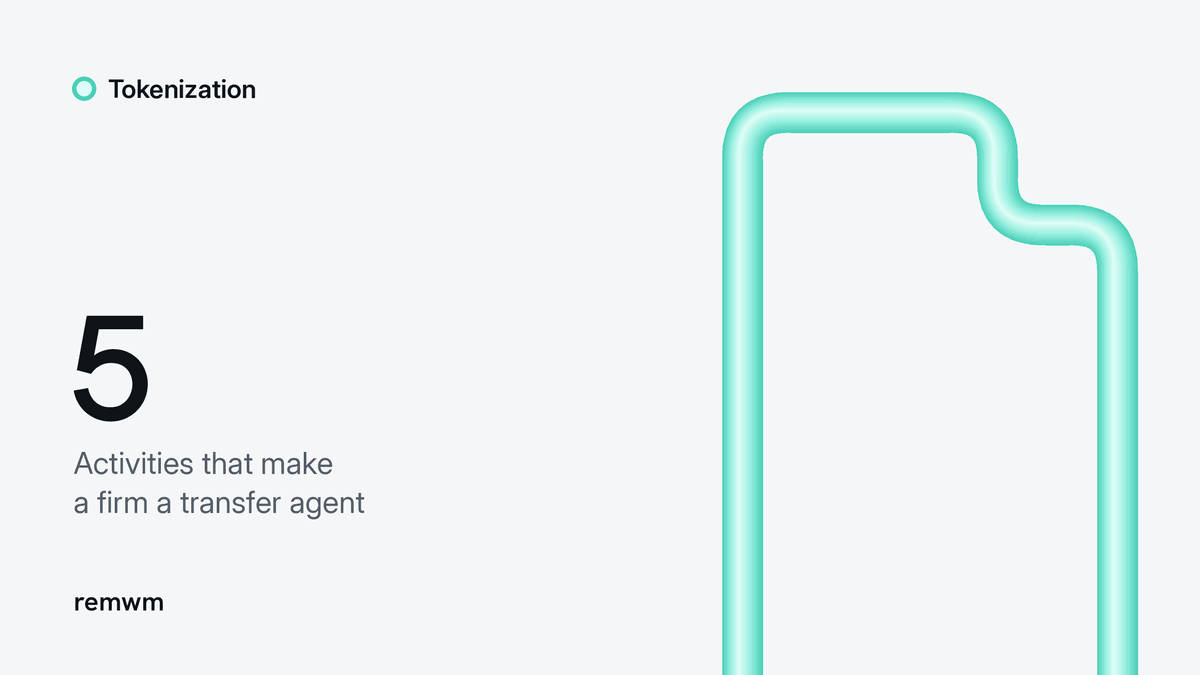
The Exchange Act defines a transfer agent by five activities, performed for an issuer. The SEC’s Division of Trading and Markets lists them in its crypto FAQ:
- countersigning securities upon issuance;
- monitoring for unauthorized issuances;
- registering the transfer of securities;
- exchanging or converting securities;
- transferring record ownership by bookkeeping entry, without paper certificates.
Under Exchange Act Section 17A, an agent doing any of these for a security registered under Section 12 of the Exchange Act, or for certain fund and insurance company securities, must register with the SEC. A bank registers with its federal bank regulator instead. The staff describe a two-step test: is the security a Section 12 security, and is the firm performing one of the five activities? A firm that serves no Section 12 securities would not have to register, the FAQ says.
Several agents can share one issuer. The FAQ notes that the issuer’s registered transfer agent “might register the transfer of the issuer’s securities but hire one or more other transfer agents” for other recordkeeping work.
The blockchain as the official record
The master securityholder file is the agent’s official list of holders, defined in Exchange Act Rule 17Ad-9(b). The SEC staff FAQ of May 15, 2025 asked whether a registered transfer agent could keep it on distributed ledger technology. The staff answer was yes, provided the agent still meets the transfer agent rules on recordkeeping, turnaround, posting, safeguarding and accounting controls (Rules 17Ad-2, 17Ad-6, 17Ad-7, 17Ad-10, 17Ad-11, 17Ad-12 and 17Ad-13). Then, the staff said, the agent “would not need to maintain a duplicate or ‘digital twin’ of its master securityholder file exclusively off-chain.”
The FAQ also describes how such a split record can look:
| Kept on the blockchain | Kept off-chain by the transfer agent |
|---|---|
| Wallet address, asset balance, ownership percentage | Investor name and investor ID |
| Number of shares or units, date of purchase | Address and other contact details |
| Transaction ID | Tax ID or Social Security number and other non-public data |
The staff left the choice of technology to the agent, as long as the records stay “secure, accurate, up-to-date, produceable to the Commission and its staff in an easily-readable format,” and are kept for the required periods. The answers are staff views, not a rule, and “have no legal force or effect.”
Two ways an issuer tokenizes
On January 28, 2026, three SEC divisions published a statement on tokenized securities. It defines one as a security “formatted as or represented by a crypto asset, where the record of ownership is maintained in whole or in part on or through one or more crypto networks.” For issuer-sponsored tokens, it separates two record models. Both depend on the issuer or “its agent,” in practice the transfer agent.
| Integrated record | Off-chain record with on-chain notice | |
|---|---|---|
| Where the master securityholder file sits | On one or more blockchains, linked to off-chain holder data | Off-chain, in the agent’s conventional database |
| What a token transfer does | Transfers the security itself on the master file | Notifies the agent to record the transfer off-chain |
| Does the token carry the security’s rights? | Yes, it is the security in token format | No, the statement says it “does not convey any rights, obligations, or benefits of the security” |
The statement says the format “does not affect application of the federal securities laws.” A tokenized share and a traditional share can be the same class if holders get substantially similar rights. Tokens created by third parties without the issuer, such as custodial or synthetic tokens, are a separate category and are covered in our explainer on rwa tokenization.
How a digital transfer agent works with the main one
A public contract shows how the pieces fit in practice. Exodus Movement, a company listed on NYSE American, filed its Digital Transfer Agency Agreement with Superstate Services LLC as an exhibit to its annual report on March 11, 2026. The agreement, effective August 8, 2025, sets out these roles:
- Two agents. Superstate is the “Digital Transfer Agent” for on-chain eligible shares. The issuer’s “Recordkeeping Transfer Agent” keeps the master securityholder file. Superstate keeps “Subsidiary Security holder Records” and sends the transfers to the recordkeeping agent.
- Registration. Superstate represents that it is registered as a transfer agent under Section 17A of the Exchange Act.
- Chains. Tokenized shares are book-entry shares “represented by digital tokens recorded on the Solana blockchain, Ethereum blockchain, or any other mutually agreed blockchains.”
- Allowlist. Tokens may only be held by wallet addresses on an allowlist. Superstate must verify each wallet owner’s identity and anti-money laundering and sanctions checks before adding the address.
- Minting and burning. Superstate mints or burns tokenized shares on a holder’s written instruction, moving shares between on-chain and conventional form.
- Exit. On termination, Superstate can freeze token transfers and coordinate with the recordkeeping agent so holders can redeem tokens for book-entry or certificated shares.
Who offers transfer agency for tokenized securities
The firms below say on their own pages or in filings that a group entity is an SEC-registered transfer agent and that it records tokenized securities. The list is alphabetical and is not a ranking.
| Company | Registered entity, as stated by the company or its client’s filing | What it records, per the same source |
|---|---|---|
| BitGo | BitGo Stakeholder Services LLC | Traditional and blockchain-based securities via API; built for Reg CF, Reg A+ and Reg D offerings |
| Injective | Injective Institutional Services, registration effective August 2026 | Securities ownership and transfer records, alongside its Injective Mint issuance product |
| Securitize | Securitize Transfer Agent, LLC, SEC file 084-06638 | Securities issued, managed and recorded “natively on-chain,” per its July 2026 SEC filing |
| Superstate | Superstate Services LLC | Tokenized shares of Exodus Movement, under the agreement above |
| Vertalo | SEC-registered transfer agent since 2019, CIK 0001793379 | A distributed ledger used as the securityholder register |
The wider platform layer, including token standards and chains, is compared in tokenization platforms, and issuers of tokenized funds are in tokenization companies.
What to check before choosing an agent
- Registration. Look up the entity on SEC EDGAR under its transfer agent filings, and match the legal name in the contract.
- Where the master file sits. Is the blockchain the official record, or a notice layer for an off-chain register? The answer decides what a token transfer does legally.
- Split of duties. If there is a separate recordkeeping agent, the contract should say who keeps which records and how transfers are passed on.
- Allowlist controls. Who verifies wallet owners, and on what checks.
- Recovery and exit. How lost-wallet cases, freezes and a move to another agent are handled.
This section describes rules and documents; it is not legal advice.