The Independent Community Bankers of America (ICBA) filed a national trust bank charter lawsuit against the Office of the Comptroller of the Currency on October 2, 2026. The suit asks the U.S. District Court for the District of Columbia to strike down the OCC rule that lets national trust banks run non-fiduciary businesses, the 2021 interpretive letter behind it, and the conditional charter of Protego, a digital asset firm.
What ICBA filed
The complaint, Independent Community Bankers of America v. Office of the Comptroller of the Currency (No. 1:26-cv-03441), names the OCC and Comptroller Jonathan V. Gould. It is brought under the Administrative Procedure Act and targets three actions:
| Target | What it is |
|---|---|
| National Bank Chartering final rule, 91 Fed. Reg. 9977 (March 2, 2026) | Amended 12 CFR 5.20 to state that a national bank limited to trust operations may engage in non-fiduciary activities; effective April 1, 2026 |
| Interpretive Letter No. 1176 (January 11, 2021) | The OCC letter that the complaint says treats such companies as engaged in “the business of banking” without taking deposits |
| Protego Holdings Corporation’s conditional approval (February 2026) | A national trust bank charter for a firm that, the complaint says, proposes custody, trading, lending and asset administration services involving digital assets |
ICBA argues that the National Bank Act lets the OCC charter trust banks only for fiduciary activities. “The OCC’s decision to allow companies to obtain national trust bank charters to conduct substantial non-fiduciary activities exceeds the authority Congress granted the agency,” ICBA President and CEO Rebeca Romero Rainey said in the association’s statement.
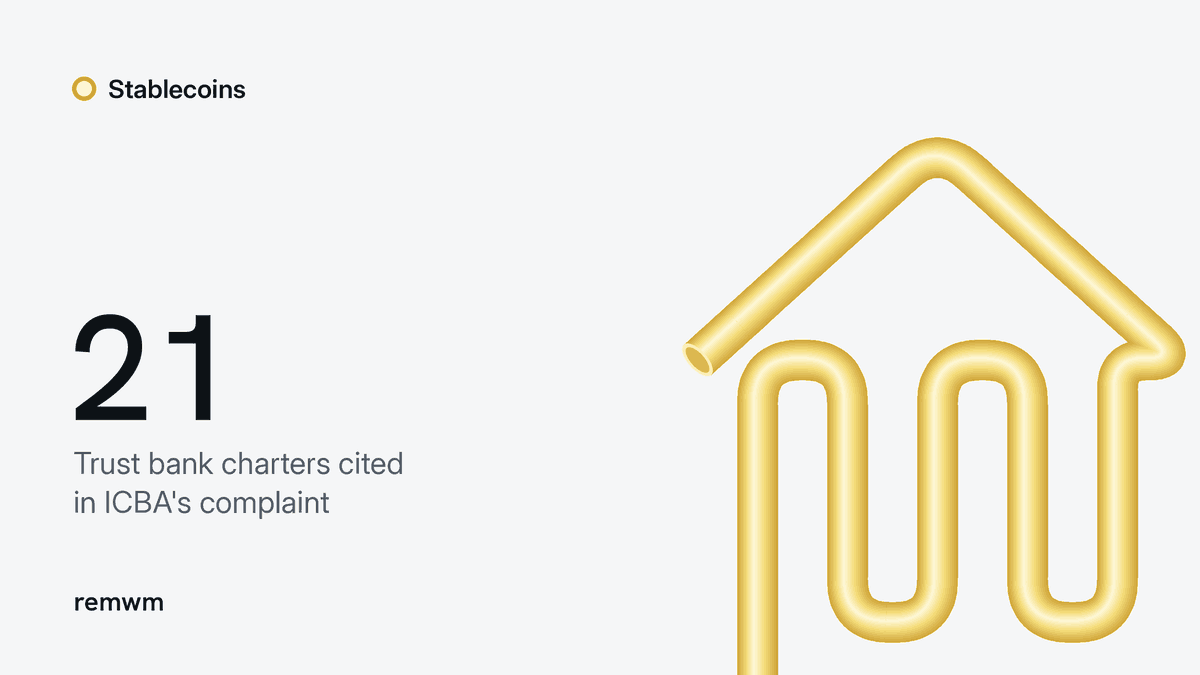
The complaint says the OCC “has approved or conditionally approved 21 trust banks, at least 13 of which are crypto companies,” under the rule and the letter.
What the court is asked to do
ICBA asks the court to declare the rule and Interpretive Letter No. 1176 unlawful and vacate them. It also asks for an order barring the OCC from using either one “to grant or conditionally approve any charter,” and for Protego’s approval to be vacated. The complaint names no other charter for vacatur.
Why it matters for stablecoin and custody infrastructure
The national trust charter has become a route for firms that issue stablecoins, hold reserves or offer custody to business clients. remwm has covered several of these decisions, including the circle national trust bank final approval, the Agora National Trust Bank OCC approval and the world liberty trust occ approval. Brands that launch a white label stablecoin through a chartered issuer depend on the same structure.
The complaint ties the dispute to the GENIUS Act. It notes that the Act lets uninsured national banks chartered by the OCC become federal qualified stablecoin issuers. It also says the Act takes effect on January 18, 2027, or 120 days after final implementing rules, whichever comes first, and that the OCC had not yet issued its final rules.
For banks, fintechs and platforms that work with a trust-chartered issuer or custodian, the practical questions are about continuity: which charter a partner holds, whether it is final or conditional, and what the partner agreement says if a charter is narrowed. Our guide to stablecoin infrastructure maps the roles involved.
What to watch
- The OCC’s response to the complaint.
- Whether the court is asked to act before a final judgment on new approvals.
- The OCC’s final GENIUS Act rules for the issuers it will supervise.