Embedded payments companies let a software platform accept card and ACH payments for its own customers inside its product. In the US they split three ways: the provider is payment facilitator of record, the provider supports platforms that register as PayFacs themselves, or a processor runs an ISV program. The payfac vs payfac as a service split decides liability, underwriting and pricing disclosure.
The companies at a glance
Ten companies sell this to US platforms. The table records what each publishes about its model, its risk allocation and its onboarding. The order carries no meaning. The underlying terms are defined in embedded payments.
| Company | Model, as published | Who covers seller losses | Onboarding and KYC | Public API docs |
|---|---|---|---|---|
| Stripe Connect | Stripe processes; users may not act as a payment facilitator | Stripe or the platform, chosen per integration; the platform for indirect charges | Stripe collects KYC when Stripe is liable, otherwise the platform | docs.stripe.com/connect |
| Adyen for Platforms | Adyen processes for the platform’s users; registered PayFacs onboard “as a payment facilitator” | The platform’s liable balance account | Adyen verifies each legal entity | docs.adyen.com/platforms |
| Finix | Registered PayFac (Flex) or the platform’s own registration (Core) | Not published; Flex settlements approved by Finix, Core by the platform | Not published on the pages cited here | docs.finix.com |
| Worldpay for Platforms (Payrix) | Referral, PayFac-as-a-Service or full PayFac | The “Facilitator” entity carries risk and underwriting liability | Worldpay in PFaaS; the platform underwrites in the PayFac track | Worldpay developer hub (Payrix Pro API) |
| Rainforest | Payment facilitator, contracting as agent of sponsor bank First Citizens | The merchant under Rainforest’s terms; Rainforest may offset | Rainforest collects merchant information and underwrites | docs.rainforestpay.com |
| Tilled | PayFac-as-a-service; registered ISO/MSP of Pinnacle Bank dba Synovus Bank, ISO of Citizens Bank | Not published beyond marketing language | KYC, KYB, MATCH list and OFAC checks included | Tilled API |
| Infinicept | Launchpay (PFaaS) or Payops for registered PayFacs | Launchpay “carries the liability”; registered PayFac: the platform | Launchpay underwrites | Not reviewed |
| Stax Connect | “PayFac-like experience” through one API; referral, reseller and PayFac programs | Not published | Stax runs enrollment and underwriting, with custom flows | docs.staxpayments.com |
| Payabli | PayFac capabilities without the platform registering as one | Not published | Payabli underwrites each merchant | docs.payabli.com |
| Braintree Marketplace | Master merchant and sub-merchant, US only | The master merchant account | Braintree verifies sub-merchants | developer.paypal.com/braintree |
Segment volumes are scarce. Stripe’s 2025 update reports $1.9 trillion in total volume across all businesses on Stripe, up 34% from 2024, and “more than 5 million businesses directly or via platforms” using its financial services. That is Stripe-wide volume; Connect volume is not published. Adyen’s H1 2026 figures, net revenue of €1,302.9 million and processed volume of €803.8 billion, are also company-wide, not Platforms alone.
Who carries seller losses
Stripe’s risk documentation says responsibility for connected accounts’ negative balances “can belong to your platform or to Stripe, depending on your integration.” The same page tells marketplaces on indirect charges to assign that responsibility to the platform, not to Stripe, and notes that if an account’s balance stays negative for 180 days Stripe transfers funds from the platform reserve to cover it. Under direct charges, the connected account “is always the merchant of record”.
Adyen concentrates the exposure in one place. Funds can be “deducted from this account if your users’ balance accounts incur negative balances” from refunds and chargebacks, where the account is the platform’s liable balance account (Adyen).
Finix registered as a payment facilitator and also keeps platforms that register themselves on the same API and dashboard. Settlement approval follows the model: “For Finix Flex customers, Finix manages and approves Settlements,” while Core customers approve their own. Finix does not publish how liability is allocated.
In Payrix Pro’s entity model (September 18, 2024), the Facilitator is the party “assuming all risk and underwriting liabilities as a payment facilitation business”; a Partner is a white-labeled reseller of PayFac-as-a-Service. Worldpay for Platforms sells both ends, PFaaS with “minimal upfront costs or risk” and a PayFac track where, as a partner, “you manage risk and compliance”.
Rainforest’s terms, updated January 9, 2026, make it the “Merchant’s sole responsibility to pay for all chargebacks”, disputes, refunds and penalties, with a right for Rainforest to offset those amounts. Rainforest signs merchants “on behalf of and as an agent of a Sponsor Bank”, listed as First Citizens Bank & Trust Company. Rainforest’s own boilerplate calls this “a no-risk model” for platforms, which is the company’s description rather than a term of the merchant agreement.
Infinicept also sells both sides: Launchpay, where “Launchpay carries the liability, so it never lands on you”, and Payops, for registered PayFacs whose risk and liability is “Managed by you”. In Braintree Marketplace, a disbursement fails with an insufficient_funds exception when the master merchant account cannot cover fees, chargebacks or refunds. Tilled, Stax Connect and Payabli do not publish their liability terms.
Onboarding and KYC
Stripe ties the identity duty to the loss duty: “Stripe is responsible for collecting KYC information from your connected accounts” when Stripe carries their negative balances, otherwise the platform is, unless those accounts use the Stripe Express Dashboard. Stripe’s services terms close the other route, stating that a user “must not act as or hold itself out as a payment facilitator”, intermediary or aggregator.
Adyen verifies the legal entities behind a platform’s users, using that information “to perform verification checks as required by payment industry regulations”. A platform already registered with Visa or Mastercard as a payment facilitator, one onboarding individuals taking in-person payments, or one onboarding high-risk MCCs, onboards to Adyen for Platforms “as a payment facilitator”.
Rainforest states it “must collect certain information about your merchant in order to underwrite and approve” that merchant, and its docs require the “RF *” prefix on card descriptors as its payment facilitator prefix. Payabli underwrites each merchant, which it calls a paypoint, for KYB and KYC purposes, and offers three boarding methods: full API-driven boarding, prefilled applications with boarding links, and its default boarding links. Tilled includes KYC, KYB, MATCH list and OFAC checks with dispute management. Stax Connect runs enrollment and underwriting through custom flows and cites an average implementation of 45 days, its own figure; Infinicept puts a registered PayFac build at “6-12+ months”, also a provider estimate.
Braintree Marketplace is narrower. Master merchant and sub-merchants must all be domiciled in the US, every merchant account needs Braintree’s approval, and a new platform is told to contact Sales. Once Braintree verifies a sub-merchant and confirms status by webhook, “you will be responsible for supporting your sub-merchants”.
Payouts
Stripe’s Connect pricing separates two cases. A platform that lets Stripe bill connected accounts for payment fees pays no additional account, payout volume, tax reporting or per-payout fees. A platform that handles pricing itself pays “$2 per monthly active account” plus “0.25% + 25¢ per payout sent”, where an account is active “in any month payouts are sent to its bank account or debit card”. Instant Payouts cost 1% of payout volume, and cross-border payouts start at 0.25%.
Adyen pays a user’s “verified bank account”, registered as a transfer instrument. Finix settlements become funding transfers after approval, by Finix under Flex and by the platform under Core. Rainforest prices a standard payout at $0.20 per item and an ACH transaction at $0.20 per item. Payabli names Pay Ins, Managed Payouts and On-Demand Payouts as separate services. Braintree Marketplace takes checking accounts only, since “Savings, deposit-only, and prepaid debit accounts will not be accepted”, and “Venmo funding destinations are no longer supported for new merchants”. Splitting funds across many sellers raises further questions, covered in marketplace payouts.
Published pricing
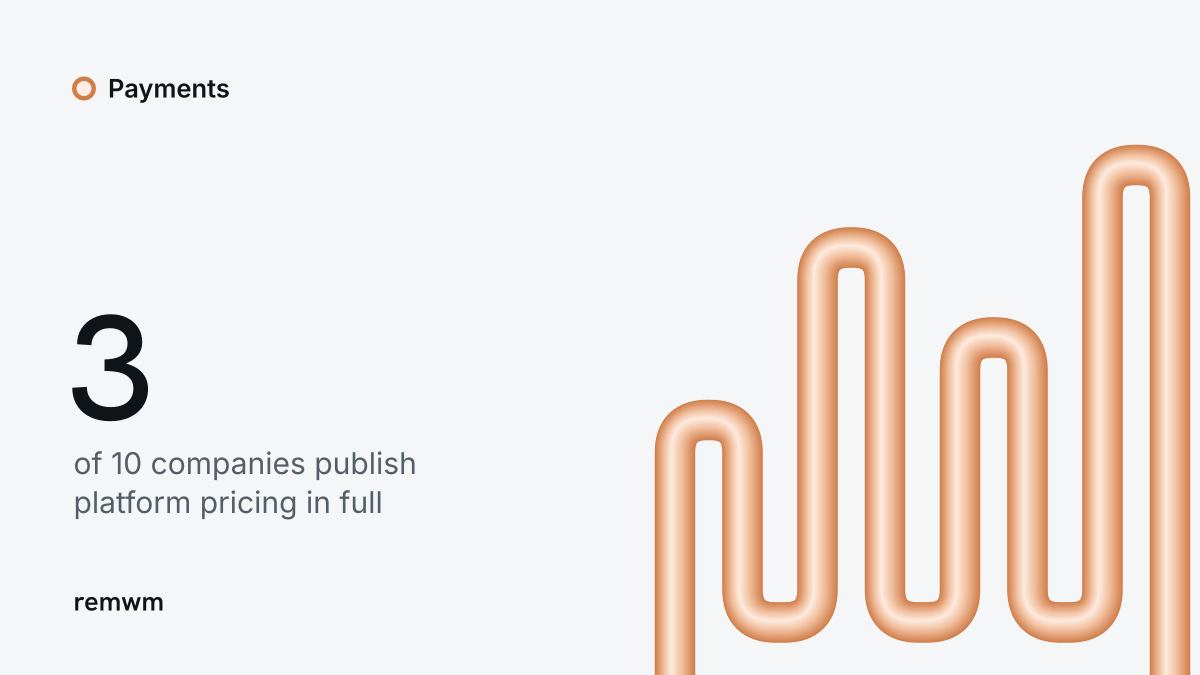
Three of the ten publish platform pricing in full. The order carries no meaning.
| Company | Published pricing |
|---|---|
| Stripe Connect | No platform fee if Stripe bills connected accounts; otherwise $2 per monthly active account plus 0.25% + 25¢ per payout |
| Rainforest | Interchange and DFA at passthrough plus 0.30% ($0m to $5m monthly volume), 0.25% ($5m to $15m), 0.20% ($15m to $25m); $0.30 per item (0 to 50k monthly transactions), $0.25 (50k to 150k); ACH $0.20 per item |
| Tilled | 70% revenue share plus $500 monthly SaaS fee under $5M monthly; 80% plus $2,500 monthly above it |
| Adyen | General page: $0.13 fixed processing fee plus a payment-method fee; Platforms pricing not published |
| Finix, Worldpay for Platforms, Infinicept, Stax Connect, Payabli, Braintree Marketplace, Fiserv, Global Payments | Not published |
Adyen’s pricing page adds “no setup or monthly fees” but no Platforms schedule. Finix says only that it offers “flat rate, dynamic, or custom pricing depending on your business needs”. Rainforest calls its model “a buy-rate, interchange-plus pricing model”, and adds a risk management fee it describes as risk dependent.
Processor programs from Fiserv and Global Payments
Two large processors sell ISV programs rather than PayFac products. Fiserv’s CoPilot API boards merchants under CardPointe, and the application cannot be white-labeled: it “contains CardPointe and CardConnect branding”, marking the merchant account as independent of the ISV partner’s software. Applications sit in an UNDER status while Fiserv’s underwriting team reviews them, and Fiserv says that with direct boarding “merchants are setup within minutes”.
Global Payments runs Affiliate and Select Plus programs, the second offering “a fully embedded payment experience without becoming a registered payment facilitator” unless the partner wants to, plus the ProPay payment facilitation program under the Global Payments Integrated brand, which is transitioning to the Global Payments brand. Global Payments claims over 1 billion transactions a year for thousands of ISV partners with over 580,000 merchant customers, an undated company figure. Neither program publishes pricing, and both are gateway-led integrations, the subject of payment gateway api.
What changed in 2025 and 2026
- March 31, 2025: Payrix rebranded to Worldpay for Platforms. The API still carries the Payrix Pro name, at version 26.29.0 on September 10, 2026.
- June 17, 2025: Payabli closed a $28M Series B, bringing total capital to $60,000,000, and said it had “surpassed 50,000 merchants”.
- September 8, 2025: Rainforest raised an oversubscribed $29 million Series B led by Matrix Partners and Infinity Ventures, total funding $57.5 million, with geographic expansion to Canada.
- January 9, 2026: Global Payments completed its acquisition of Worldpay Holdco at a $24.25 billion enterprise valuation and sold Issuer Solutions to FIS (Form 8-K, filed January 12, 2026), placing Worldpay for Platforms and Global Payments Integrated in one group.
- February 17 and July 30, 2026: Payabli brought embedded payment and banking capabilities into The Huntington National Bank’s online banking portal, then launched Amigo, its AI agent suite, with Agent Skills and an MCP server for partners.
- February 25, 2026: Rainforest launched an embedded PayPal integration, letting platform clients’ merchants take PayPal, Venmo and PayPal Pay Later.
- April 28 to September 24, 2026: Finix announced Model Context Protocol server integrations, an integration with Cybersource, a redesigned dashboard and custom Android applications on supported terminals. The Cybersource link touches the same ground as payment orchestration.
- August 13, 2026: Adyen reported H1 2026 results, with net revenue up 19% year on year, processed volume up 24%, and its Toast partnership expanded into the US.
Dated coverage of this segment sits in payments news, and company pages in the provider directory.