What is embedded finance? It is the sale of financial products inside a non-bank company’s own software: payments, accounts, cards or loans offered by a software platform, marketplace or retailer. A bank or another licensed firm supplies the regulated product, usually through a technology provider’s APIs. U.S. bank regulators describe these arrangements as ones where a third party, “rather than the bank,” delivers the product to the end user.
What embedded finance means
The working U.S. definition sits in supervisory material. In a joint statement of July 25, 2024, the Federal Reserve, FDIC and OCC addressed bank arrangements with third parties that deliver deposit products, and a footnote says these are sometimes called “banking-as-a-service” or “embedded finance,” “depending on the structure and parties involved.” In them, a third party, “rather than the bank,” typically markets, distributes or facilitates access to the deposit product for the end user, and an “end user” covers consumers and businesses. The bank may rely on that third party for the system of record, payment processing, compliance, the app, servicing, customer service and complaints. The statement lists the names such firms go by: intermediate platform providers, processors, middleware providers, aggregation layers and program managers.
The structure is old. The agencies point to prepaid card programs as a long-standing example and say the statement “does not alter existing legal or regulatory requirements.”
The same-day Request for Information on Bank-Fintech Arrangements (OCC Docket OCC-2024-0014, Fed Docket OP-1836, FDIC RIN 3064-ZA43) is more concrete about products. It says these arrangements “commonly fall into one or more categories” of deposit-taking, payments including card issuance and digital wallets, and lending, delivered “through online and mobile applications, platforms, or digital wallets.” Its examples are checking and savings accounts; P2P, debit card, contactless, ACH and wire capabilities; and unsecured consumer or small business loans. The RFI’s “fintech companies” include non-financial retailers that want to use their existing infrastructure and customer relationships to offer a “one-stop-shop.”
Vendors define the term more broadly. Stripe describes an embedded finance provider as one that lets a business put services “traditionally offered by a bank,” such as accounts, cards and financing, inside its own software, and says those providers normally work directly with banks while platforms call APIs. A Stripe resource page dated November 30, 2023 adds insurance to the list of payments and lending. No insurer’s own documentation was reviewed for this page, so insurance stays a mention here rather than a section.
Anna Paulson, President of the Federal Reserve Bank of Philadelphia, opened the bank’s Ninth Annual Fintech Conference on November 12, 2025 with a wider framing, speaking for herself: “Embedded finance is blurring the very definition of what constitutes a financial service.”
How it works: the value chain
Four parties usually appear, and each holds a different piece of the work and the risk. Row order carries no meaning.
| Role | What it does | Named examples |
|---|---|---|
| Brand or platform | Owns the software, the interface and the customer relationship; markets the product | Shopify, Toast, DoorDash |
| Technology provider | APIs, ledger, card and account tooling, compliance operations, program management | Unit, Stripe, Adyen for Platforms, Parafin |
| Bank or licensed entity | Holds deposits, issues cards, originates loans, answers to its regulators | Fifth Third Bank, Celtic Bank, WebBank |
| Payment systems and card networks | Routing, settlement, network rules, card brand license | Visa, on the Shopify Balance card |
The RFI also describes the network layer: a bank may “sponsor” a fintech’s access to payment systems or card networks, which can mean pre-approving its activity, monitoring it against network rules and accepting risk-of-loss liability.
Unit puts the licensing limit plainly in its guide to banking infrastructure: a company launching embedded financial products needs a bank partner, because only a bank can offer bank accounts and charge cards. Unit says its platform keeps a direct, ongoing relationship between the tech company and its bank partners while Unit supplies technology and compliance tooling, including KYC/KYB, AML monitoring, disputes and reconciliation. Its homepage splits the products into holding, moving, spending and lending money. Comparable stacks are covered in our guide to the baas platform layer.
Shopify Balance shows the whole chain. Shopify says Balance “is not a bank account.” Its disclosure names Stripe Payments Company for money transmission and account services, with funds held at Fifth Third Bank N.A., Member FDIC, and says Balance Visa Commercial cards are powered by Stripe and issued by Celtic Bank under a Visa U.S.A. license. (A Shopify help page on managing multiple Balance accounts still names Evolve Bank & Trust alongside Fifth Third.) Stripe states that Balance runs on Stripe Treasury for platforms and Stripe Issuing, and that Treasury for platforms was built in partnership with Fifth Third. Fifth Third said on July 29, 2024 that Newline, its embedded payments API platform, would power Stripe Treasury.
The chain, end to end: merchant, then Shopify as brand and interface, then Stripe as provider and money transmitter, then Fifth Third holding the funds and Celtic Bank issuing the card, then Visa.
The product layers
Four layers carry almost all embedded finance programs. Order carries no meaning.
| Layer | What the end user gets | Who holds the license (examples) | Example product |
|---|---|---|---|
| Payments | Card and bank payments taken inside the platform, plus payouts | Acquiring bank, with the provider as payment facilitator, or the provider’s own license | Stripe Connect; Adyen for Platforms |
| Accounts and money movement | A balance with ACH and wires inside the software | Partner bank holds the funds, often with a money transmitter in between | Shopify Balance; Unit deposit accounts and FBO wallets; Adyen business accounts |
| Cards | Branded debit, prepaid, charge or credit cards | Issuing bank plus a card network license | Shopify Balance Visa card; Stripe Issuing; Adyen Embedded Issuing |
| Lending | Loans or advances repaid from sales | Lender of record: WebBank, Celtic Bank, Lead Bank, or YouLend for advances | Shopify Capital; Toast Capital; Stripe Capital; Parafin |
On payments, Stripe’s acquirer disclosure lists Stripe, LLC as a payment facilitator of named U.S. acquiring banks, including Stripe’s own Georgia bank, Stripe MALPB. Our guide to embedded payments covers the acquiring models and PCI scope, and payfac vs payfac as a service covers who registers with the networks.
On cards, Stripe says that “In the US, Stripe is not a bank” and that Stripe Issuing works with “licensed bank partners and card networks,” acting as program manager or issuer processor depending on the program. Its U.S. compliance docs name banks by program: Celtic Bank for commercial cards, Sutton Bank for prepaid payout cards, Cross River Bank for charge and commercial prepaid, and Fifth Third for charge cards. Issuing balances sit with Stripe Payments Company, a licensed money transmitter, at Stripe’s bank partners. See how to choose an issuer processor and virtual card issuance.
On lending, the RFI’s description matches the vendor pages: a partner bank facilitates and funds the loans while the fintech solicits end users and collects application data, and the loans may stay with the bank or be sold. Shopify says “All loans through Shopify Capital are issued by WebBank in the United States,” repaid as a share of daily sales with a maximum 18-month term, with eligibility set by Shopify’s own underwriting model on store data. Stripe Capital loans are issued by Celtic Bank or Lead Bank, with YouLend providing the merchant cash advances. Toast’s help page says “Toast Capital Loans are offered by WebBank through its partnership with Toast Capital,” that the two are not affiliates, and that offers reach up to $300k for customers with 90 or more days of card processing on Toast. Parafin says “All loans are issued by Celtic Bank” and, in a December 9, 2025 release with NMI, that it has launched on Amazon, Walmart and DoorDash and extended over $25 billion in offers, its own figure. Product-by-product detail for business customers is in b2b embedded finance.
Who holds the license, who holds the customer
Contracts split the work; the law does not follow the split. The RFI says the fintech may maintain the end-user relationship, but “the end user may still qualify as a customer of the bank” for certain regulatory purposes, and the joint statement adds that using third parties “does not diminish its responsibility to comply with all applicable laws and regulations,” AML/CFT included. On deposits, the fintech often keeps the system of record while the bank’s core ledger shows only omnibus accounts “held for the benefit of (FBO) end users.”
That gap is the RFI’s stated worry. A seamless experience can leave users unsure whether they deal with the bank or the fintech, and users “may not understand that Federal deposit insurance does not protect them” from a nonbank’s failure. The disclosures are specific. Shopify says “Neither Stripe nor Shopify are an FDIC insured institution,” while Balance funds are eligible for pass-through FDIC insurance up to $250,000 if the FDIC’s requirements are met. Adyen’s platform docs require the opposite statement: “Adyen Business Bank Accounts in the U.S. are not insured by the FDIC.”
Three license patterns appear in the companies’ own material:
- A partner bank. Shopify, Toast, Stripe and Parafin programs run on Celtic Bank, WebBank, Fifth Third, Sutton Bank, Cross River Bank or Lead Bank, each named in the program’s disclosures.
- The provider’s own license. Adyen says its “EU, UK, and US financial licenses give you more control across markets.” In the United States, Adyen N.V. San Francisco Branch is a federal branch licensed by the OCC and the Federal Reserve Board, which the Fed approved on May 24, 2021. Adyen’s own account of its licensing says it received its first EU banking license in 2017 and used sponsor banks before that.
- Shared credit risk. Toast’s 10-K for fiscal 2025, filed in February 2026, says its industrial bank partner originates the loans while Toast markets and services them, and that Toast must buy certain missed or delayed loans up to a set percentage of total originations, measured quarterly and accounted for as a financial guarantee.
Whichever pattern applies, the bank answers to its own supervisors. See how to read a consent order and the sponsor bank enforcement actions tracker.
How platforms earn from it
The economics are disclosed in outline, not in numbers. Stripe says Connect platforms earn revenue by collecting fees for the services they provide, and that with Issuing “Platforms earn a share of interchange” each time a card is used; the share is not published. Parafin offers platforms a turnkey program, running underwriting, compliance and risk, servicing and support, and tells them they “Earn a share of the capital fee when a customer converts”; that share is not published either. Toast’s 10-K says the company earns underwriting and marketing fees on the loans plus servicing fees, and notes that state advertising, loan brokering, loan servicing and debt collection laws may apply to the services it provides to the bank that makes them. Published platform pricing is compared in b2b embedded finance.
Embedded finance and banking as a service
The two terms often describe the same contract from different ends. The 2024 joint statement uses “banking-as-a-service” and “embedded finance” for the same bank-third-party arrangements, “depending on the structure and parties involved.” In practice, BaaS names what the bank and its technology provider sell to a fintech, while embedded finance names the product the brand’s own user sees inside the app. A third variant, where the bank distributes others’ products through its own channels, is covered in banking as a platform.
How big the market is
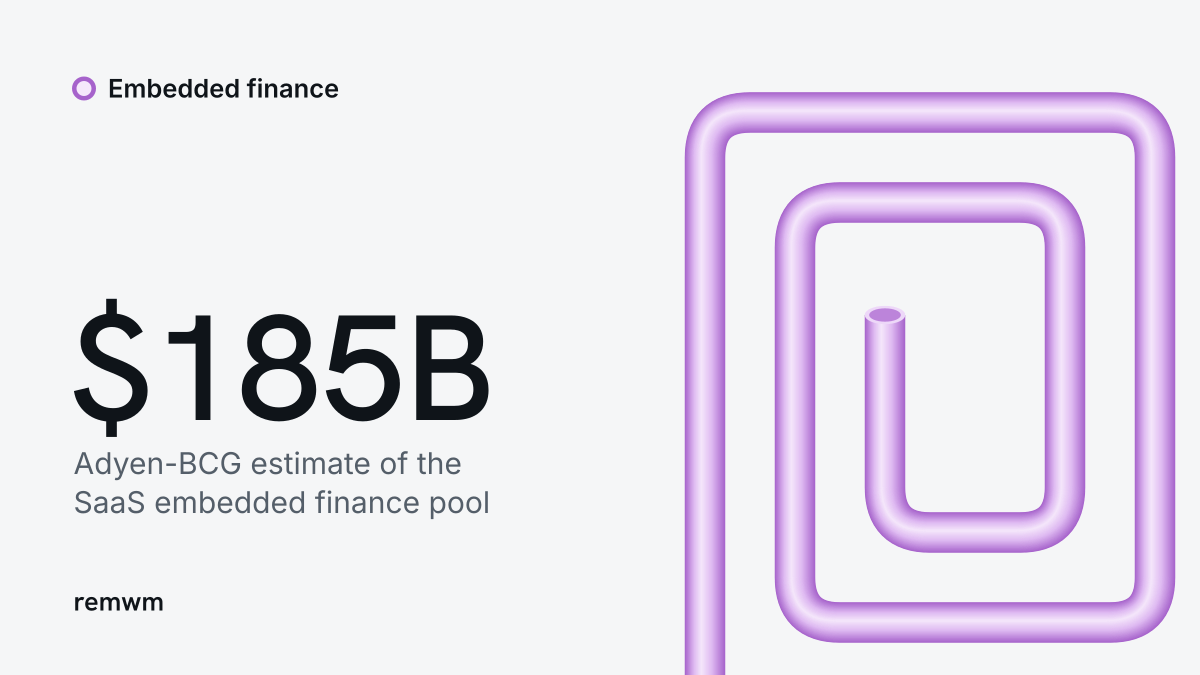
No government sizing was found for this piece. The one figure available is an estimate from research Adyen commissioned with Boston Consulting Group, published October 28, 2024: a $185 billion market opportunity for SaaS platforms, up 25% since 2022, with less than 20% of it addressed at the time. Treat it as a vendor-commissioned estimate rather than a measurement.