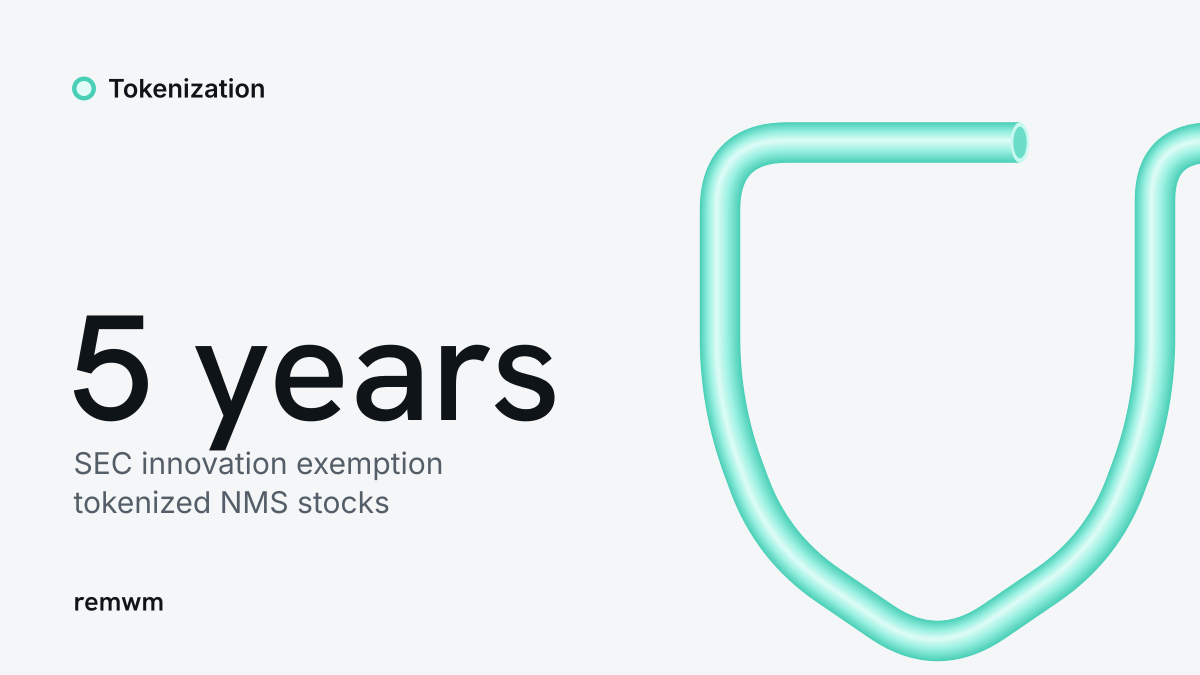
The SEC on September 17, 2026 issued an innovation exemption, an order that lets tokenized versions of listed stocks trade on-chain for the next five years. Chairman Atkins said it exempts venues called Tokenized Securities Venues “from the definition of ‘exchange’” and exempts certain liquidity providers, named Covered Firms, from the dealer definition, in his statement on the order. Tokens that give synthetic exposure are excluded.
What the order exempts
The order uses the term “Tokenized NMS Stock” for the instruments it covers, and it excludes crypto assets issued by a third party that give “synthetic exposure” to someone else’s security. The order calls itself “an interim, targeted measure” and expires five years after publication. It is filed as Release No. 34-106402, File No. 4-927.
The two exemptions do different work. A trading venue that meets the conditions is not treated as an exchange, so it does not have to register as one. A liquidity provider that meets the conditions is not treated as a dealer. Both are described in Chairman Atkins’s statement.
Conditions on a venue
Holders of a tokenized stock keep the economics of the share: Atkins named “rights to receive dividends and exercise voting rights”. Issuers are not passive either, since they “must have the opportunity to object” and keep their security off a venue. A venue must also set standards of access so that only certain participants trade there.
Trading is capped. Commissioner Uyeda said the exemption is subject to “symbol limits and volume caps” calibrated by limit up, limit down tiers, in his own statement.
What it means for tokenization platforms and brokers
This is the first US path for secondary trading of listed stocks on a blockchain, and it comes with written conditions rather than a general permission. A custodian, a broker platform or a vendor building a venue can now design against the exclusion of synthetic tokens, the holder rights, the issuer objection and the trading caps.
The clock matters as much as the conditions. Anything built on the order has five years unless a rule replaces it, and Congress has not supplied one: “Earlier this week, Congress was unsuccessful in advancing the CLARITY Act,” Atkins said. For background on the asset side, see rwa tokenization and the vendors in tokenization companies, plus the tokenization guides and stablecoin and tokenization news.
What to watch
- Five years after publication. The order expires then, and it describes itself as interim.
- Issuer objections. Each issuer gets the chance to prevent its security from trading on a venue.
- Symbol limits and volume caps. Calibrated by limit up, limit down tiers, per Commissioner Uyeda.