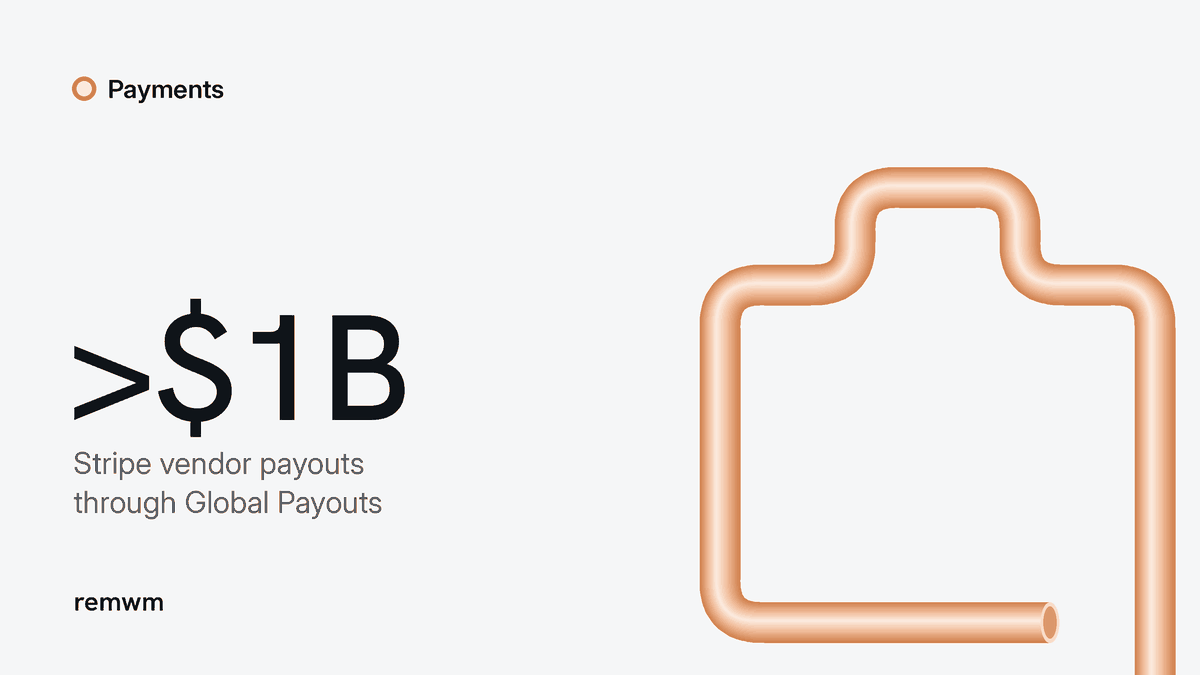
Stripe says it paid over $1B to 3,400+ of its own US and UK vendors via Global Payouts, in a move it ran in four waves.
In an October 30, 2026 engineering post, Stripe said its own vendor payments through Global Payouts had passed $1 billion by October 2026, sent to more than 3,400 vendors in the US and UK. The company described how it moved those payments off direct bank integrations and manual bank-portal entry, and what it changed along the way: earlier recipient data checks, statement descriptors and higher ACH and wire limits.
A four-wave migration
Stripe said it began testing in February 2026 by sending one low-dollar ACH or wire payment through each US payment flow. It started a four-wave rollout in March, raising payment amounts only after nearly all eligible payouts in the preceding wave succeeded. By June, the company said Global Payouts handled the vast majority of its domestic US vendor payments by both count and value.
Before the migration, Stripe made its vendor payments through direct bank integrations connected to its enterprise resource planning (ERP) system. Where an integration was absent, staff entered payments in bank portals. Stripe says it makes nearly 20,000 vendor payments a year in more than 70 markets, and investigating a failed payment could require searching both the ERP and bank portals.
Stripe says Global Payouts can pay recipients in more than 160 countries, but the $1 billion figure refers to Stripe’s payments to vendors in the US and UK. Stripe said it is still working to bring more of its cross-border and cross-currency vendor payments onto the product.
Recipient data and payment visibility
Stripe attributed the majority of failures during its migration to recipient data problems. Its example was an incorrect postal code, which might surface only days later when the bank returned the payment. Stripe moved those checks earlier in the payment flow, so the API confirms that required information is present and valid before money moves.
The second lesson concerned the recipient’s view. Stripe said its own teams could trace each payment through a unique reference number and invoice metadata, but a vendor’s bank statement did not always show who sent the money or which invoice it covered. Stripe added customizable statement descriptors so senders can attach recognizable information to recipients’ bank statements.
For a platform building payouts, the lesson is to test both views: the operator’s status and reconciliation record, and the information the recipient can actually see. See marketplace payouts for the broader payout workflow, and the Stripe Connect profile for Stripe’s platform products.
Limits and reported results
Stripe said some vendor payments were larger than the system had been designed to handle, and payments over the existing limits had to be processed manually. It raised the ACH and wire limits on its Outbound Payments API to $100 million. Customers should check the limits that apply to their own accounts.
Stripe also reported that the time to set up vendor payouts in a new market fell from as many as six weeks to one, that its finance and treasury teams save an estimated 20–30 hours a month, and that payouts have maintained a 99.9% success rate. These are Stripe’s own figures for its own rollout.
Stripe says Global Payouts is now generally available in the US and UK. Its next work includes wider recipient-country coverage, stablecoin payouts, and payments where a vendor’s address and bank are in different countries or the payment currency differs from the account currency.