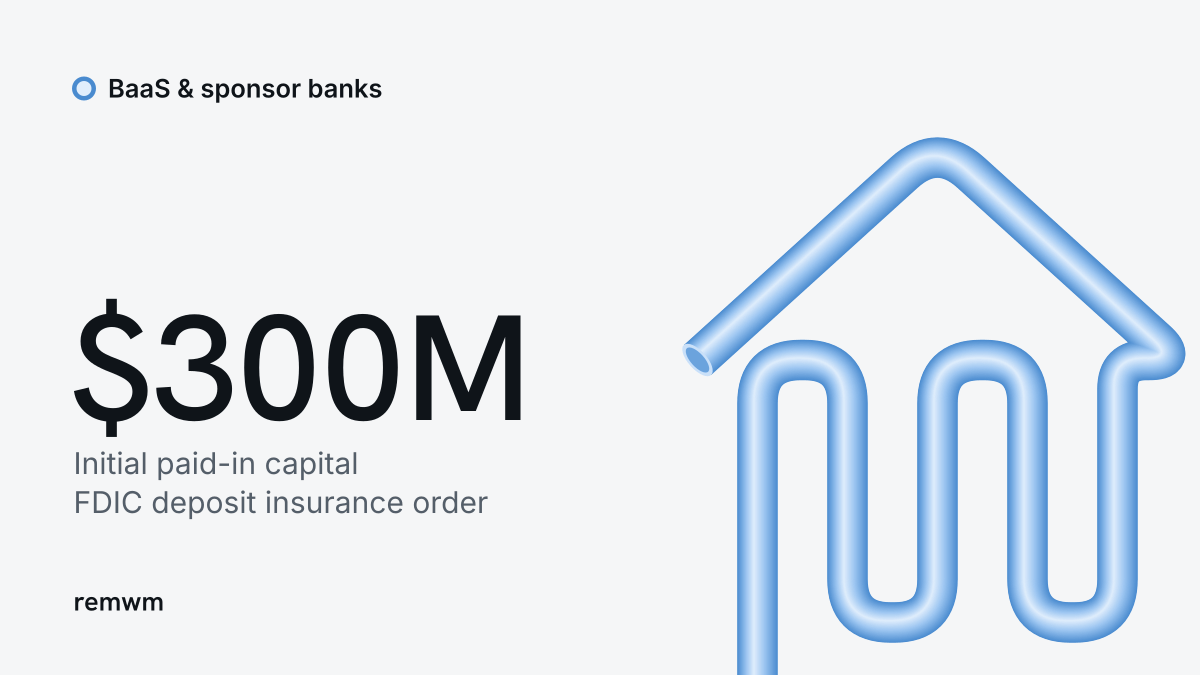
The FDIC on September 8, 2026 approved deposit insurance for Mercury Bank, N.A., a proposed fully digital bank in Salt Lake City, Utah. The deposit insurance approval requires at least $300 million of initial paid-in capital and a leverage ratio of 10% or greater for the bank’s first three years. Mercury Technologies, Inc. will apply to the Federal Reserve to become the bank’s holding company.
What the FDIC order says
The FDIC ordered that the application “be, and the same hereby is, approved, subject to the following conditions,” and dated the order “this 8th day of September, 2026.” Two conditions set the bank’s opening balance sheet. It must provide initial paid-in capital funds of “not less than $300,000,000,” and during the first three years of operation it must “maintain a Leverage ratio of ten percent (10%) or greater.”
The accompanying statement describes the plan as a “fully digital bank focused on serving small to midsized businesses” and consumers in the United States. The organizers have received preliminary conditional approval from the OCC, according to the statement. The next corporate step is named in the order: Mercury Technologies, Inc. “will apply for registration with the Board of Governors of the Federal Reserve to become the Bank’s bank holding company.”
What it means for fintechs and sponsor banks
Mercury reaches customers today through partner banks. Its own charter moves those deposits onto a balance sheet it controls and puts a federal supervisor between it and its customers instead of a sponsor. For the banks that hold those balances now, the approval marks the end point of a deposit relationship rather than a new one.
The order also prices the route. A fintech weighing embedded finance vs banking as a service against a charter application can read $300 million of paid-in capital and a 10% leverage floor for three years as the capital cost of owning the bank, before any technology or examination spending. That is a different calculation from the one behind how to choose a sponsor bank, and only a handful of fintechs can make it. The pattern is not isolated: Chime’s agreement to buy Stride Bank took the acquisition route to the same place. More approvals and applications are tracked in our BaaS news archive and the sponsor bank directory.
What to watch
- The holding company filing, which the order names as Mercury Technologies, Inc.'s registration application to the Board of Governors of the Federal Reserve.
- The capital conditions, which must be satisfied on the terms in the order: $300 million of paid-in capital, and a 10% leverage ratio held through the first three years of operation.