PO finance pays a supplier so a firm can fill a big order, and the funder is paid back, with fees, when the buyer pays.
A purchase order financing workflow runs from order checks to supplier payment, delivery, customer payment and settlement. A finance provider pays the supplier to fill a confirmed customer order, then recovers its advance and fees when the end customer pays. That can bridge a real working-capital gap, but it adds dependencies a platform must understand before it shows the product as a simple funding button.
This guide explains the transaction flow, the checks behind it and the questions product teams should ask when connecting purchase order finance to procurement or commerce software. For the wider picture, start with the lending software overview.
Where the funding sits
Purchase order finance is designed for the period before goods are delivered and before an invoice is available. The British Business Bank describes a common flow in which a business receives a purchase order, seeks finance to cover supplier costs, and the finance provider pays the supplier directly. After the supplier fills the order, the customer pays the finance provider, which deducts its fees and releases the balance to the business.
That sequence is different from invoice finance. Invoice finance generally starts after goods or services have been supplied and an invoice has been raised. Purchase order finance starts earlier, using the confirmed order and the supplier relationship as core parts of the underwriting case.
A typical transaction flow
The exact contract varies, but an implementation usually has six stages.
- Order verification. The funder confirms that the purchase order is genuine, non-cancelable where required and issued by a creditworthy customer.
- Supplier review. The funder checks the supplier, production terms, delivery timetable, costs and evidence that the supplier can perform.
- Funding decision. The provider sets the eligible supplier cost, advance amount, fees and any contribution the applicant must make.
- Supplier payment. Funds normally move to the supplier rather than into the applicant’s general operating account.
- Fulfillment and invoicing. The supplier ships the goods, the business completes the sale and an invoice is issued to the end customer.
- Repayment and reconciliation. The customer pays into a controlled account or directly to the funder. The funder deducts principal and fees, then remits the remainder.
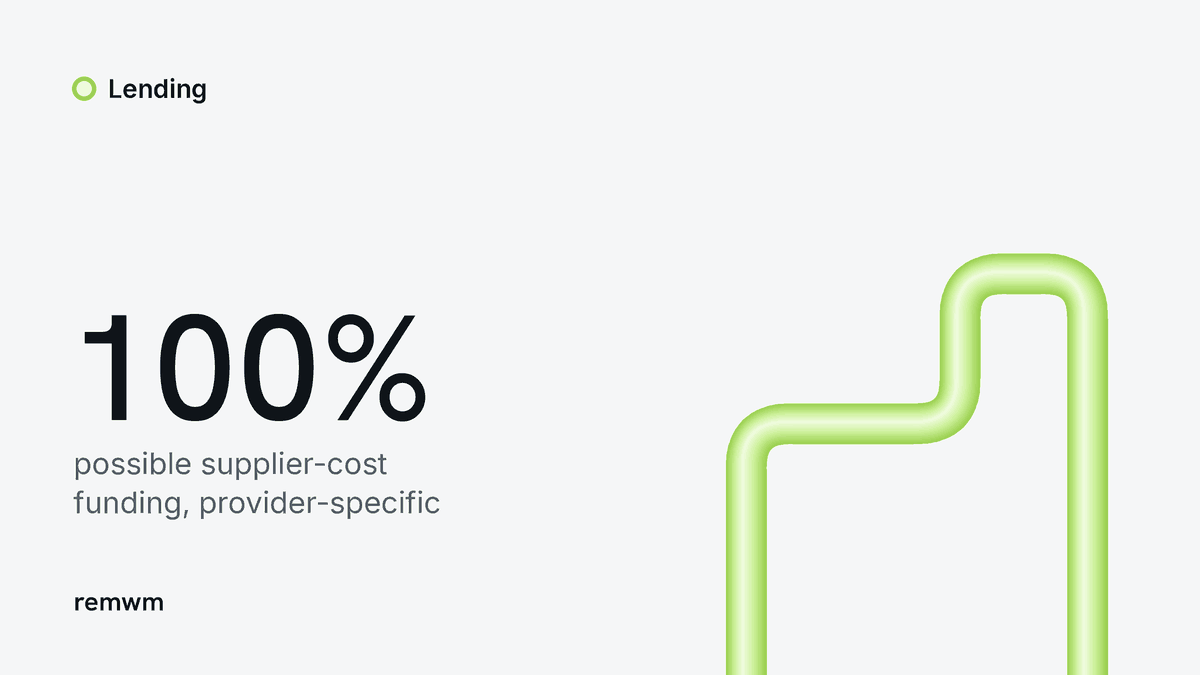
British Business Bank guidance says some providers may fund up to 100% of supplier costs, but that is not a universal entitlement. Eligibility, advance rates and required contributions depend on the provider, the order, the customer and the supplier.
Underwrite the order, customer and supplier
The applicant’s balance sheet is only one part of the risk. The transaction can fail if the purchase order is false, the customer disputes delivery, the supplier misses a deadline or the gross margin is too small to absorb finance costs.
A useful underwriting packet includes:
- the signed purchase order and any cancellation rights;
- the sales contract, delivery terms and acceptance criteria;
- supplier quote, production schedule and payment instructions;
- customer credit information and payment history;
- expected gross margin before and after finance costs;
- insurance, freight, customs and inspection responsibilities; and
- evidence that the applicant can manage fulfillment and customer service.
Platforms should make clear which party is responsible for verifying each item. Automated document collection can shorten the process, but it does not remove the need to confirm the commercial transaction.
Control the money movement
Direct supplier payment is an important control because it limits the risk that proceeds are used for unrelated expenses. It also creates a three-party or four-party payment flow that the software must reconcile accurately.
The ledger should show the approved supplier cost, applicant contribution, funder advance, every supplier payment, customer receivable, fees, deductions and final remittance. Exceptions need named owners. Common examples include partial shipments, price changes, damaged goods, customer deductions and payments sent to the wrong account.
Account changes deserve extra scrutiny. A supplier bank-detail change close to disbursement can indicate business email compromise or invoice fraud. Use independent verification, dual approval and a clear hold process rather than relying on an emailed instruction alone.
Price the whole cycle
Purchase order finance can be more expensive than conventional bank borrowing. The relevant comparison is not just an advertised rate. Model the total cash cost across the expected production, shipment, acceptance and customer-payment period.
Ask for the full fee schedule, including minimum fees, due-diligence charges, transfer costs, inspection costs and extensions if the customer pays late. Test a delayed-payment scenario and a partial-delivery scenario. A profitable order before financing can become unattractive if the cycle runs longer than expected.
Product copy should avoid presenting a maximum advance as typical. Show that pricing and approval are transaction-specific, and separate the funder’s decision from the platform’s own service.
Platform integration checklist
An embedded workflow needs more than an application form. Product and operations teams should map:
- consent for sharing purchase orders, invoices and customer data;
- who performs customer and supplier verification;
- how duplicate financing is detected;
- how approval conditions are displayed and accepted;
- how supplier payment instructions are authenticated;
- how shipment and acceptance evidence is captured;
- where customer payments are directed;
- how repayments and residual balances are reconciled; and
- who handles disputes, late delivery and customer non-payment.
The UI should keep the commercial parties visible. Users need to understand that the finance provider may pay the supplier and collect from the end customer, rather than simply extending an unrestricted cash loan.
Purchase order finance versus invoice finance
The simplest distinction is timing. Purchase order finance supports supplier costs before fulfillment. Invoice finance advances against money already owed after fulfillment. A business may use both at different points, but the controls and evidence are not interchangeable.
If the receivable already exists, compare the structure with invoice factoring and the difference between recourse and non-recourse arrangements, or read embedded invoice financing for the platform version. For platforms placing any credit product inside software, our embedded payroll guide shows how funding, payment timing and platform dependencies can interact.
Purchase order financing works best when the order, supplier and customer are all verifiable and the margin can absorb the full financing cost. The software should make those dependencies easier to see, not hide them behind a single approval status.