A fintech that puts user cash at two or more banks can be a deposit broker, so its bank may book the cash as brokered.
Brokered deposits matter to a fintech because the label sits on its sponsor bank’s books. Under 12 CFR 337.6, a deposit is brokered when it comes “directly or indirectly” through a deposit broker. A fintech that spreads customer funds across more than one bank, or sets their terms, can meet that definition. Most fintech programs escape it through the primary purpose exception, usually by filing a notice under the 25 percent test or the enabling transactions test.
Why the label matters to a sponsor bank
Section 29 of the Federal Deposit Insurance Act limits who may take brokered deposits. The FDIC’s rule sorts banks by capital category:
| Bank’s capital category | What the rule allows |
|---|---|
| Well capitalized | Brokered deposits may be accepted, renewed or rolled over without restriction under section 337.6 |
| Adequately capitalized | Brokered deposits only with an FDIC waiver |
| Undercapitalized | No brokered deposits at all |
The rule is a funding question for the bank, and a continuity question for the fintech. If a sponsor bank drops to adequately capitalized, it “accepts” a nonmaturity brokered deposit when a new brokered account opens. For agency or nominee accounts, that also happens each time funds for a new depositor reach the pooled account. A program that keeps onboarding users through an FBO account is exactly that pattern.
When a fintech counts as a deposit broker
The rule names four kinds of deposit broker. Two matter most for fintech programs:
- Placing deposits. A person that receives third-party funds and deposits them at more than one insured bank.
- Facilitating placement. A person that, for deposits placed at more than one insured bank, can close the account or move the funds to another bank, negotiates or sets the account’s rates, fees, terms or conditions, or engages in “matchmaking”.
Matchmaking means proposing how deposits should be split between banks using both a depositor’s financial information and the banks’ target deposit balances. The FDIC can also treat a structure built to dodge that definition as matchmaking, after a finding and written notice.
Both tests turn on deposits placed at more than one bank. A multi-bank sweep or a program that can move balances between partner banks is the case the rule was written for.
The primary purpose exception
The rule excludes “an agent or nominee whose primary purpose is not the placement of funds with depository institutions.” The FDIC’s rule turns that into a list of designated business relationships, assessed one business line at a time.
Fintech programs lean on two of them:
| Designated test | Condition in 12 CFR 337.6 | Ongoing duty under 12 CFR 303.243 |
|---|---|---|
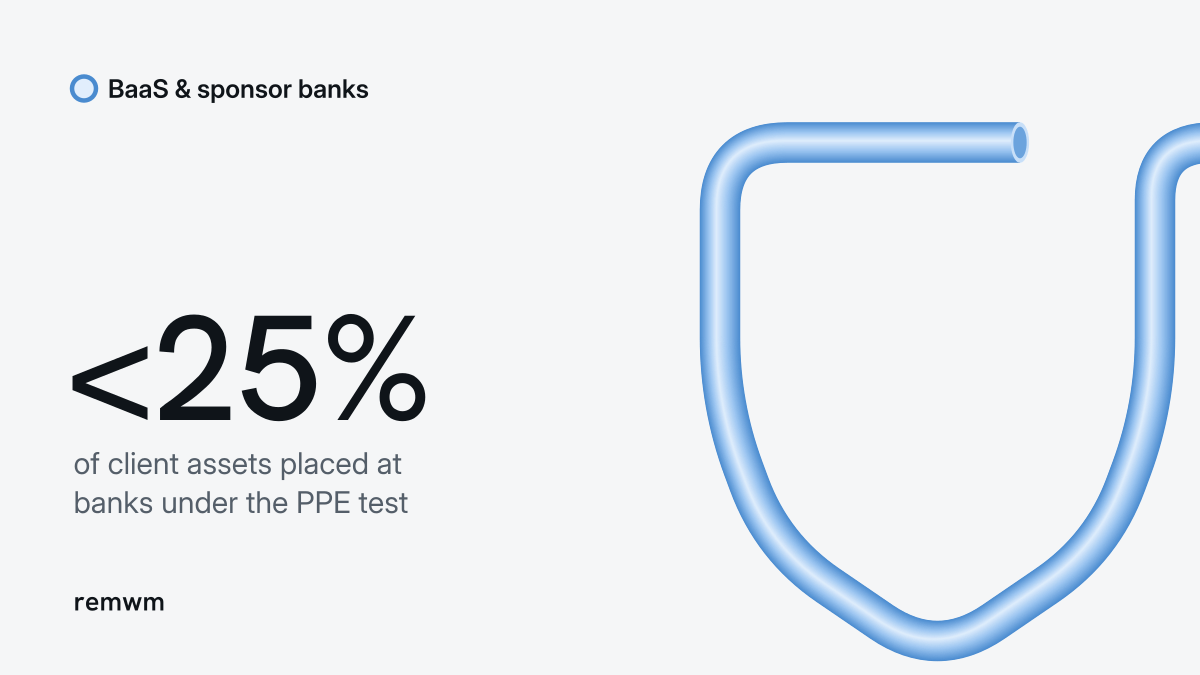
| 25 percent test | Less than 25 percent of the total assets the agent holds under administration for its customers in that business line is placed at banks | Quarterly updates of both figures |
| Enabling transactions test | 100 percent of the customer funds it places go into transaction accounts that pay no fees, interest or other remuneration to the depositor | Annual certification |
Other designated relationships cover property managers, mortgage servicers, title companies, 1031 exchange intermediaries, broker-dealer and FCM customer funds, HSAs, 529 plans, IRAs, secured credit card collateral, cross-border clearing and government benefit programs.
Brokered CDs never qualify. The rule treats them as a separate business line from any other deposit placement work.
Notices: who files and what goes in
The two fintech tests are not automatic. The agent, or a bank on its behalf, must notify the FDIC in writing before relying on them. The notice names the test, describes the business line and lists any other third party that may itself be a deposit broker. A nonbank filer also lists the banks receiving deposits through that line.
Each test adds its own evidence:
- 25 percent test: total customer assets under administration in the business line and total deposits placed at all banks.
- Enabling transactions test: contractual evidence that customer accounts earn no interest, fees or other remuneration, plus a certification that all placed funds sit in transaction accounts.
A filer that stops meeting its test must send a new notice. The FDIC can revoke the exception if the program no longer qualifies, if the reporting is inaccurate or if required reports stop arriving.
The FDIC publishes a list of entities with filed notices under these two tests. The September 15, 2026 edition shows, for example, Airwallex US, LLC with an enabling transactions notice for stored-value, custodial and global payment services, received June 11, 2026. The list excludes approved or pending applications. Its footnote warns that when another party in a program meets the deposit broker definition, banks should still report those deposits as brokered on the Call Report.
When a program needs an application instead
A business line that fits no designated test needs an FDIC application. The common fintech case is a payments account that pays interest or rewards, so the enabling transactions test fails.
For that case the application must show the interest or fees paid, the marketing given to banks and customers, the average number of transactions per customer account, and why customers use the service to make payments rather than to place deposits. It must also give the share of funds held outside transaction accounts.
The FDIC answers a complete application in writing within 120 days. If an application is incomplete, the agency tells the applicant within 45 days.
Where the rule stands in October 2026
The framework in force is still the one the FDIC adopted in December 2020 and published on January 22, 2021. Since then:
- March 3, 2025: the FDIC withdrew its July 2024 brokered deposits proposal and said it no longer intends to finalize it (FIL-6-2025).
- June 3, 2026: a correction fixed technical errors in the 2021 text, including “assets under management” in Part 303, which now reads “assets under administration”. The FDIC said it imposes no new substantive requirements.
- September 1, 2026: an interim final rule conformed the reciprocal deposit exception to section 902 of the 21st Century ROAD to Housing Act, which took effect on July 11, 2026. The current text caps the excluded amount at 50, 40 and 30 percent of an agent bank’s liabilities across three size bands.
For the wider sponsor-bank checklist, see how to choose a sponsor bank and sponsor bank due diligence.