Payment orchestration platforms connect one merchant to several processors through a single API, route each payment and keep cards in a vault the merchant controls. This list covers six that sell orchestration as their main product and publish developer documentation: Gr4vy, IXOPAY, Payrails, Primer, Spreedly and Yuno. The order is alphabetical and carries no meaning. The facts come from each company’s own pages.
How this list was selected
Four criteria, each checkable on the company’s own pages:
- Orchestration is the main product. The company sells a routing and vault layer rather than processing. Gr4vy’s home page puts it directly: “Gr4vy is a payment orchestration platform, not a PSP.”
- Public developer documentation covering both routing rules and a card vault or tokenization service.
- Published coverage figures for connections and regions, stated by the company itself.
- Primary sources only: product and API documentation, pricing pages and dated company releases.
Processors and acquirers that also route are out of scope. Stripe’s orchestration documentation says a third-party processor “continues to act as the processor” for payments routed to it, and Stripe Orchestration is in private preview. CellPoint Digital and APEXX are not on the list this round, because the public pages checked did not document routing and vaulting in comparable detail.
There are no scores, no ranks and no per-use-case picks here, and no provider paid for inclusion. For the definition and the questions to put to a vendor, see payment orchestration. Our methodology describes how these lists are built.
Payment orchestration platforms compared
| Platform | Connections (each company’s own figure) | Routing | Vault and tokens | PCI DSS (as stated) | Regions (as published) | Documentation | Pricing |
|---|---|---|---|---|---|---|---|
| Gr4vy | 400+ payment methods and anti-fraud providers | Flow rules by amount, BIN, card country, scheme, currency; retry on the next connection; split routing across one to four variants | Vault, PSP tokens, vault forwarding, network tokens, token import | Level 1 | Global, a dedicated cloud instance per customer | docs.gr4vy.com | Not published |
| IXOPAY | 200+ PSPs, 300 payment methods | Meta-Connector rules for routing, cascading, load balancing and fallback, on card, IBAN, customer, transaction or risk data | TokenEx Universal Tokens and network tokens | Level 1 service provider | Merchants worldwide (company wording) | documentation.ixopay.com | Not published |
| Payrails | 100+ integrations (PSPs, acquirers, fraud tools, BNPL, local methods, ERPs) | Workflow conditions on BIN, issuing country, issuing bank, scheme, card type, fraud score, value, metadata; PSP cascade reusing the 3-D Secure cryptogram | Token Vault, standalone or in orchestration; network tokenization; card lifecycle updates | Level 1 (vault) | Europe, Middle East and Africa; regional headquarters in Dubai’s DIFC | docs.payrails.com | Not published |
| Primer | 100+ global integrations | No-code Workflows with A/B tests across processors; Fallbacks reusing 3-D Secure data | Centralized vault; network tokens for Visa and Mastercard only | Level 1 (vault) | Global; the US about a fifth of revenue (May 2026) | primer.io/docs | Not published |
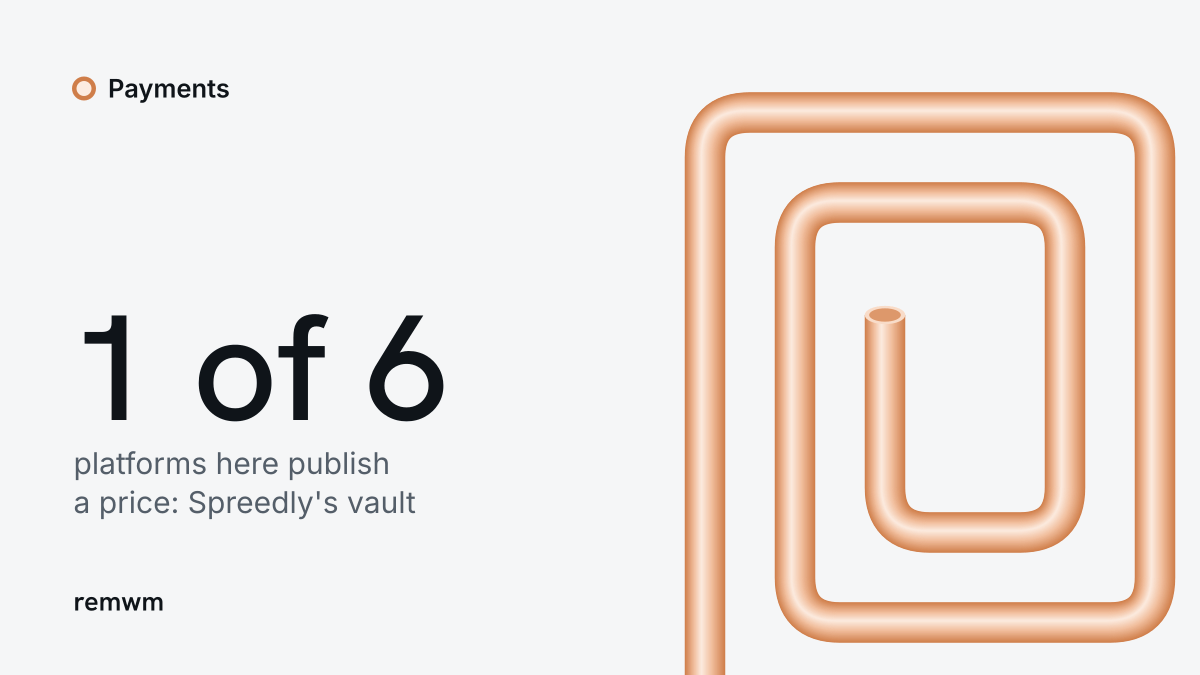
| Spreedly | 150+ gateway connections, 60+ payment methods, 32+ fraud and risk solutions | Composer: single (static) gateway, split volume across two gateways, conditional rules; Recover retries on up to two gateways | Vault, standalone since July 15, 2026; network tokenization; Account Updater | Level 1 | 400+ customers in 100+ countries (January 2026) | developer.spreedly.com | Independent Vault from $750 per month; routing tier on request |
| Yuno | 1,000+ payment methods, PSPs and fraud solutions | Conditions on card type, amount, currency and origin; fallback steps by decline type, timeout or error; Smart Routing across two or more connections | Vaulted tokens across connected processors; network tokens; PCI Proxy | Level 1 | Provider counts published for six regions, highest in Latin America | docs.y.uno | Not published |
The connection figures are each company’s own and count different things, so they do not compare one to one. The notes below link the page behind each row.
The six platforms
Gr4vy
Gr4vy’s home page states 400+ payment methods and anti-fraud providers, PCI DSS Level 1 compliance, a PSP-agnostic model and dedicated cloud instances. Merchants keep their “contracts and fees directly with the provider”, per its connections documentation. Card routing tries connections in sequence and retries technical failures and retriable declines on the next one; split routing spreads matched traffic across one to four variants. The vault tokenizes cards, provisions PSP tokens and forwards card data to a third-party endpoint, and token import moves stored cards in from a current provider. Gr4vy launched an Agentic Development Kit on April 13, 2026. Its pricing page is a contact form. Profile: Gr4vy.
IXOPAY
IXOPAY and TokenEx agreed to merge on April 17, 2024, and the combined company trades as IXOPAY, a TokenEx Company. Its shared responsibility matrix of June 30, 2025 describes it as a Level 1 service provider. A release of June 2, 2026 states more than 200 payment service providers and 300 payment methods, and announced Payments Intelligence and the IXONav assistant. Routing runs on a Meta-Connector, comparing card, IBAN, customer, transaction or risk data such as risk score or chargeback volume. Fallback routing needs no conditions; its purpose is to “recover transactions declined by one provider” and send the same transaction to another. TokenEx packages of January 20, 2026 pair network tokens with Universal Tokens portable across processors, and TokenEx Connect adds 20+ PSP integrations. Pricing is not published: a 2022 post offers “hybrid usage-based pricing options” without figures. Profile: IXOPAY.
Payrails
Payrails was founded in Berlin in 2021 and raised a $32 million Series A on June 12, 2025, naming Puma, Vinted, Flix, InDrive, Just Eat Takeaway and Careem as clients. Its platform page states 100+ integrations across PSPs, acquirers, fraud tools, BNPL providers, local payment methods and ERPs. Routing uses BIN, issuing country, issuing bank, card scheme or card type, plus fraud scores, values or metadata; when the primary PSP declines after a 3-D Secure challenge, Payrails passes the cryptogram to the next PSP in the cascade. Its documentation says “sensitive information stays protected in a PCI-DSS Level 1 compliant Vault”, which works standalone or inside orchestration. It announced a Middle East headquarters in Dubai’s DIFC on February 24, 2026. No pricing is published. Profile: Payrails.
Primer
Primer states 100+ global integrations. Its vault is described as a centralized PCI DSS Level 1 service for stored payment methods, and its network tokenization page says: “Primer currently only supports network tokens for Visa and Mastercard.” Workflows build payment logic without code and run A/B tests across processors, while Fallbacks reuse the 3-D Secure data from the first attempt. Primer announced a $100 million Series C on May 20, 2026 and said the US accounts for around a fifth of revenue. Pricing is not published. Profile: Primer.
Spreedly
Spreedly’s pricing page lists 150+ gateway connections, 60+ payment methods and 32+ fraud and risk solutions, with an Independent Vault “Starting at $750 per month” and the routing tier priced on request. Composer workflows offer single (static) gateway routing, split volume routing across two gateways and conditional rules, and Recover retries a failed transaction on up to two retry gateways. On July 15, 2026 it launched a standalone payment vault with PCI DSS Level 1 tokenization, network tokenization and Account Updater. A January 27, 2026 release says it processes over $60 billion in gross merchandise value for more than 400 customers in over 100 countries. Profile: Spreedly.
Yuno
Yuno’s home page states over 1,000 payment methods, PSPs and fraud solutions through a single API, with provider counts by region: 180+ in Latin America, 120+ in the Middle East, 70+ each in Africa and APAC, and 60+ each in North America and Europe. Routing directs payments by card type, amount, currency and origin, fallback steps fire on chosen decline types, timeouts or errors, and Smart Routing allocates traffic across two or more connections to optimize conversion with latency or with cost. Its tokenization service is PCI DSS Level 1, and the documentation says “vaulted tokens work across all processors connected to your Yuno account”. A PCI Proxy forwards stored card data to third-party APIs. Yuno Payments Arabia announced a SAMA Payment Technical Service Provider certification on April 22, 2026; SAMA’s rulebook says that activity “does not require a license from SAMA at this time”, so it is not a licence. No pricing is published. Profile: Yuno.
Where the published figures differ
The counts are the clearest case. Gr4vy’s 400+ mixes payment methods with anti-fraud providers. IXOPAY splits its figure into 200+ PSPs and 300 payment methods. Payrails counts 100+ integrations of six kinds. Spreedly reports gateways, methods and fraud tools separately. Yuno’s 1,000+ covers methods, PSPs and fraud solutions together. Gr4vy, Payrails, Primer and Yuno do not publish how many processors are connected, so a larger headline number does not mean more processors.
Routing is described in different shapes: rules evaluated top to bottom at Gr4vy, Meta-Connector rules with cascading and load balancing at IXOPAY, workflow steps at Payrails and Primer, three named options in Spreedly’s Composer, and conditions plus traffic allocation at Yuno. Three publish a vault that does not depend on their routing: Payrails’ Token Vault, Spreedly’s vault since July 15, 2026, and IXOPAY’s Universal Tokens, which it presents as portable across processors. That overlaps with the wider tokenization companies market.
All six state PCI DSS Level 1 for the platform or the vault. Those are company statements, not entries from a card-network registry. The PCI Security Standards Council published PCI DSS v4.0.1 in June 2024, so ask which version an attestation covers. On price, only Spreedly publishes a figure.
What to check before signing
Ask which processors and payment methods are live today rather than listed, on what terms stored tokens and card data can be exported if you leave, and for the attestation of compliance behind the PCI DSS claim, including what it covers. The full checklist sits in our guide to payment orchestration. Other vendors in the category are in the provider directory, and more sits in our payments guides.