FedNow participation is set per routing number, and the core must post around the clock.
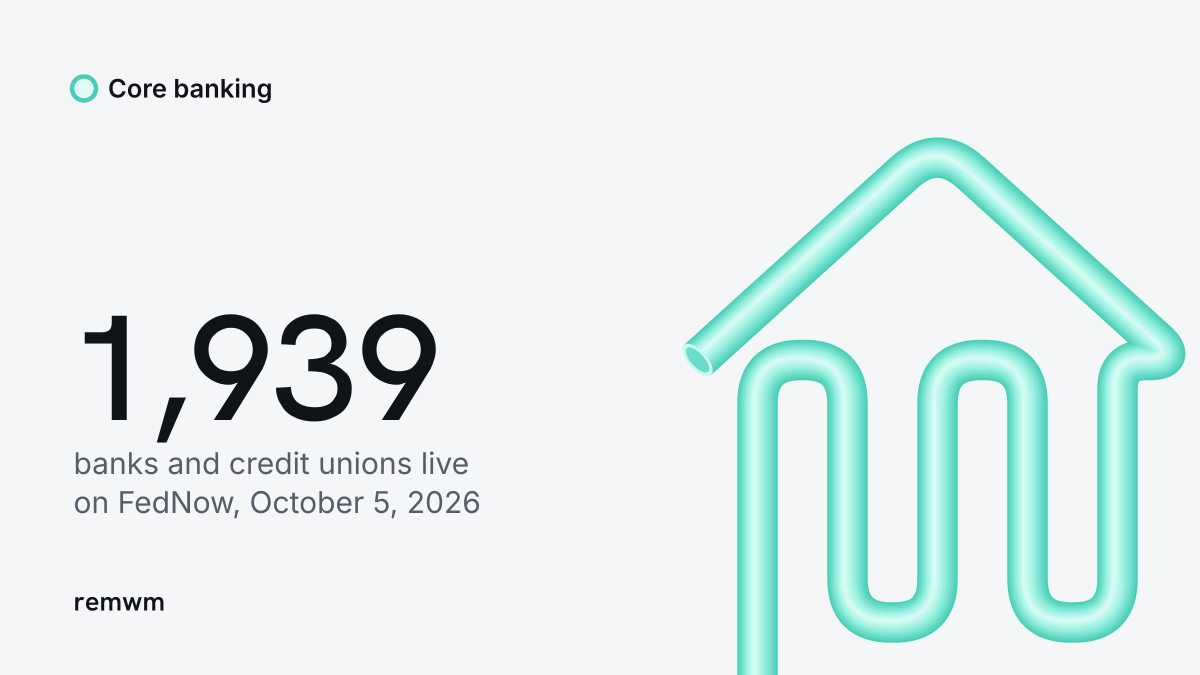
FedNow participation means a bank or credit union connects one or more routing transit numbers (RTNs) to the Federal Reserve’s instant payment service, chooses what each can do, and settles through a Federal Reserve master account. The Federal Reserve’s participant list dated October 5, 2026 had 1,939 rows. This guide covers participation types, settlement, service providers and what the core banking system has to handle.
Participation types
The Federal Reserve’s readiness guide describes several participation types, configured for each RTN:
| Type | What it allows |
|---|---|
| Receive | Receive credit transfers |
| Send and receive | Originate and receive credit transfers |
| Request for payment (RFP) | Receive requests for payment |
| Liquidity management transfers (LMT) | Move funds between master accounts |
| Settlement | Settle FedNow activity in a master account |
An institution can start with receive only and add sending later. The LMT window runs from 7 p.m. to 7 a.m. ET each night and at any time on weekends and holidays. A correspondent can settle for its respondents without its own FedNow profile.
Settlement and liquidity
Each RTN maps to one master account, either the institution’s own or a correspondent’s. No separate prefunded account is needed: payments settle in the master account, and settlement is final. Participants must follow the Federal Reserve’s payment system risk policy, and correspondents can set net send limits for the respondents they settle for.
The service has a $10 million credit transfer limit, with a default limit of $100,000. The FedNow cycle date is aligned with Fedwire, closing at 7:00:59 p.m. ET. Treasury teams need balance monitoring and liquidity sources that work 24x7x365, because a Saturday outflow cannot wait for Monday.
Reconciliation runs on ISO 20022 messages: the readiness guide points to pacs.002 status reports and camt.054 notifications.
What the core banking system must do
FedNow operating procedures require the receiving institution to make funds available to the customer as soon as practicable, but no longer than a few seconds, on a 24-hour basis. The receiver confirms the payment before settlement, so the core or a layer in front of it must validate the account, accept or reject, and post in seconds at any hour.
There is one exception. With accept without posting (ACWP), a receiver can accept a payment it wants to screen further; it must then either reject it or make the funds available by midnight ET of the next business day.
For a batch-oriented core, that usually means one of three designs:
- a real-time posting interface on the existing core;
- a sidecar ledger that posts instantly and syncs to the core later, covered in our guide to what is core banking;
- a middleware or payment hub that handles the ISO 20022 messages and calls the core.
If you are replacing the core anyway, 24x7 posting belongs on the requirements list in how to choose a core banking system.
Service providers
Only depository institutions can participate. A fintech or other non-bank reaches FedNow through a participating institution, and the institution stays responsible for its partner. Institutions can also use service providers, such as processors and core banking providers, to connect. Several providers may send for an institution, but only one may receive for it.
The Federal Reserve publishes a list of certified service providers. The list dated September 28, 2026 had 54 entries, including Fiserv, FIS, Jack Henry, Temenos, Finastra, Galileo, i2c, Increase, Modern Treasury, Moov, TabaPay, Volante, CSI and COCC.
Sponsor banks on the list
For fintech programs, the useful question is whether the sponsor bank is live. On the October 5, 2026 participant list we found Cross River Bank, Lead Bank, Column National Association, Sutton Bank and Choice Financial Group. We did not find Celtic Bank, Evolve Bank & Trust, Pathward or The Bancorp Bank under those names; an institution can also reach FedNow under another RTN or through a correspondent, so ask the bank directly. Our guide on how to choose a sponsor bank lists the other checks.
Fees and volume
The Federal Reserve’s 2026 fee schedule charges $0.045 per credit transfer originated, $1.00 per liquidity management transfer and $0.01 per request for payment. The participation fee of $25 per RTN per month is discounted to $0 for 2026, and a discount offsets the transfer fee for up to 2,500 credit transfers a month. The FedNow discount program news covers the next round.
In the second quarter of 2026 FedNow settled 4,997,811 payments worth $274.7 billion, about 54,921 a day, with an average payment of $54,957. The whole of 2025 had 8,413,402 payments.
FedNow and RTP
The Clearing House’s RTP network is the other U.S. instant payment system. It also has a $10 million transaction limit, and any federally insured depository institution can join without being a Clearing House owner.