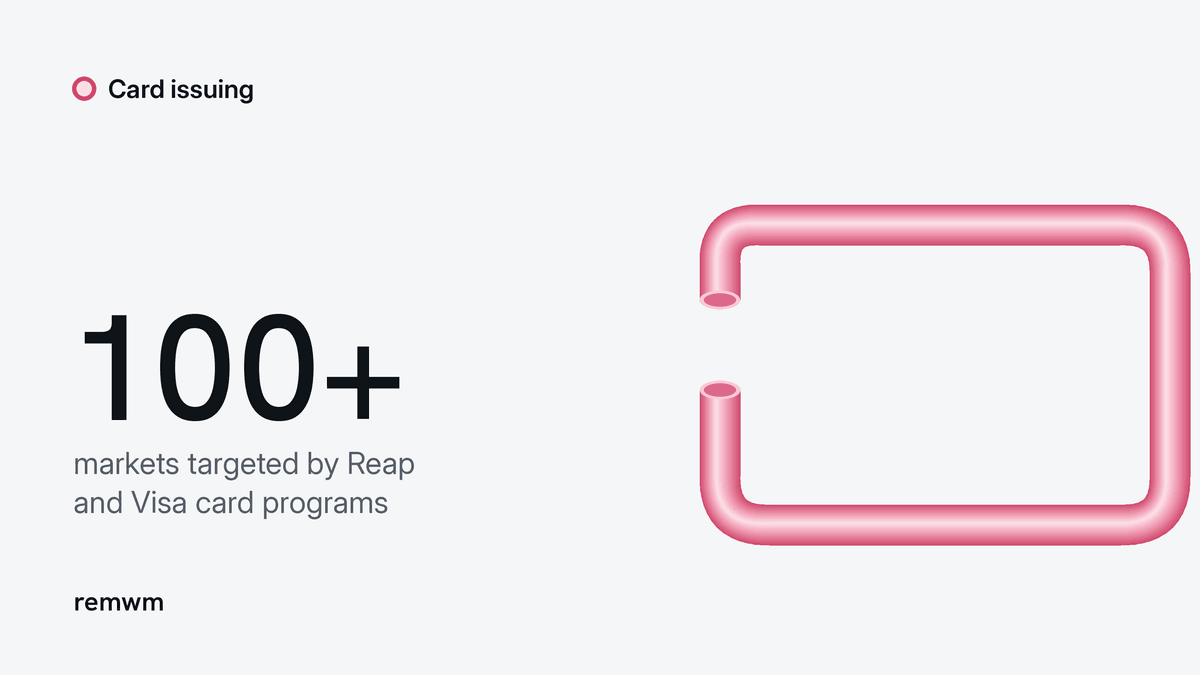
Reap and Visa announced on September 24, 2026 a collaboration to take Reap’s stablecoin-linked Visa credit card programs to more than 100 markets. Reap, owned by Kraken’s parent Payward since July 2026, provides the card issuing infrastructure. Fintechs and platforms that sign up can let cardholders fund and repay spending in stablecoins, with Reap handling authorization, processing, compliance and operations. The programs extend beyond Asia and Latin America into EMEA and Africa.
What was announced
The release describes Reap as the first fintech in Asia to partner with Visa on global stablecoin credit card issuing at scale. Partners integrate once with Reap, which, the release says, provides “the card network authorization, card processing, compliance frameworks, and operations.” Programs launch “in compliance with local regulations,” market by market.
| Item | What the release says |
|---|---|
| Card type | Stablecoin-linked Visa credit cards |
| Markets | Over 100, adding EMEA and Africa to Asia and Latin America |
| Funding and repayment | Stablecoins as collateral; cardholders can repay balances in stablecoins |
| Use cases | Corporate treasury and cross-border spend, global payouts and vendor spend, branded cards for B2B platforms |
| Settlement | Reap already settles its obligations with Visa in stablecoins under Visa’s Asia Pacific settlement program |
| Next | Multicurrency stablecoin cards; Visa and Reap to explore agentic commerce payments |
Visa gave its own figures in the release: a $20 billion annual run rate of global stablecoin settlement volume, up 15 times year over year, and more than 160 stablecoin card programs worldwide. Those are Visa’s own figures.
Who owns Reap
Payward, the parent of the Kraken exchange, agreed to buy Reap in May 2026 for up to $600 million in cash and stock. Payward said on July 1, 2026 that the deal had closed. Reap runs as a standalone brand inside Payward, and the September 24 release was published on Payward’s site.
What it changes for fintechs and platforms
A stablecoin-linked credit card lets a business spend at ordinary card merchants while its funds sit in stablecoins. The card itself is a normal Visa credential; the stablecoin part sits in funding, collateral, repayment and settlement. For a platform, the main change is reach: one program provider for card programs in many countries, where a card program usually needs a local issuer and processor in each market.
Settlement is the other part. Reap settles with Visa in stablecoins, which the release says works “beyond traditional banking hours and weekend delays” and “reduces the need to hold large pre-funded balances.” Card programs normally pre-fund settlement accounts in fiat on banking days.
The same pattern is showing up at U.S. issuers: SoFi stablecoin settlement on Mastercard and stablecoin backed cards from Marqeta and BVNK. To compare processors, see card issuing platforms.
What to watch
- Which markets go live first in EMEA and Africa, and which local issuers Reap uses there. The release names none.
- U.S. availability. Payward said at the acquisition that its U.S. licenses would open new corridors for Reap; the Visa release does not list the United States among new markets.
- Credit terms. The release does not publish pricing, credit limits or collateral ratios.